

The announcement came in early February, and if you were paying attention to biotech Twitter, the reaction wasn't quite surprise. OpenAI said GPT-5 had cut protein synthesis costs at Ginkgo Bioworks' cloud lab by 40%—through fully autonomous experiments, no human hand-holding required. What struck insiders wasn't the percentage so much as the milestone it represented. AI assistants that summarize papers or float experimental suggestions? Those had become table stakes. This was different: machines designing protocols, executing them, refining results, then iterating—all without someone checking in at each step.
Weeks later, a two-person YC startup called Synthetic Sciences surfaced with what it's calling infrastructure for "AI co-scientists." The platform promises agents that move from literature review through hypothesis generation, experiment planning, GPU orchestration, even manuscript drafting. Nature Medicine weighed in mid-March with a declaration that felt less like news and more like confirmation: "The AI co-scientist is here." For R&D leaders, the question has shifted. It's not whether this happens anymore. It's how fast their own labs can catch up.
Building the Pipes
Synthetic Sciences bills itself as "Claude Code for Scientific Research," which undersells the ambition a bit. Co-founders Ishaan Gangwani and Aayam Bansal—both Thiel Fellows with competitive programming backgrounds and a string of NeurIPS, ICML, and ICLR publications between them—are building persistent agent runtimes that handle end-to-end computational research workflows. The March launch came with integrations spanning GitHub, Hugging Face, Weights & Biases, Modal, Prime Intellect, Pinecone, OpenAlex, PubMed. The company claims 92% performance on BixBench Verified, a biology benchmark designed to cut through label noise. Pricing starts at fifty bucks a month for solo researchers, scales to two hundred for professionals, custom deals for enterprise.
What separates this wave from earlier literature-mining tools is scope, frankly. Synthetic Sciences offers modes for research, biology, something called "Flywheel" for post-training evaluation loops, even LaTeX manuscript generation. The Flywheel concept reflects a broader bet that's gaining traction: start on expensive frontier models, capture process feedback, then post-train smaller task-specific models through supervised fine-tuning and reinforcement learning. Eventually you "graduate" off per-token APIs entirely. Bansal made the case on LinkedIn in early March that most teams "overpay for frontier APIs" when they should be owning models once they've accumulated proprietary workflow data. It's a pitch that lands in an environment where enterprise AI budgets are climbing, yes, but so is cost-per-experiment scrutiny.
The company's hardly alone in this race. AI2 released Asta in August 2025—an open-source agent platform bundling baselines, benchmarks (AstaBench), and resources for scientific discovery. Early leaderboard results showed Asta v0 hitting 53% on AstaBench tasks. February brought AIRS-Bench, a suite targeting frontier AI research science agents specifically. Multi-agent frameworks have proliferated: EvoScientist in March, OmniScientist in November 2025, ATHENA in December. Each proposes role-specialized workflows with persistent memory and structured protocols. A Nature Communications paper in late 2024 demonstrated end-to-end chemical synthesis planning using LLM-powered literature agents and lab integration. The architecture is converging around a familiar stack—memory, retrieval, planning, execution, verification—stitched together through orchestration engines that treat experiments like code.
Hardware Meets Intelligence
The substrate for autonomous labs isn't purely software, though. NVIDIA's been inking partnerships. Opentrons and Recursion both signed deals in early 2026. Opentrons, whose OT-2 and Flex robots sit in the top twenty U.S. research universities and fourteen of the top fifteen global biopharma companies, announced February 5th it would accelerate AI-enabled lab robotics through NVIDIA collaboration. Recursion had already completed BioHive-2, an NVIDIA-powered supercomputer delivering four to five times the performance of its predecessor, back in May 2024. Platform updates have continued through 2025 and into 2026, underpinning AI-driven drug discovery at what the company describes as scale.
Chemspeed and SciY unveiled an open Self-Driving Lab platform at SLAS 2026 in February—automation hardware, analytics, AI orchestration, the works. Cloud lab providers like Emerald Cloud Lab have moved to establish AI scientific advisory boards. The hardware ecosystem is maturing in lockstep with the agent layer, creating closed-loop environments where hypothesis, execution, and result interpretation happen within one integrated stack. Which sounds seamless until you remember that most labs still run on a patchwork of legacy systems and manual processes.
Materials science offers a glimpse of the speed gains when the stack works. A North Carolina State study published last July showed dynamic-flow self-driving labs generating at least ten times more data than steady-state systems—and identifying the best materials candidates on the first attempt after training. An August paper proposed acceleration and improvement metrics (AF/EF) to quantify self-driving lab performance systematically. DeepMind's 2023 GNoME project—predicting 2.2 million crystal structures, 736 experimentally verified as stable—established a historical baseline for AI-accelerated materials discovery. What took years then is now operationalizing in weeks.
The Economics, Messy as They Are
McKinsey estimated in early 2024 that generative AI could deliver sixty to a hundred-ten billion dollars per year in value to pharma and medical products. That projection still gets cited heading into 2025. Market research firms peg AI in drug discovery around $2.8 billion in 2025, growing to $15.2 billion by 2035—an 18.3% compound annual growth rate. Laboratory automation and robotics markets are forecast to expand at mid-to-high single-digit CAGRs through 2030, with pharma and biotech driving adoption. Gartner projected $644 billion in overall generative AI spending for 2025. A McKinsey survey showed the share of life sciences companies spending at least five million on generative AI rising from 20% in 2024 to 32% in 2025.
But here's where the narrative meets the ground: a Gallup workforce survey from Q4 2025, reported in January, found only 12% of U.S. workers use AI daily. Nearly half engage with it a few times a year, sure, but adoption remains concentrated in desk-based roles. A Pistoia Alliance survey found over 75% of life science labs expect to use AI within two years, yet significant skills gaps remain. Technology Networks reported 51% of companies anticipated using robotics and automation in labs over the next two years—down from 57% in 2024, actually. The story of inevitability runs ahead of operational reality in most organizations.
This gap is where startups like Synthetic Sciences see an opening. The pitch isn't that frontier models will do everything. It's that teams need infrastructure to capture research workflows, build task-specific agents, transition from expensive API calls to owned models as they scale. It's a bet on process data as a durable moat in a landscape where model weights themselves commodify fast. Whether that thesis holds is another question.
Self-Driving Labs, Actually Running
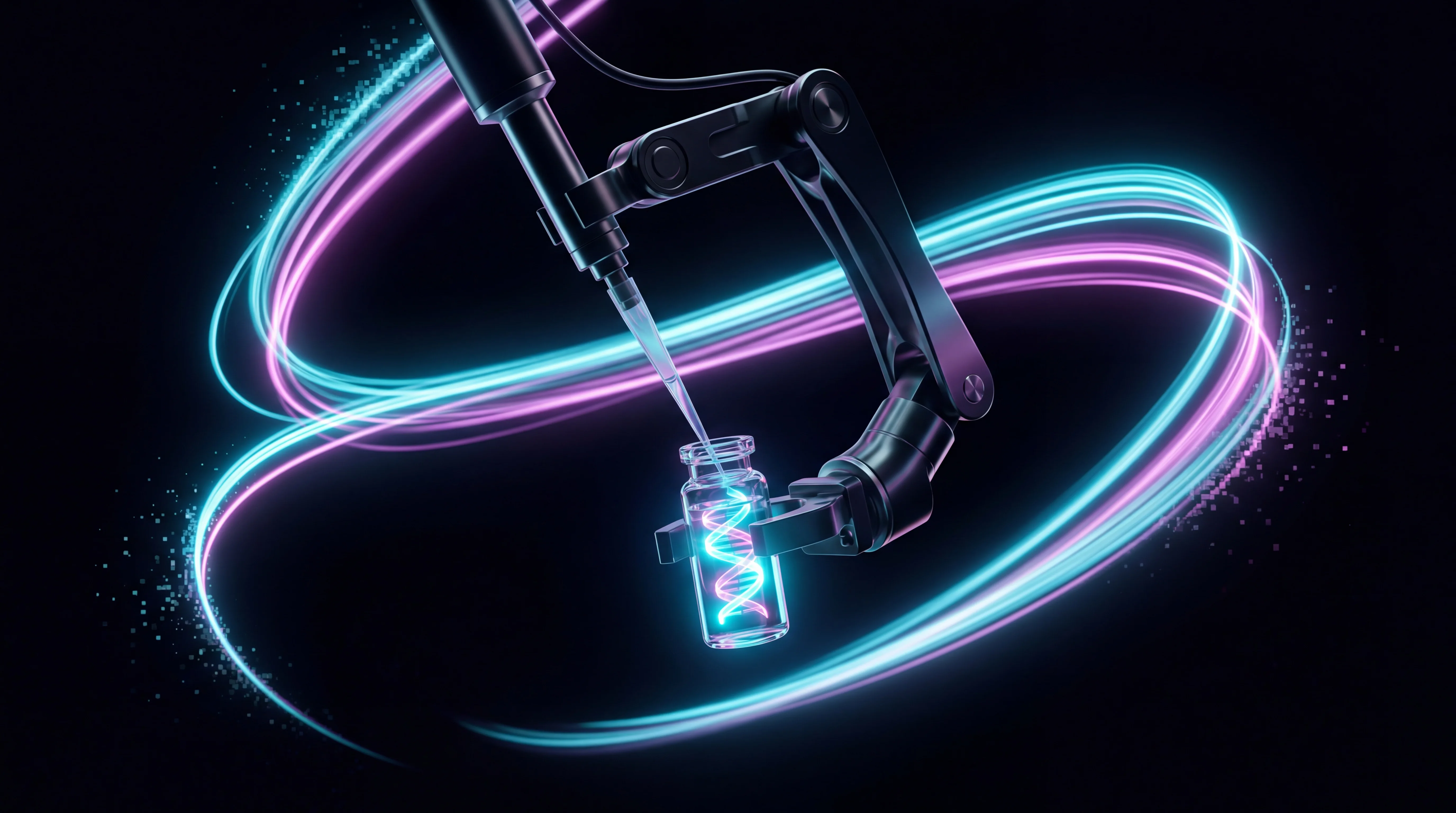
The OpenAI-Ginkgo collaboration in February marked a shift from pilot to production-scale validation. GPT-5 orchestrated closed-loop experiments in Ginkgo's cloud lab—achieving that 40% cost reduction in cell-free protein synthesis. Ginkgo's Q4 2025 release had signaled plans to make 2026 "a year of investment in autonomous labs." The result wasn't just a cost metric. It was proof that large language models could interface with physical lab equipment, iterate on experimental protocols, optimize outcomes without manual intervention between cycles.
Self-driving labs aren't a single architecture, though. Some emphasize dynamic-flow systems adjusting parameters on the fly based on intermediate results. Others focus on steady-state throughput with high parallelization. The NCSU materials work demonstrated dynamic approaches could deliver order-of-magnitude data increases. A 2026 ACS Central Science perspective outlined the establishment challenges: data standardization, interface complexity, reproducibility verification. LLMs lower barriers by generating natural-language protocols that compile into machine instructions, but the literature underscores that hallucination and oversimplification remain risks. A January JMIR systematic review found biomedical LLMs score higher on knowledge-based multiple-choice questions than on open-ended clinical practice tasks—highlighting the gap between benchmarks and real-world reliability.
Academic and open-source projects are accelerating the feedback loop. Papers in 2025 and early 2026—AutoLabs, AgentChemist, ChemNavigator—propose multi-agent experiment planning with self-correction and domain-specific rule discovery in chemistry. A JACS paper in 2025 described a multi-agent-driven robotic AI chemist. The foundational Coscientist project from 2023, where LLM agents read hardware manuals and operated a cloud lab, now looks more proof of concept than outlier.
Government Moves In
The U.S. government formalized its AI-for-science ambitions with Executive Order 14363, "Launching the Genesis Mission," signed November 24, 2025. The Department of Energy was tasked with building a national platform linking supercomputers, datasets, autonomous experimentation infrastructure. By December, the DOE had formed a consortium and issued agreements with 24 organizations. February and March brought 26 science and technology challenges under Genesis, setting the stage for platform-scale AI infrastructure across national labs and private partners through 2028.
The policy backdrop matters here. NIH has maintained restrictions on using generative AI in peer review since August 2023. Guidance issued in 2025 limits sharing or training generative AI on controlled-access human genomic data. Journal publishers including the Nature portfolio have issued responsible AI use guidelines; Nature Methods reiterated in March that AI can't be listed as an author and content generation must be transparent, limited. California's AI policy report in June 2025 flagged bio and nuclear misuse risks—underscoring the dual-use concerns that accompany autonomous research capabilities.
Genesis represents a tailwind for the sector, but it also signals the U.S. government views AI-driven science as strategically critical. Worth coordinating at the national level. Worth regulating to manage risk. The interplay between open-access platforms, proprietary commercial systems, government-backed infrastructure—that'll shape which architectures dominate over the next three to five years.
The Reality Check No One Wants to Hear

For all the momentum, autonomous research remains unevenly distributed. Benchmark performance is improving, context-dependent though. BixBench Verified and AstaBench provide standardized tasks, yet that JMIR review noted LLMs perform better on structured knowledge tests than messy, open-ended practice scenarios. The Synthetic Sciences claim of 92% on BixBench Verified is notable—if independently confirmed—but that's a curated subset designed to reduce label noise. Real-world research involves ambiguous data, shifting hypotheses, iterative judgment calls that benchmarks only approximate.
The competitive landscape is still forming. FutureHouse launched BIOS, benchmarked on BixBench. Elicit from Ought PBC and SciSpace Copilot offer literature assistance. Isomorphic Labs has multi-billion-dollar collaborations with Novartis and Eli Lilly dating to early 2024 and raised six hundred million in 2025. Insilico Medicine advanced an AI-designed anti-fibrotic candidate, Rentosertib, into Phase 2a trials with Nature Medicine proof-of-concept validation in 2025. Recursion continues expanding its NVIDIA-powered platform. Meta reportedly acquired Manus, an agents startup, for over two billion in January. The spectrum runs from academic open-source projects to venture-backed infrastructure plays to pharma-backed discovery engines.
Differentiation will likely hinge on orchestration robustness, post-training loops on proprietary process data, safety and verification layers for scientific claims, integrations with physical labs for closed-loop testing. Synthetic Sciences is betting that owning the infrastructure layer—where teams generate high-quality process data and train task-specific agents—creates a durable position even as frontier models commodify. Whether that thesis holds depends on execution, adoption rates among R&D teams, the pace at which open-source alternatives close the capability gap.
What Comes Next
The convergence of large language models, lab automation hardware, cloud orchestration is remaking R&D workflows faster than many organizations anticipated. Perhaps faster than they're comfortable with. The OpenAI-Ginkgo result in February wasn't an isolated lab demo. It was production-scale validation of closed-loop autonomous research. Synthetic Sciences and its cohort are building infrastructure to generalize that capability across computational biology, proteomics, materials science, beyond.
Government backing through Genesis adds momentum and resources, though it also introduces oversight and standards that will shape what autonomous agents can and cannot do in regulated domains. For R&D leaders, the question has evolved. It's less about whether AI agents will run experiments—they're running them now—and more about how quickly organizations can capture the process data and build internal capabilities to own, not just rent, their intelligence.
The gap between pilot and production remains wide in many labs. But the trajectory is clear enough. Autonomous research isn't science fiction anymore. It's infrastructure. And the labs that treat it as such—investing in orchestration, verification, post-training loops rather than waiting for turnkey solutions—those labs will set the pace for the next decade of discovery. The rest will be catching up.


