

The arithmetic of artificial intelligence has always been brutally simple: pour in more compute, get more capability. But somewhere around 2023, the equation started to break. U.S. data centers consumed roughly 4.4% of the nation's electricity in 2023, according to Department of Energy figures. By some projections, that could rise to 6.7–12% by 2028. AI workloads alone now eat up 15 to 25% of data center electricity demand, per recent analysis from the Electric Power Research Institute. The math, to put it mildly, doesn't add up.
Which makes what's happening in a nondescript Melbourne facility all the more startling. Earlier this year, 120 units of biological hardware went live there. Each draws about 30 watts—less than a decent reading lamp. Inside: living human neurons, grown on silicon chips, trained to compute.
Not a metaphor. An actual biological data center.
When Neurons Become Infrastructure
This isn't speculative futurism dressed in a press release. Cortical Labs, the Australian startup behind the Melbourne facility, has been shipping these systems commercially. The CL1 unit—retailing for roughly $35,000—houses up to 800,000 neurons cultured on multi-electrode arrays. Lifespan? Up to six months, they claim. The company announced the Melbourne prototype earlier this year, with plans to scale a Singapore facility to 1,000 units through a partnership with data center operator DayOne. Regulatory approvals and validation remain pending.
They aren't working in isolation. In Switzerland, FinalSpark operates something called the Neuroplatform, offering remote access to organoid-based processors for researchers willing to pay $500 a month (as of mid-2024, at least—pricing may have shifted). California's The Biological Computing Company closed a $25 million seed round recently, positioning neuron-in-the-loop systems as an alternative to silicon for computer vision and generative video tasks. And Parasma, a Y Combinator-backed startup out of San Francisco, is tackling the algorithmic side: writing software to train living neurons to perform computation.
The underlying technology goes by the somewhat clinical name of organoid intelligence, or biological computing. The premise is deceptively straightforward. Wire neurons into closed-loop systems with electronics, and they can learn tasks through reinforcement learning. Back in 2022, researchers published results in the journal Neuron showing cultured brain cells learning to play Pong—yes, Pong—through a feedback mechanism rooted in what they called free-energy principles. By early this year, similar setups were running Doom. Scientific American reported that a hybrid system pairing roughly 200,000 neurons with a standard learning algorithm outperformed the algorithm working alone.
The infrastructure question practically asks itself. If a single GPU cluster can pull megawatts while training a foundation model, and a biological processor draws 30 watts, you don't need a PhD to see where this could go. Whether that arithmetic holds under real-world workloads—well, that's still an open engineering problem.
The Pressure Points

Energy constraints are tightening like a vice. The U.S. Energy Information Administration's most recent short-term outlook projected electricity load growth accelerating through the next few years, with the sharpest increases concentrated in regions dense with data center development. In June, the Federal Energy Regulatory Commission launched what it termed "aggressive targeted action" to speed large-load integration, ordering regional grid operators to either justify their interconnection rules for facilities like data centers or reform them. The regulatory wind is at this sector's back, but so is the bottleneck.
Neurons offer something silicon fundamentally doesn't: intrinsic parallelism and adaptive learning with minimal energy overhead. Hon Weng Chong, Cortical Labs' CEO, has framed the pitch around dual efficiency gains—energy and data. In interviews over recent months, he's positioned the Melbourne facility as a "practical alternative" to energy-intensive AI infrastructure. Brett Kagan, the company's chief scientific officer, has struck a more measured tone, describing biological computing as complementary rather than a wholesale replacement.
FinalSpark's marketing materials claim energy efficiency improvements of up to one million times compared to digital compute. Those figures haven't been independently verified, and the pricing model suggests the company is still in a research-access phase rather than production deployment. Still, the efficiency thesis keeps surfacing across the field.
Academic momentum is building in parallel. Johns Hopkins University received $15 million recently to develop platforms studying neurological diseases using organoid-based methods, expanding both the talent pool and funding base for organoid intelligence research. Thomas Hartung, a JHU researcher who helped author the 2023 Baltimore Declaration on organoid intelligence, continues positioning the field as a frontier not just for computation but for reducing animal testing and advancing what he calls new approach methodologies in neuroscience.
Inside the Wetware Stack
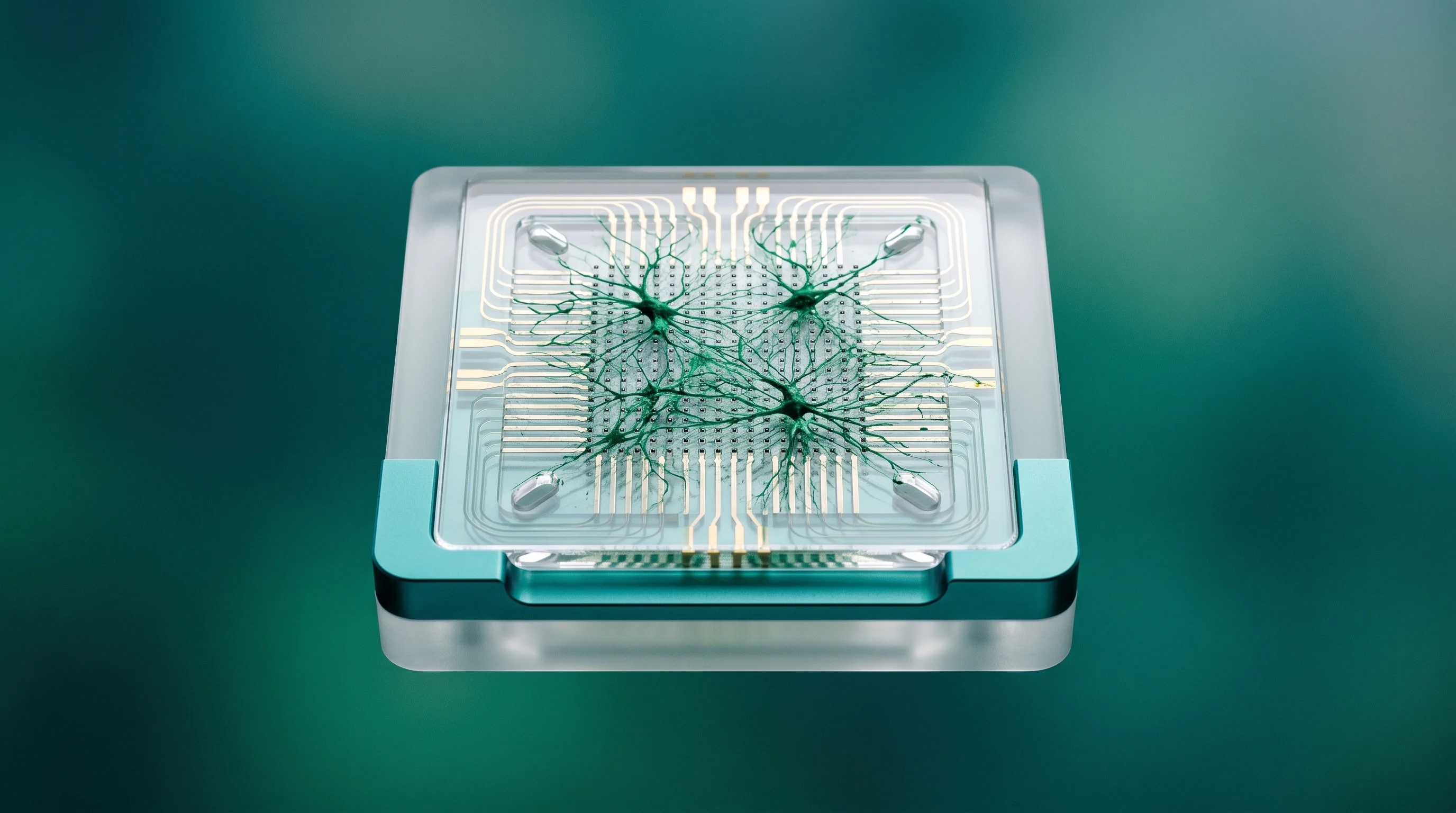
Cortical Labs launched its CL1 hardware in 2025, built around 2D neuron cultures on multi-electrode arrays. The closed-loop API enables sub-millisecond interactions with biological neural networks—fast enough to feel almost real-time. The Melbourne biological data center, announced publicly earlier this year, represents the first large-scale deployment anyone's attempted. Each CL1 unit houses neurons that receive input, process patterns, and produce output through electrical stimulation and recording. The company also runs Cortical Cloud, a developer platform offering remote access to biological processors. Funding to date includes a $10 million round in 2023 led by Horizons Ventures.
The Singapore project with DayOne is considerably more ambitious. Plans call for a phased expansion reaching up to 1,000 units, though the timeline and validation requirements remain murky. Regulatory frameworks for biological computing infrastructure don't exist yet in any standardized form—something that may slow deployment more than the technology itself.
The Biological Computing Company is positioning itself further up the application stack. CEO Alexander Ksendzovsky has spoken publicly about integrating neurons into workflows for computer vision and generative video, arguing that biological processors can augment traditional AI rather than replace it outright. The $25 million seed round came from Primary Venture Partners, with participation from Builders VC, Refactor, Wonder, and others. In May, the company added strategic advisors from big tech and academia, signaling a push toward commercial partnerships. Company materials describe performance gains—one investor post referenced 27 times efficiency improvements versus baselines—but independent benchmarks have yet to surface. Which is to say, we're still taking a lot of this on faith.
Parasma represents the algorithmic end of the market. The YC-backed startup, founded this year and based in San Francisco, describes its mission as writing "the algorithms to turn brain cells into compute." Its public profile remains lean—team size listed as one on the Y Combinator directory—but the company published a research note in June addressing consciousness and suffering in neural cultures. The note argues that systems using around 200,000 neurons lack the features required by leading consciousness theories, and that stimulation protocols avoid nociception or pain pathways. It's a telling artifact: bioethics isn't an afterthought in this sector. It's a design requirement.
Independent researcher Sean Cole, credited by Scientific American as the architect behind the Doom demo, exemplifies how adjacent technical communities are converging on this space. His work paired cultured neurons with reinforcement learning loops, demonstrating adaptive behavior in real time. The open-source code sparked community debate, including skeptical blog commentary pointing to a docstring stating "CL1 performs NO computation," raising questions about how much processing comes from wetware versus software. The back-and-forth feels healthy, actually. It signals a field still working out its benchmarks rather than pretending it has all the answers.
FinalSpark and Intactis Bio round out the landscape. FinalSpark's Neuroplatform uses 3D organoids rather than 2D cultures, offering cloud-based access to researchers. Newsletter updates over the past year or so detail work extending organoid lifespan and refining protocols, though much of the publicly available pricing and client data is beginning to age. Intactis Bio, a U.S.-based early-stage startup, announced a $250,000 raise after demonstrating neurons performing matrix math and outputting "Hello, World!" It's nascent—very nascent—but it's another data point in a pattern: infrastructure, platforms, algorithms, and applications are all moving in parallel.
The Path Gets Complicated

The near-term trajectory hinges on three variables: task fit, stability, and governance.
Task fit is the engineering filter. Neurons excel at pattern recognition, adaptive learning, and probabilistic reasoning—domains where silicon often brute-forces solutions through sheer scale. Computer vision, sensor fusion, and real-time adaptive systems seem like plausible early targets. Large language model training? Probably not. The Doom and Pong demos prove adaptive learning in closed loops; they don't prove general-purpose computing at data center scale. Standardized benchmarks will clarify where biological processors add value versus where they're essentially a very expensive parlor trick.
Stability is the practical constraint nobody wants to talk about publicly. CL1 units reportedly last up to six months. FinalSpark's roadmap targets longer lifespans, but variability remains a persistent challenge. Biological systems aren't deterministic like silicon. Batch-to-batch differences, environmental sensitivity, upkeep costs—media replacement, contamination control—these complicate deployment in ways that don't show up in a pitch deck. The Melbourne facility and planned Singapore expansion are prototypes. Whether they scale into production infrastructure depends on solving these constraints, not just demonstrating proof-of-concept in controlled conditions.
Governance is the wildcard, and perhaps the most interesting piece of this puzzle. The Nuffield Council on Bioethics released a report recently outlining ethical considerations around neural organoids: consent, moral status, commercialization, ownership, and potential transplantation issues. A study published in Scientific Reports examined public attitudes toward biocomputers and consciousness in embodied systems. Academic journals are publishing governance frameworks addressing IP, consent for donor-derived cells, and regulatory gaps that currently exist in a legal gray zone.
Parasma's public ethics note is instructive here. By explicitly addressing consciousness and suffering—even for systems using only 200,000 neurons—the company is setting a precedent. Founders entering this space won't have the luxury of treating bioethics as something to figure out later. Policymakers and the public are already paying attention.
The broader market dynamics favor experimentation. FERC's recent actions on grid interconnection signal that regulators recognize the infrastructure bottleneck. Data center operators are hunting for alternatives with growing urgency. Energy efficiency isn't a nice-to-have anymore; it's an existential constraint. If biological computing can deliver on even a fraction of its efficiency claims—validated, reproducible, and scalable—it becomes a serious infrastructure wedge.
Expect more pilot deployments over the next year or two. Cortical Labs and DayOne's Singapore plans are slowly taking shape. More startups will emerge targeting specific AI tasks where neurons offer computational advantages—or at least claim to. Academic funding for organoid intelligence is expanding, which means more talent and more foundational research feeding commercial translation.
The biggest risk isn't technical failure, though. It's premature hype colliding with unmet expectations. The field has a Pong demo and a Doom demo. It has energy efficiency claims that sound too good to be true, because they might be. What it doesn't yet have is a killer app running in production at scale, with transparent benchmarks and validated economics that hold up under scrutiny. That's the next milestone, and it's a critical one.
For now, 120 units are humming away in Melbourne. Each one draws less power than a light bulb.
Each one is alive.


