

The pitch sounds almost mundane when you strip away the rocket science: scheduled delivery service, predictable pricing, book your slot and go. Except the packages are returning from orbit, and the logistics network doesn't exist yet.
Catalyx Space, a San Francisco startup with outposts in India, announced a $5.4 million seed round on October 30, money it says will build what amounts to AWS for the final frontier—a vertically integrated platform handling both cargo headed to orbit and, crucially, the stuff coming back down. Outlander VC led the round, which pushes the company's total raised to roughly $7.1 million after a $1.7 million pre-seed closed in January 2025. That earlier tranche came from HF0 Residency and Founders, Inc., with this latest infusion drawing participation from Arka Venture Labs, Lex Reddy, KDX Management, Together Fund, Higher Life Ventures, Nivesha Ventures, Prana Tech Ventures, Bria, and Techstars.
The timing feels deliberate. Orbital return capability—long the province of NASA capsules and Roscosmos Soyuz modules—is suddenly a competitive category, with well-funded players racing to serve customers who want to manufacture pharmaceuticals or semiconductors in microgravity and actually get the product back to Earth.
Six Months From Check to Capsule
What Catalyx accomplished with its pre-seed money suggests either unusual execution velocity or a willingness to cut corners—possibly both. Six months after banking that January capital, the team dropped its first ReX reentry capsule from 14,000 feet over Nevada in June, a recovery rehearsal designed to validate parachute systems and thermal protection ahead of the real thing. A second drop test followed in September.
These aren't orbital flights—not yet. But for a company founded in 2024, the pace is noteworthy. Co-founders Rifath Shaarook, Clinton D. Antony, Keerthan Chand Aluvala, and Saqib Hussain are running a roughly 30-person operation split between San Francisco headquarters and Indian facilities, with plans to erect a 25,000-square-foot complex in Ahmedabad for consolidated development work. Headcount is expected to climb to 45 or 50 by next year, assuming milestones land and cash flow cooperates.
The company frames its offering as launch-and-return-as-a-service, bundling reentry capsules with satellite buses, deployment hardware, and ground-station software into what it hopes customers will treat as a bookable utility. The ReX capsule handles downmass—bringing payloads home. The Cosmotron bus, a 50-kilogram satellite platform, is slated for a first-quarter 2026 demonstration. There's also DeployerX, an in-house satellite separation system, and what Catalyx markets as a non-canisterized deployment standard for smallsats.
Target markets include defense contractors, advanced manufacturers, and biopharma companies—anyone willing to pay a premium for microgravity experiments or edge computing that needs to physically return to a laboratory or factory floor. It's an elegant thesis. Whether it scales is another question.
The Reentry Gold Rush
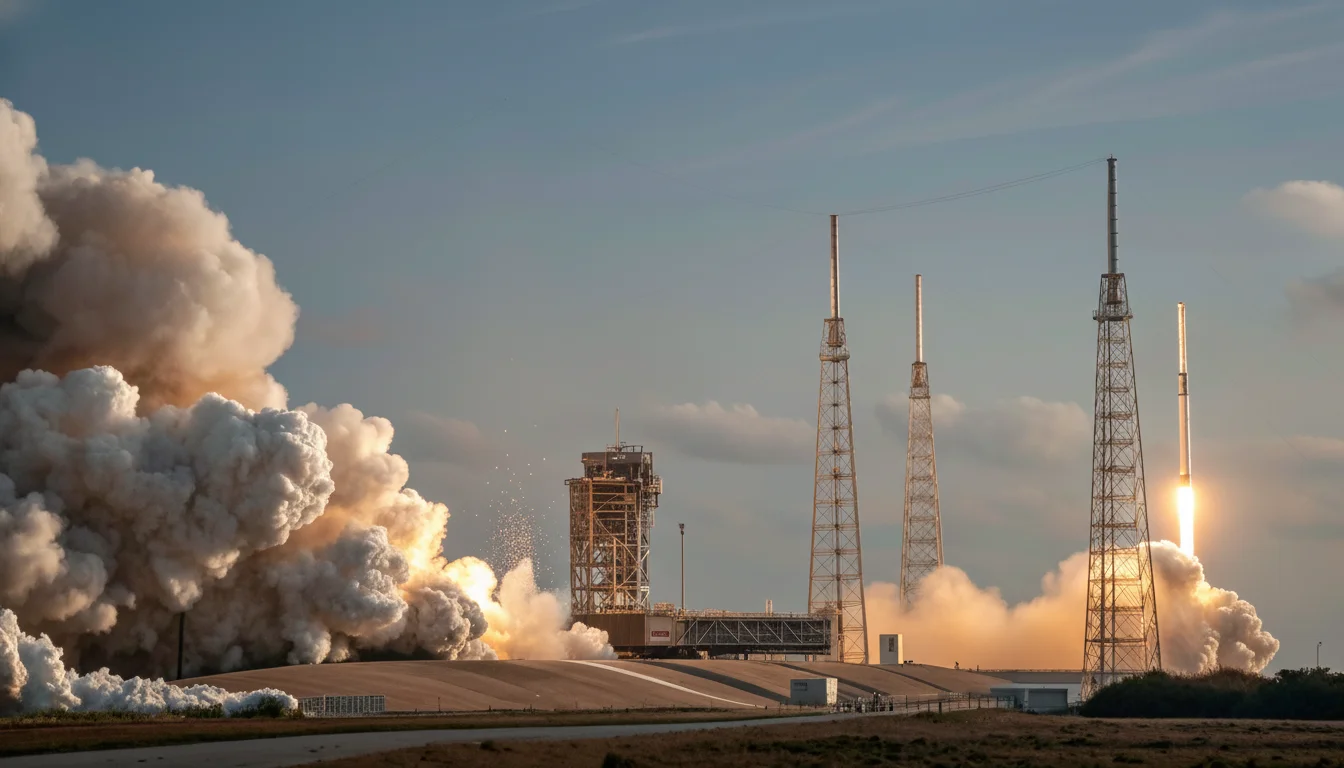
Catalyx isn't alone in chasing this opportunity, and some rivals have longer runways and deeper pockets. Varda Space Industries raised $187 million in July 2025 to industrialize microgravity pharmaceutical production and has already completed multiple launch-and-return missions. Inversion Space secured FAA reentry approval in October 2024, then closed a $44 million Series A the following month. Sierra Space's Dream Chaser cargo vehicle—backed by NASA contracts—is targeting a free-flight demo in late 2026, though that timeline has slipped before. Across the Atlantic, UK-based Space Forge pulled in £22.6 million last May and launched its ForgeStar-1 in-orbit manufacturing demonstrator with return missions on the roadmap.
The market projections are enticing, if you believe them. Catalyx cites Fortune Business Insights figures estimating the global space infrastructure market will swell from $148.8 billion in 2024 to $307.41 billion by 2032. That's a steep growth curve, one that assumes geopolitical stability, sustained investor appetite, and technological breakthroughs that don't blow up on the pad—or during reentry.
What the Money Buys

Outlander VC partner Paige Craig and AJ Smith were quoted in the funding announcement, though detailed investor commentary wasn't disclosed. The seed capital will fund commercialization of the reentry architecture, expand overseas operations, and support global customer acquisition, according to the company. Conspicuously absent from the announcement: customer names, letters of intent, or pre-sold capacity—the sort of commercial traction that might validate demand beyond PowerPoint decks and market studies.
CEO Rifath Shaarook carries an unusual backstory for a space founder. In 2017, while still a teenager, he earned international headlines for KalamSat, a 64-gram 3D-printed satellite that generated considerable buzz if not necessarily orbital longevity. Catalyx flew an SR-0 demonstration satellite on an ISRO SSLV mission last August under its earlier "Space Rickshaw" branding—a name since abandoned for something more boardroom-friendly.
The roadmap ahead is compressed: Cosmotron bus demo in Q1 2026, on-orbit ReX capsule test in Q2 2026. Those are tight windows. Hardware development in aerospace has a way of humbling even the best-capitalized teams, and Catalyx is neither uniquely funded nor insulated from the technical realities that make orbital mechanics unforgiving.
The Open Question
Whether the company can translate drop-test momentum into operational capability before capital markets stiffen—or before competitors with bigger war chests lock up key customers—remains the central uncertainty. The seed round buys runway, perhaps 18 months if the team stays lean. After that, a Series A will require more than engineering milestones. It will require revenue, or at least credible revenue visibility.
Catalyx is making a familiar wager: that vertical integration and "bookable" service will win over customers tired of bespoke mission planning and unpredictable costs. It's a bet worth watching. The prize, if they're right, is substantial. The penalty for being wrong is just another startup that couldn't cross the gap between prototype and product—a gap that, in aerospace, tends to be wider than it looks from the ground.


