

On a platform somewhere between laboratory curiosity and industrial reality sits Cruz Foam, a Santa Cruz materials startup that thinks the answer to America's packaging problem might be hiding in seafood waste.
The company pulled in $18 million in Series A funding back in October 2022—Helena Special Investments led, with Will Peterffy's family office One Small Planet, Regeneration.VC, and a handful of others following. The pitch was straightforward, if ambitious: turn shrimp shells and other seafood processing byproducts into biodegradable foam that could go toe-to-toe with expanded polystyrene, the ubiquitous white foam that cushions everything from refrigerators to takeout containers.
One year on, Cruz Foam appears to have made the leap from promising idea to something resembling a real business—though the jury's still out on whether chitin-based packaging can achieve the scale and economics to genuinely threaten petroleum-based incumbents.
Chitin Meets Commerce
The months after the Series A saw Cruz Foam move aggressively to line up distribution. By February 2023, the company had tapped Atlantic Packaging as its go-to-market partner, rolling out a product suite that included everything from mailers to cooler inserts. Wild Idea Buffalo started using Cruz Foam for cold-chain meat shipments. Tempest, a weather hardware outfit, signed on for protective packaging.
Then came a series of European distribution agreements: Unified² Global Packaging Group in April 2024 for cold-chain applications, AMC Industrie to crack the French market that September, and Swefco Packaging after that. On the customer front, Cruz Foam has confirmed work with Whirlpool—replacing traditional foam components in appliance packaging—and, according to a 2023 CNBC segment, discussions with Rivian.
It's a tidy roster, though the company hasn't disclosed volume figures or revenue. For a materials startup trying to displace an entrenched incumbent, distribution deals are table stakes. The harder question is whether orders are arriving at the pace and scale needed to justify commercial production.
The Regulatory Tide (Maybe)
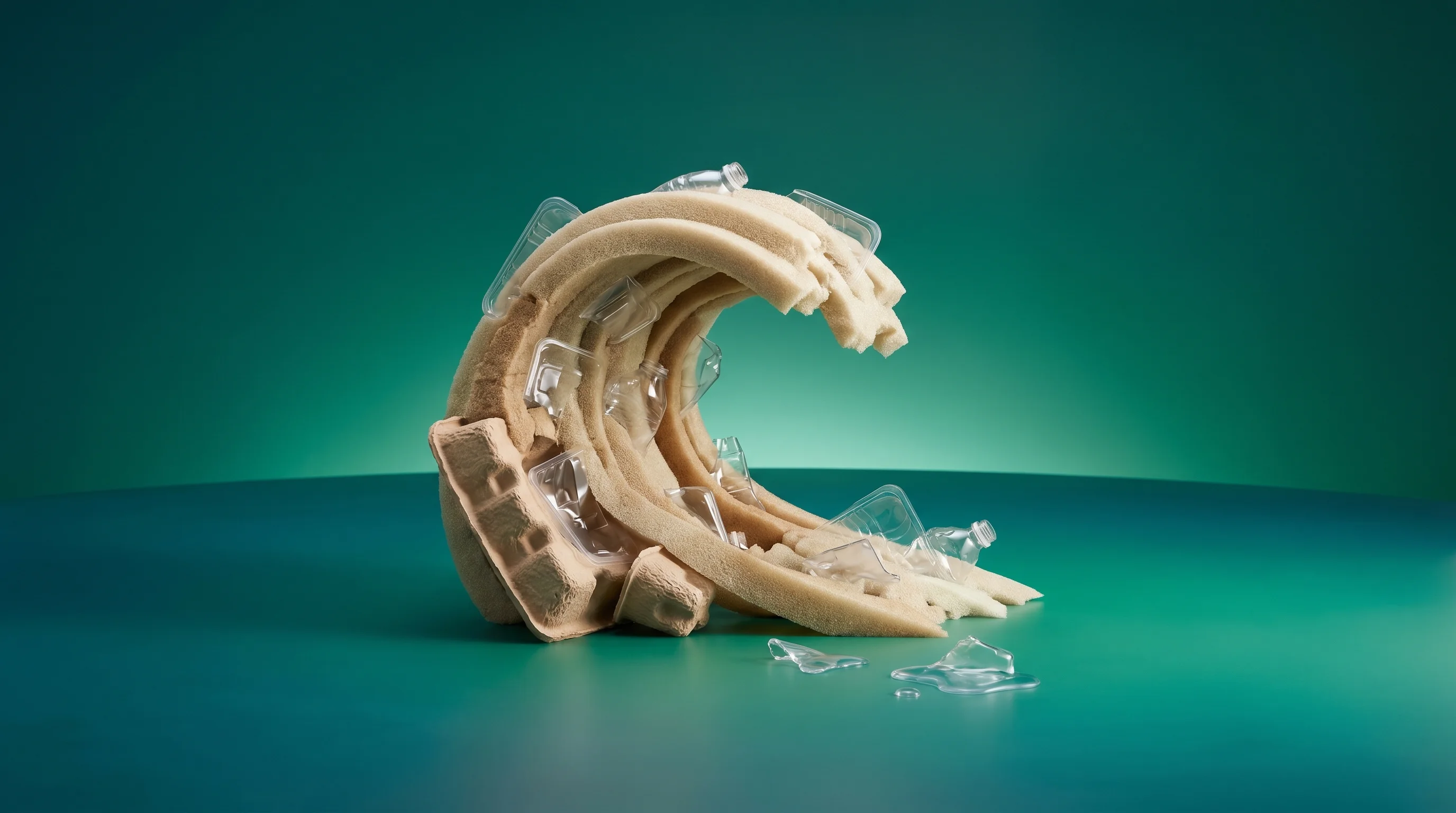
Cruz Foam's timing may prove fortunate, or at least well-considered. California's SB 54, signed into law in June 2022, mandates that all single-use packaging sold in the state must be recyclable or compostable by 2032. The law also calls for a 25% reduction in plastic packaging and a 65% recycling rate for single-use plastics—targets that sound ambitious even by California standards.
Implementation has been uneven, and the plastics industry hasn't exactly rolled over. But the statute establishes a timeline, and expanded polystyrene is squarely in the crosshairs. Cruz Foam claims its materials achieve 97.7% biodegradation in 45 days, meeting ASTM standards for industrial composting, which would position the company as a potential beneficiary of the regulatory shift.
Whether that translates to genuine market pull or remains aspirational depends on factors well beyond Sacramento: cost parity with EPS, supply chain logistics, customer willingness to switch. The regulatory wind is at Cruz Foam's back. That doesn't guarantee smooth sailing.
Building the IP Fortress
Since the Series A, Cruz Foam has been steadily accumulating patents—a move that suggests the company is thinking several moves ahead. Recent filings cover naturally sourced chitin foam, biodegradable foam with laminate layers, foam precursor systems with biodegradable copolymers, and pellet manufacturing processes. One PCT application for foam paneling surfaced last spring.
The portfolio extends beyond chitin alone, incorporating starch and PBAT (a biodegradable copolymer) systems. That's notable: it implies Cruz Foam sees itself less as a single-material company and more as a broader platform play in sustainable foams. Whether that's strategic foresight or hedging bets is harder to say.
Patents, of course, don't pay bills. But in a capital-intensive materials business where formulation and process matter, intellectual property can serve as both competitive moat and investor signaling device. Cruz Foam appears to be accumulating both.
The Founders and the Funding Trail
John Felts, the CEO, is a UC Santa Barbara chemical engineering graduate who later did materials science work at the University of Washington. His origin story for Cruz Foam involves surfing and a mounting frustration with ocean plastics—a narrative that fits neatly into the startup mythos but also happens to be rooted in legitimate technical work. Marco Rolandi, the chief science officer, is a professor of electrical and computer engineering at UC Santa Cruz with a background in materials and bioelectronics. Toby Corey, a Tesla and SolarCity alum, serves as executive chairman and COO.
Before Helena and Peterffy signed on, Cruz Foam had already raised a $2.5 million seed round led by At One Ventures in April 2022, followed by a $3.5 million seed extension that brought in Leonardo DiCaprio and Ashton Kutcher—the celebrity investor stamp of approval that tends to generate press but raises questions about who's actually doing diligence. Earlier backers included Sony Innovation Fund and Parley for the Oceans. A $1 million NSF SBIR grant landed in mid-2021.
Total capital raised depends on who's counting and how grants are categorized. CB Insights pegs it at $23.74 million; Owler shows $26.1 million. Neither figure includes any funding raised since, which may or may not have occurred.
The company's employee count sits somewhere between 11 and 50, according to LinkedIn—a wide enough range to be essentially uninformative, though it does suggest Cruz Foam remains a relatively small operation.
What TIME Saw

In October 2023, Cruz Cool—the company's cold-chain packaging product—earned a spot on TIME's Best Inventions list under Reuse & Recycle. The recognition came alongside a stint in LVMH's La Maison des Startups accelerator earlier that year and a Bronze Pentaward for packaging design.
Awards don't equal traction, but they're not meaningless either. TIME's list tends to spotlight technologies that have crossed some threshold of plausibility, even if commercial viability remains open. For Cruz Foam, the recognition offered third-party validation at a moment when the company was transitioning from funded startup to scaling operation.
The Scale Question
Cruz Foam now operates with distribution reach across North America and Europe, partnerships with automotive and appliance manufacturers, and a growing intellectual property portfolio. The sustainable packaging market, depending on which analyst report you trust, is projected to reach somewhere in the neighborhood of $365 billion in the next few years. Protective packaging alone represents a $40 billion-plus segment globally.
Cruz Foam is positioning itself as a drop-in replacement for EPS across cold chain, electronics, appliances, and automotive applications—sectors where performance requirements have historically favored petroleum-based foams because they're cheap, lightweight, and reliably protective.
The challenge, as with most materials startups, is proving unit economics at scale. Can Cruz Foam manufacture chitin-based foam at a cost that makes sense for high-volume customers? Can it secure consistent feedstock supply from seafood processors? Can it navigate the operational complexities of selling into conservative industries that don't switch suppliers lightly?
The Series A capital appears to have carried the company from pilot projects to multi-sector partnerships and a measure of industry recognition. That's progress, certainly. Whether it's the kind of progress that leads to a sustainable business—or just another well-funded experiment in sustainable materials—will depend on what happens in the next phase, when distribution deals mature into recurring orders and customer trials turn into long-term contracts.
For now, Cruz Foam has moved its shrimp shell technology well beyond the lab. The harder part is still ahead.


