

The laboratory notebook has evolved—from marble-covered ledgers to digital spreadsheets to something approaching a conversation. Cypher AI, a Cambridge startup convinced that scientists shouldn't need to code their own research infrastructure, closed a $2 million seed round in late May, betting that AI agents can replace the unwieldy stack of software most labs run on today.
Investors were not disclosed.
Founded in 2025 and operating out of The Engine at MIT, Cypher employs six people from offices at 750 Main Street in Cambridge. Its pitch is deceptively simple: describe what you need in plain language, and the platform generates the tool. No Python scripts, no wrestling with rigid laboratory information management systems, no makeshift spreadsheet solutions held together by hope and macros.
Whether that vision scales beyond early adopters remains an open question. But the company has attracted notable talent from one of synthetic biology's best-known names.
The Ginkgo Alumni Network
Founder and CEO Yaoyu Yang spent four years as a principal software engineer at Ginkgo Bioworks, the Boston-area synthetic biology company known for engineering microbes and, more recently, navigating a challenging post-SPAC existence. Yang holds a PhD in electrical and computer engineering from the University of Washington, where he worked in the Klavins Lab on synthetic biology and lab automation—precisely the kind of environment where software meets pipettes.
In February, Cypher announced the appointment of Jamie Cho as vice president of engineering, effective April 2026. Cho's resume tells a growth story of its own: nine years at Ginkgo, where he built the software team from eight engineers to 70. Before Ginkgo, he worked at Sapient Bioanalytics, BioTrove, and Bruker—a career arc through instrumentation and data systems that gives Cypher credibility in a market skeptical of outsiders.
The Ginkgo connection isn't incidental. It signals familiarity with the messy reality of high-throughput biology, where data pipelines break, protocols drift, and scientists spend as much time managing software as designing experiments.
What Cypher Actually Does
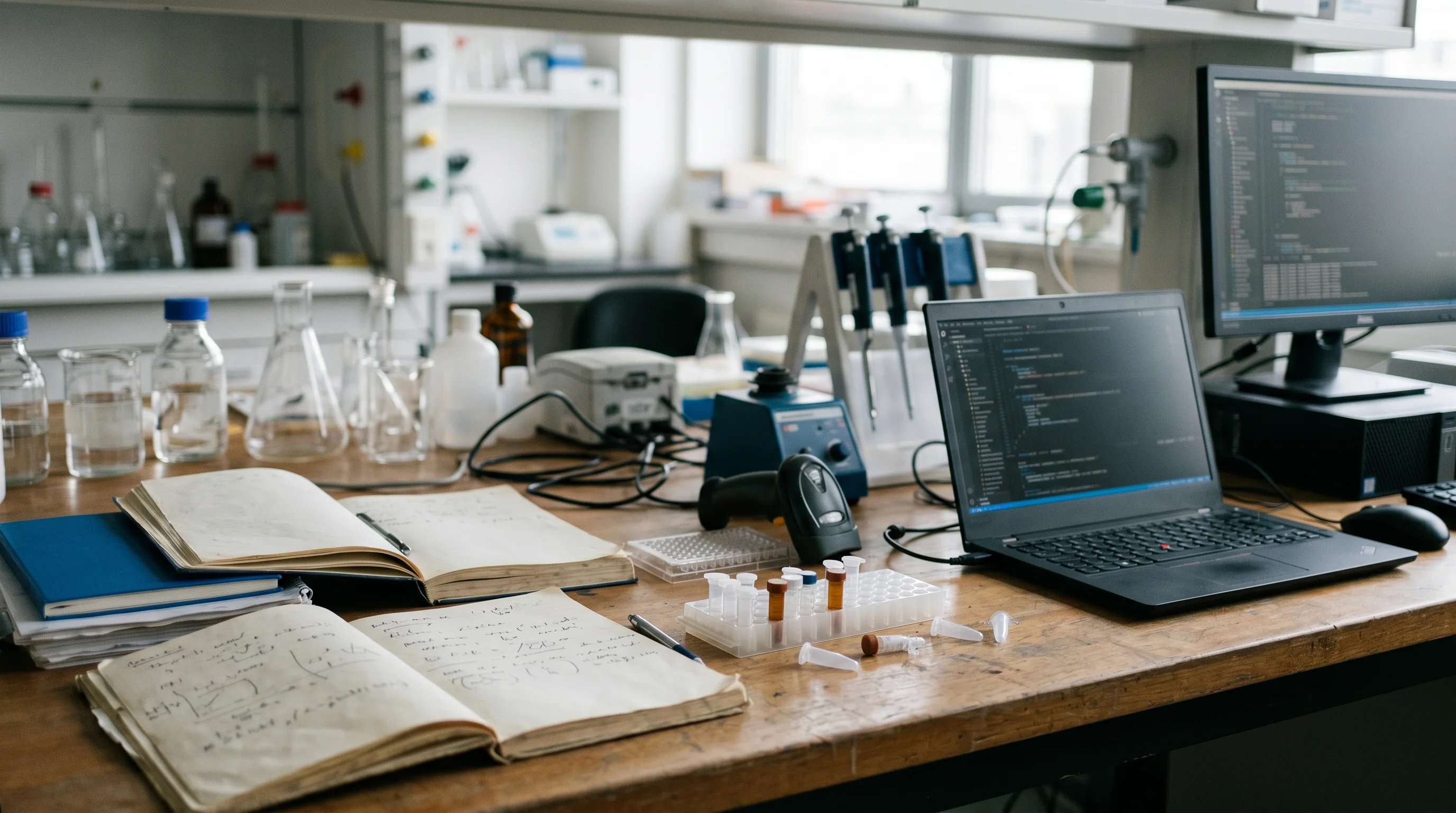
Most research labs operate on a fragmented infrastructure: electronic lab notebooks for record-keeping, LIMS for sample tracking, spreadsheets for everything else, and a collection of one-off scripts written by whoever happened to know Python. Cypher's platform aims to collapse that stack into a single adaptive layer.
Scientists interact with an AI agent that, according to the company, handles workflows, data analysis, visualization, and protocol creation. The emphasis is on flexibility—software that molds itself to the experiment, rather than forcing the experiment to fit the software.
It's an appealing idea, particularly for smaller biotech companies and contract research organizations without dedicated software teams. But it also puts Cypher in direct competition with established players like Benchling, which rolled out "Benchling AI" in November 2025, and legacy systems like Illumina's Clarity LIMS that have entrenched positions in large research institutions.
Cypher's counter-argument appears to be architectural: it's not adding AI features to traditional lab software but building the entire platform around AI as the execution layer. Whether customers see that distinction as meaningful—or merely marketing—will likely determine the company's trajectory.
Early Traction, Familiar Challenges

Recent announcements suggest Cypher is moving beyond pilot projects. In May, the company said it was onboarding external bioinformatics service providers and biotech customers through an end-to-end order management interface. Two early partners—nCode Biosciences, which optimizes mRNA sequences, and Prairie Helix Consulting, focused on microbial and fungal bioinformatics—joined the platform. Cypher also maintained a presence at SynBioBeta 2026, the industry's annual gathering.
Earlier collaborations with Enzidia (around September 2025) and Flock Bio (December 2025) predate the funding round by several months, suggesting the company has been testing its approach in the field for at least half a year.
The $2 million will go toward advancing the AI agent and building custom tools for scientists, according to the company's announcement. That's enough runway to prove the concept and land additional customers, but not enough to outspend the competition. Benchling, for context, raised hundreds of millions before going through layoffs in 2024. Cypher is playing a different game—smaller, more focused, and perhaps banking on the idea that incumbents move too slowly to truly reimagine lab software from scratch.
A Market in Motion

Cypher isn't alone in sensing opportunity. Converge Bio pulled in $25 million in January 2026 for AI-guided drug discovery. SymbyAI raised $2.1 million in February 2025 with a similar promise to simplify research workflows. Investors appear willing to fund experiments in this space, even if the path to market dominance remains unclear.
The question is whether AI agents can actually handle the nuance and variability of real-world lab work—or whether they'll end up as another layer of abstraction scientists have to manage. Early customers will provide the answer, probably sooner than Cypher would like.
For now, the company has capital, experienced leadership, and a clear thesis: that the future of lab software isn't built by scientists who code, but by AI that codes for scientists. Whether that future arrives in Cambridge or somewhere else is still very much in play.


