

Darwin Robotics, a Y Combinator 2025 startup that YC's directory lists at four people, has raised a $3.6 million pre-seed round led by Link Ventures to build robots that construct and maintain AI data centers. The company is targeting first deployments in early 2027.
Chief executive Sergio Charles announced the round in a company blog post dated November 5, 2026.
What Darwin says it is building
The announcement describes work-order-driven tasks: installing fiber-optic connections, diagnosing and repairing servers, assembling equipment and inspecting infrastructure. That is the company's stated product scope, and the announcement does not show that every task is already autonomous or commercially deployed.
Darwin also says it is in talks about initial deployments with hyperscalers (the giant cloud operators that run data centers at enormous scale) and other operators, according to its YC profile. These are company statements rather than disclosed customer contracts. Darwin has not named any customers.
The round
Link Ventures led the financing, according to a November 6 funding brief from Atoms Not Bits. Rebel Fund's LinkedIn feed also acknowledges the $3.6 million raise by its portfolio company, though the date of that post could not be independently confirmed. RuntimeWire, in a November 6 story by Ryan Merket, covered the round based on the company's thread on X.
One point remains unclear: whether the $3.6 million includes Y Combinator's own investment. Public materials do not say, so the figure should not be added to YC's standard deal. Nor does the announcement signal a new YC cohort admission. Darwin's official YC profile lists 2025 and the Charles brothers as founders, and SJSU's newsroom reported on November 4, 2025, that students had been accepted into the program.
Team and hiring
YC's directory lists four people at Darwin, though the figure is undated. The company has three open roles posted on YC: Member of Technical Staff, Robot Learning; Member of Technical Staff, Robotics Hardware; and Chief of Staff.
Those listings say less than they might appear to. The hardware posting does not establish a finalized robot configuration, and the robot-learning posting describes desired expertise, not methods already in production.
Charles discussed an earlier project, Thesis, which was positioned around automated AI research, on the Deeptech Decoded podcast. The episode dates to April 30, 2026. It offers founder history, not a picture of Darwin's current commercial status, and it does not establish when the company changed direction.
Why data centers, and why now
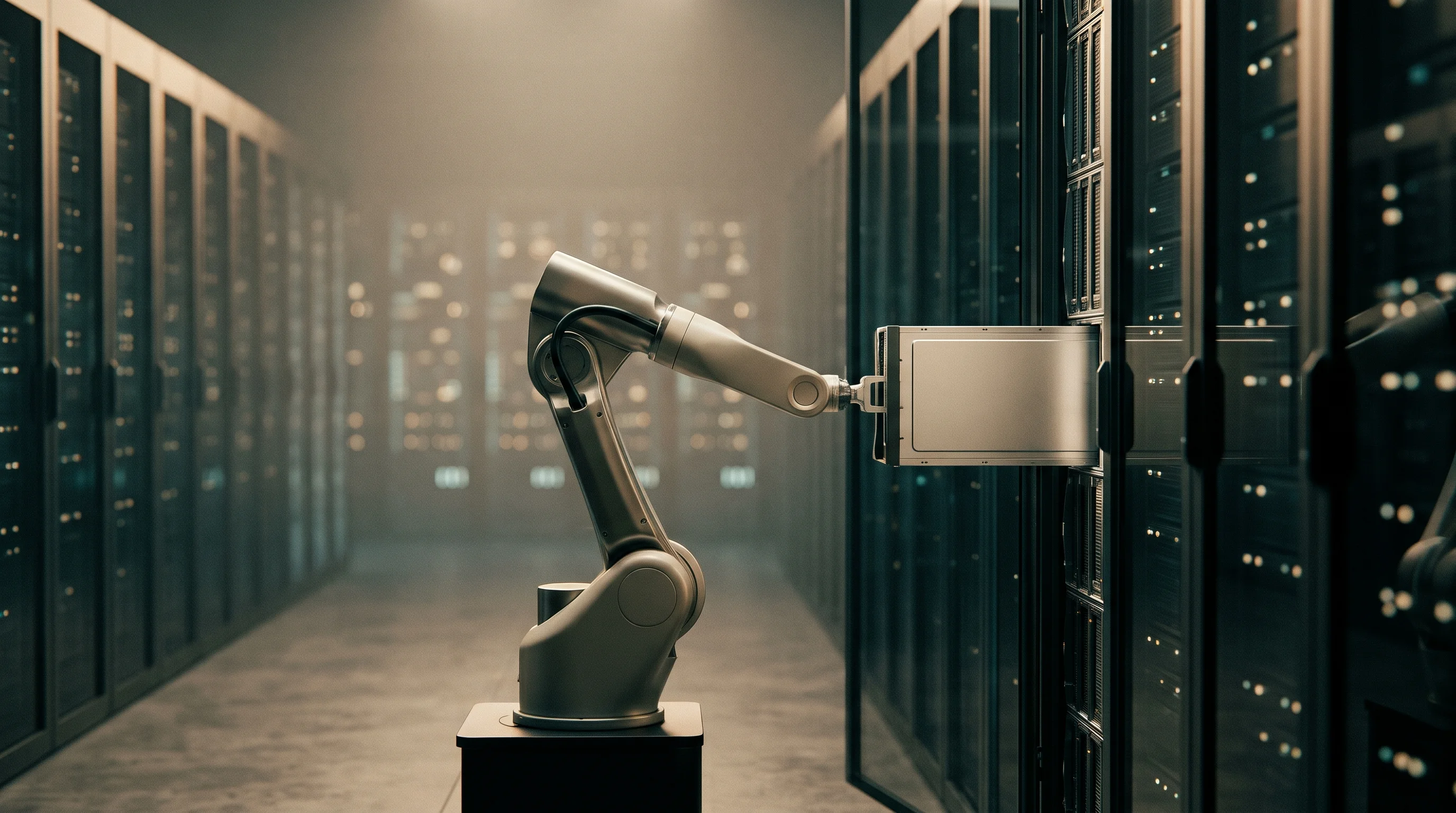
JLL titled a release on its global data center outlook "Global data center sector to nearly double to 200GW amid AI infrastructure boom." Darwin is betting that physical labor will become a constraint on that buildout.
Robots face constraints of their own. A McKinsey account of a CES 2026 panel, whose participants included Robert Playter of Boston Dynamics and Mikell Taylor of General Motors, identified hardware, sensing, data, organizational readiness and trust as limits on industrial robot adoption. The account is general industry context, not commentary on Darwin.
Darwin's place in the YC pipeline
YC describes a three-month cycle, with roughly 11 weeks leading to Demo Day, and says it holds four Demo Days a year. Its Demo Day page lists December 2, 2026, for the F26 batch, a different cohort from Darwin's.
A University of Illinois report from December 12, 2025, named Airbnb, Instacart, Reddit and DoorDash among YC's established alumni. Those are examples from the program's history, not predictions for Darwin.
For now, the deployment target is the next milestone that matters. Darwin's own wording is early 2027, and the company has not said where.


