

Most hardware companies guard their prototypes like state secrets. Flipper Devices is doing the opposite.
The Miami-based firm behind the controversial Flipper Zero—that dolphin-branded gadget that became the target of a proposed Canadian ban amid car theft concerns in 2024—has published complete schematics for its next product, opened a technical wiki, and essentially asked the internet: what are we missing? The device in question, Flipper One, is a pocket-sized Linux computer designed for network penetration testing. And rather than polish it behind closed doors, the company wants developers to tear the design apart before crowdfunding begins.
"We're not asking for money yet," CEO Pavel Zhovner wrote in the announcement. "We're asking for something more valuable: your expertise."
The blog post quickly climbed to 1,121 points on Hacker News, pulling in 438 comments that dissected everything from Wi-Fi chipset performance to whether dual Ethernet ports make sense on a handheld. Which was probably the point.
Not Your Father's Flipper
This isn't simply Flipper Zero with better specs. The original device—which raised $4.8 million on Kickstarter and later became a political lightning rod—focused on offline protocols: RFID badges, infrared remotes, NFC tags. Flipper One targets an entirely different problem space. It's built for networked systems.
Think portable network lab, not electronic lockpick. The device packs dual Gigabit Ethernet ports, Wi-Fi with monitor mode and packet injection (assuming the MT7921AUN chipset delivers), and an M.2 expansion slot that accepts 5G modems, satellite modules, or software-defined radios. Use cases, according to Flipper, range from wardriving expeditions to VPN gateway deployment, IP traffic analysis to running AI inference locally via an on-chip neural processing unit.
The hardware runs Debian Linux on a Rockchip RK3576 ARM processor with 8GB of LPDDR5 RAM and 64GB storage. At 155 × 67 × 40 mm, it's roughly the size of a chunky smartphone. There's a touchpad, haptic feedback, a physical D-pad, five programmable buttons. Even a front-facing power meter for watching battery drain in real time—apparently useful when you're trying to squeeze another hour from the device during field work.
Whether all this actually fits comfortably in a pocket remains to be seen.
The Open Hardware Bet
Flipper is partnering with Collabora to push full mainline Linux kernel support for the RK3576 system-on-chip. The stated goal: build "the most open and best-documented ARM computer in the world." That's not a modest claim. The company acknowledges one remaining binary blob—buried in early-boot DDR memory training—but says everything else is moving toward open-source implementations.
The documentation hub went live alongside the announcement, with pages covering hardware specs, mechanical designs, GPIO pinouts, and a running list of open development tasks. Full 3D CAD models are available for community modification. The M.2 expansion system's interface specs—PCIe 2.1 ×1, USB 2.0/3.1, SATA3, SIM routing—are detailed publicly.
Perhaps the most curious software piece is FlipCTL, a text-based UI framework for tiny screens. It wraps command-line tools like ping and nmap into navigable interfaces optimized for Flipper One's button layout. The team envisions FlipCTL becoming portable enough that you could eventually "apt install flipctl" on any Debian system. It's still prototyping. But it addresses a legitimate problem: how do you make network analysis tools remotely usable on a 3-inch display?
The company's Linux distribution uses "profiles"—essentially full OS snapshots that let users switch contexts for different tasks or clone working environments. Bouncing between pentesting gigs and IoT development? Maintain separate profiles rather than constantly reconfiguring packages. The concept is borrowed from virtualization workflows, applied to bare metal.
What's Actually Inside
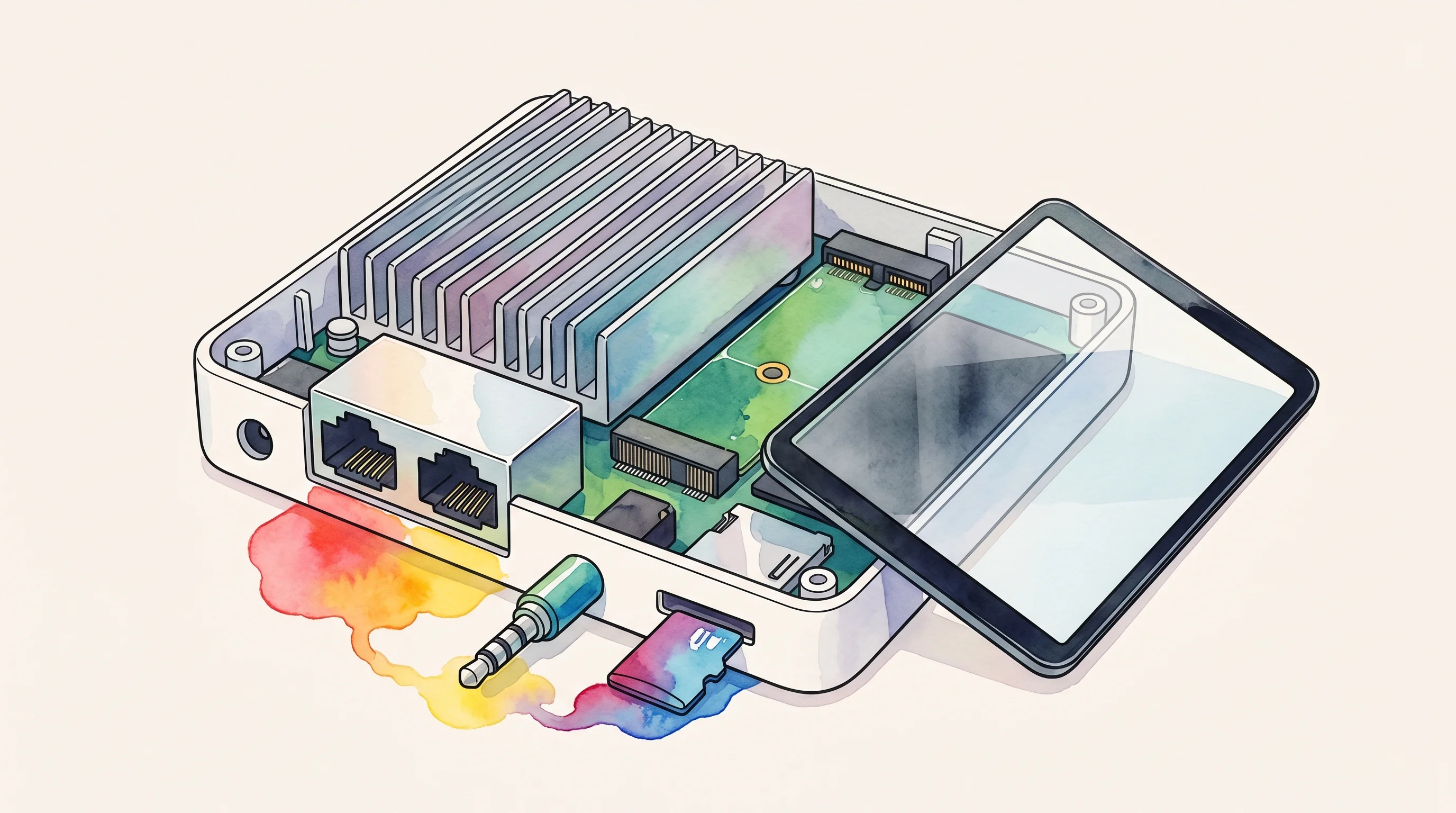
Under the chassis—PC/ABS plastic, anodized aluminum heatsink, Gorilla Glass over the display—Flipper One resembles what you might get if a Raspberry Pi mated with a network engineer's field kit. Beyond the dual Ethernet ports and M.2 slot, there's a 3.5mm TRRS audio jack, a microSD card slot (UHS-I SDR104), and a nano-SIM slot routed to the M.2 port for cellular modules.
The device exposes UART, I2C, and additional GPIO interfaces. An external antenna connector accommodates add-on radios. The touchpad includes haptic feedback. There's a push-to-talk button—oddly specific, but potentially useful for mesh network communication or coordinating over encrypted channels.
Weight and final battery capacity aren't locked down. The specs page carries a disclaimer that several values remain "under active development," including the microSD signaling mode and audio hardware implementation. This is where community input becomes critical, or so the company hopes. Flipper is explicitly asking for field testing on the Wi-Fi chipset to validate monitor mode and injection before finalizing the design.
It's unclear how much feedback will actually influence final decisions versus simply validating choices already made.
Reception and Risk

The Hacker News thread quickly became a referendum on open hardware development models. Some commenters praised the transparency. Others questioned whether crowdsourcing hardware decisions would lead to design-by-committee paralysis. A separate post about tech specs had already accumulated 495 points.
Coverage from Tom's Hardware, CNX Software, BleepingComputer, and international outlets including GIGAZINE and Golem.de followed within hours. Most emphasized the unusual approach—launching a developer portal before a product exists.
Zhovner told Gizmodo the company hopes to launch crowdfunding "later this year" with a base configuration around $350, though he noted that figure depends on RAM prices and backer volume. The base model won't include a cellular module; those will presumably be sold as M.2 expansion options.
As of the announcement, no crowdfunding campaign has launched. The announcement deliberately avoids pricing or retail timelines, framing the launch purely as an open development effort. It's an interesting gamble—invite scrutiny and suggestions when the hardware can still change, rather than announce a finished product and field complaints about decisions already cast in silicon.
The Flipper Zero's trajectory—viral popularity followed by retail restrictions and moral panic over car theft—likely informed this strategy. By positioning Flipper One as a networking multitool for professionals and making the development process transparent, the company seems to be preempting narratives about "hacking gadgets."
Whether that works depends partly on what the community builds with it. The M.2 slot and open software stack mean the device could become whatever its users need: a portable VPN router, a radio spectrum analyzer, a mesh network node. Or something no one's imagined yet.
That's the pitch. Now Flipper Devices is waiting to see if the developer community actually shows up—and whether opening the design process early is strategic transparency or just good marketing dressed up as collaboration.


