

When GPS signals die at the threshold of a warehouse or underground parking garage, most companies reach for Bluetooth beacons or ultra-wideband tags. Wheere, a Montpellier deeptech venture, thinks the answer lies 340 miles overhead.
The company closed an €8.5 million bridge round on June 23, 2026, split almost evenly between equity (€4.2 million) and non-dilutive financing from banks and grants (€4.3 million). It's the kind of runway extension that buys time—in this case, until Wheere attempts to prove its technology works not just on the ground, but broadcast from low Earth orbit.
The equity slice came from an eclectic mix: Blast Club, a private investment collective, put in €2.4 million; Éric Larchevêque, who co-founded hardware wallet maker Ledger, contributed €1 million; and regional fund Sofilaro added €500,000. A cluster of existing angels rounded out the syndicate. Since launching in 2020, Wheere has pulled in close to €20 million by June 2026, including an €11 million seed round that closed in mid-2023.
Concrete Problems, Radio Solutions
Wheere's central proposition sounds deceptively simple: use VHF radio signals to pinpoint objects indoors with sub-meter accuracy, even through 50 meters of reinforced concrete. The company has patented the approach, which relies on just four ground antennas per square kilometer—a far cry from the mesh of beacons that make competing systems expensive to deploy and maintain.
Early traction has come from energy and industrial clients. The company claims EDF and TotalEnergies are testing the system; L'Oréal gets mentioned as a reference customer, though Wheere remains tight-lipped about deployment scale. The startup, which now employs 25 people, is targeting €1 million in revenue this year—modest, but perhaps enough to signal product-market fit before the real capital demands begin.
The company has also woven its technology into Flowcate's omlox ecosystem, a German-led effort to standardize industrial real-time location systems. It's the kind of interoperability play that matters if you're pitching infrastructure-grade reliability.
The Orbital Gambit
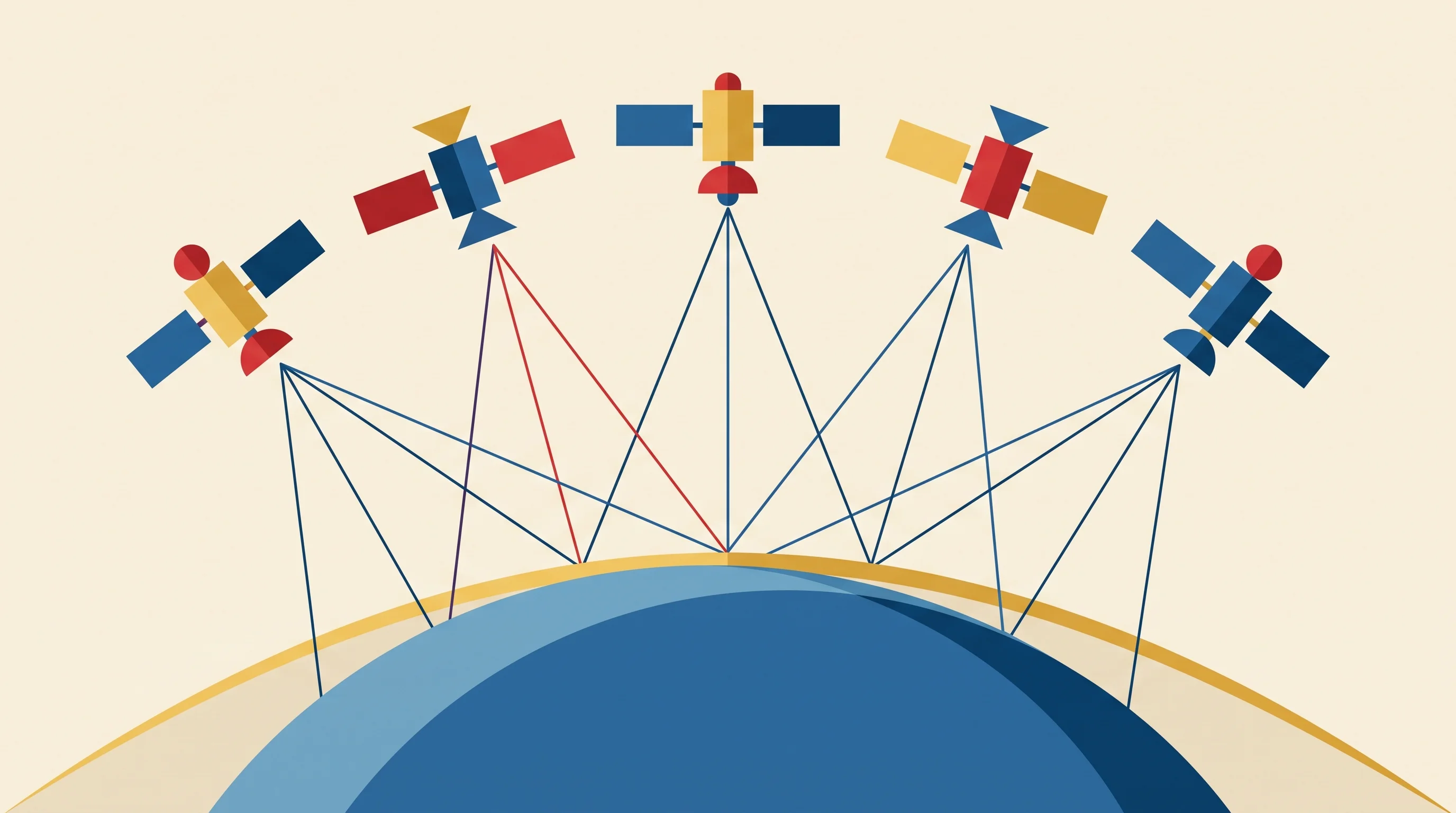
Here's where the story gets more speculative, and more expensive.
Wheere plans to validate its positioning signals from space in the first half of 2027, a milestone that precedes a five-satellite pilot constellation slated for July 2028. If all goes to plan—and satellite ventures rarely do on schedule—the company envisions a 300-satellite network operational by 2030. That's a sovereign positioning system, a European alternative to GPS for both indoor and outdoor use cases.
It's an audacious roadmap. Building, launching, and operating even a modest constellation demands capital far beyond what Wheere has raised to date, which is why the company is already eyeing a €40 million Series A. The bridge financing buys breathing room to hit technical milestones and, presumably, to sweeten the pitch for institutional investors who might otherwise balk at the execution risk.
In the meantime, Wheere is channeling some of the fresh capital into an ASIC development program—custom silicon tends to signal seriousness—and expanding sales into Germany and Canada. The company graduated from ESA BIC Sud France, the space agency's business incubator in the south, and earned a slot in the French Tech 2030 program earlier this year.
Dual-Use Hedging

The bridge structure tells its own story. Wheere is essentially hedging: terrestrial deployments generate near-term revenue and prove the technology works at ground level, while the satellite infrastructure unlocks a vastly larger market—if it can be financed and executed. One pays the bills; the other justifies venture-scale returns.
Whether investors will back a €40 million round before in-orbit validation remains an open question. Satellite startups have burned through billions in recent years, and the positioning-as-a-service market, while tantalizing, is crowded with competitors who've been at it longer. Wheere's bet is that its VHF approach—simpler infrastructure, better building penetration—offers enough differentiation to matter.
For now, the company has another year or so to prove the technology scales and that paying customers exist beyond pilot contracts. After that, the real test begins: convincing investors that a French startup with a novel radio trick can build and operate a constellation that challenges decades of GPS dominance.
That's a harder sell than closing a bridge round.


