

The timing, Mike Horton will tell you, was hardly accidental.
Four months after the Federal Communications Commission effectively locked foreign-made drones out of the U.S. market, Horton's Santa Clara-based chip startup, Hyfix Spatial Intelligence, announced a $15 million seed round. The funding—announced April 15, 2026, and led by Craft Ventures, with Catapult Ventures, Multicoin Capital, Finality Capital, and tech entrepreneur and aerospace investor Sky Dayton joining in—arrived at a moment when the commercial drone industry found itself scrambling for alternatives to a supply chain dominated by Chinese manufacturers.
It's a substantial seed by any measure. More than three times the $4.1 million median for U.S. seed rounds in March 2026, according to industry data. But perhaps more revealing is what the round signals: a scramble to build the domestic infrastructure that American regulators now say they want, and that the defense establishment has been quietly demanding for years.
The FCC's Move, and DJI's Response
On December 22 and 23, 2025, the FCC added all foreign-made drones and critical components to its Covered List—a regulatory maneuver that bars new equipment authorizations for imports deemed a national security risk. The decision didn't name DJI explicitly, but it didn't have to. The Shenzhen-based manufacturer controls roughly 80% of the U.S. commercial drone market and about 70% globally, according to 2024 Atlantic Council analysis.
DJI filed suit against the FCC in February. The case is ongoing, and the regulatory uncertainty has left fleet operators, surveyors, and agricultural operators in a familiar bind: keep flying aging equipment, or hope someone can build a credible American alternative fast enough to matter.
Hyfix is wagering it can.
One Chip to Rule the Flight Deck
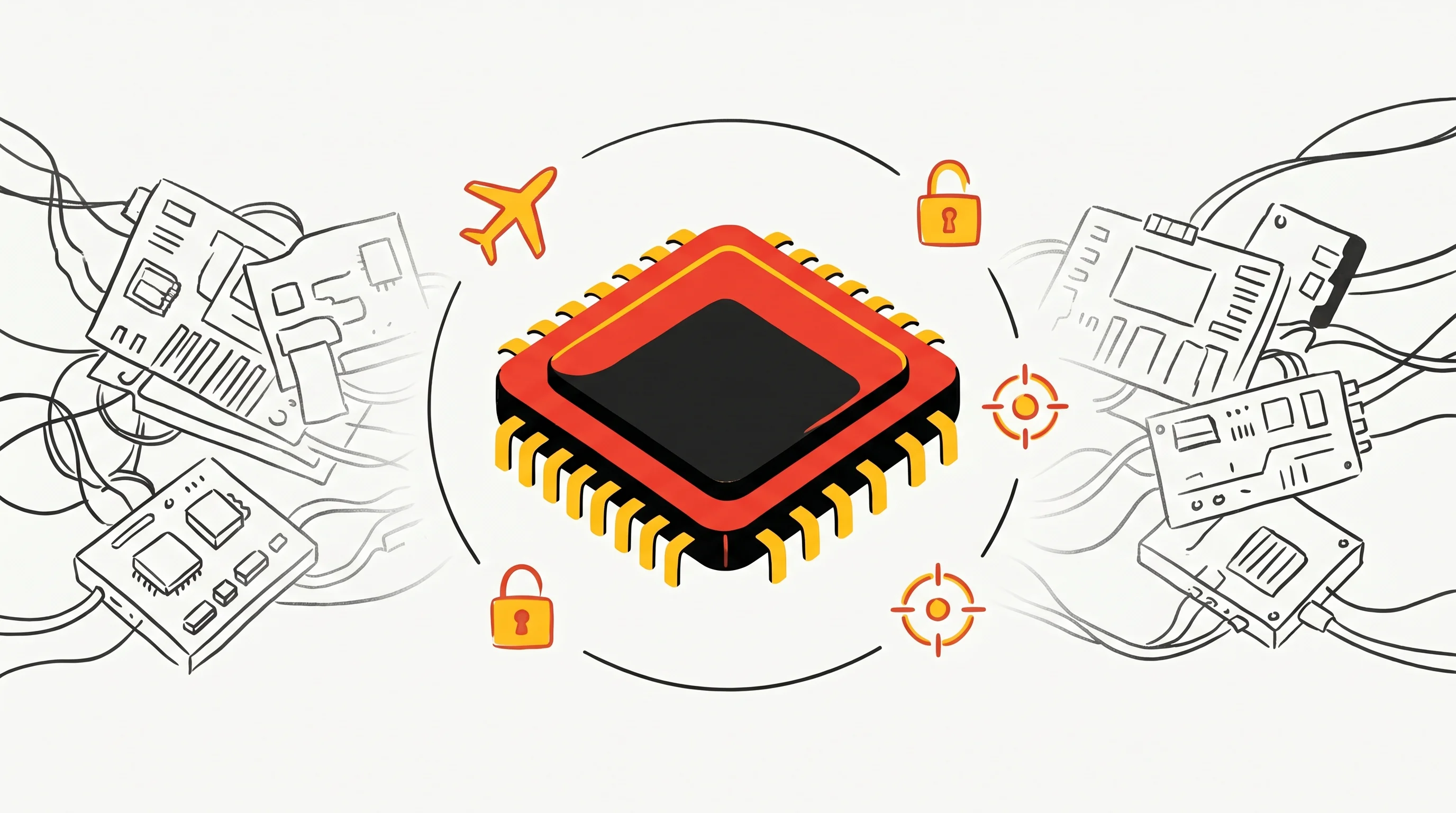
The company's pitch is deceptively straightforward—build a single system-on-chip that does what now typically requires a tangle of separate boards. Flight control, high-precision positioning, secure communications, onboard compute: all integrated into U.S.-manufactured silicon. Hyfix hasn't disclosed which domestic foundry it's partnering with, though the choice of partners will matter as much as the design itself in a market newly sensitive to where chips are fabbed.
Horton brings a particular pedigree to the effort. He previously co-founded Crossbow Technology, a sensor and navigation firm acquired by Moog Aerospace in 2011, and later started Anello Photonics. His cofounder, Udan Ercan, is described by Fortune as a GNSS specialist who built high-precision positioning systems at Topcon, a Tokyo-based maker of surveying and geospatial equipment.
Their chip is engineered around a vulnerability that's become more glaring as drones proliferate: GPS jamming and spoofing. The solution, Hyfix says, lies in tight integration with GEODNET, the RTK (real-time kinematic) reference network Horton also founded. As of the funding announcement, GEODNET was operating around 21,000 ground reference stations worldwide—a distributed network that cross-checks satellite signals for interference and drift.
"It uses reference stations… for more resilient and more accurate positioning than GPS alone," Horton told Fortune in an interview tied to the funding announcement.
The architecture isn't entirely new—commercial agriculture and surveying have relied on RTK corrections for years—but packaging it into a drone-ready chip, with U.S. supply chain credentials, is.
The Roadmap, and the Reference Drone

Hyfix plans to use the $15 million to complete the chip's design and push it through tape-out, the final validation step before mass production. The company expects to ship production-ready silicon to select partners sometime in 2026, though timelines in hardware have a way of stretching.
To prove the concept, Hyfix is also building a sub-250-gram reference drone—light enough to skirt some FAA registration requirements, and designed to showcase what the integrated platform can do when it's not stitched together from off-the-shelf components.
"There is currently no end-to-end American supply chain for drones," Jeff Fluhr, a partner at Craft Ventures, said in Fortune's coverage. "Hyfix is tackling one of the most critical pieces, custom silicon."
Whether that's enough to unseat entrenched players like DJI—or even to carve out a defensible niche in government and enterprise contracts—remains an open question. The commercial drone market is projected to reach $55 billion by 2030, according to Grand View Research. But projections assume relatively open trade, and the regulatory landscape is shifting faster than the hardware.
A Company Tied to Its Roots

Hyfix was formally incorporated in Delaware and registered with California's Secretary of State in March 2024, making it a relatively young entity even by startup standards. It has maintained close operational ties to GEODNET—the reference network's online store is still run by Hyfix Spatial Intelligence, and company materials describe Hyfix as having been "founded in 2024."
That organizational intertwining may prove advantageous, or it may complicate things as Hyfix courts customers wary of vendor lock-in. Either way, the company is betting that a regulatory tailwind and a genuine technological constraint—foreign reliance in a strategically sensitive market—will create an opening.
It's a gamble that a growing number of investors seem willing to back. Whether the market will follow is another matter entirely.


