

The pitch sounds almost comically ambitious: thirty tons of ammunition, spare parts, or medical supplies, dropped anywhere on Earth in less than an hour. Not by cargo plane—those are too slow and too vulnerable. By rocket. The kind that normally hauls satellites to orbit, reconfigured to land on remote islands, forward operating bases, or any austere coordinate where runways don't exist and supply chains have collapsed.
Yet here's the thing: it's actually happening.
In September 2025, a six-person Los Angeles startup called Hop Aero—still operating largely in stealth—walked away with a $1.25 million contract from the Air Force Research Lab. Their mandate? Develop rocket cargo vehicles capable of hypersonic speeds and delivery into what the military euphemistically calls "contested environments." Translation: places where people are actively trying to destroy your supply lines. Then in March 2026, Rocket Lab locked in $190 million for twenty hypersonic test flights. Blue Origin secured a study award of approximately $1.37 million, while Anduril, the defense tech unicorn better known for autonomous drones, received around $1 million for a parallel study. Sierra Space floated the idea of repurposing its Dream Chaser spaceplane—originally designed for NASA cargo runs to the International Space Station—for 90-minute global deliveries of five to ten tons.
Then in October, Inversion Space, a startup focused on what it calls "orbital return," unveiled Arc: a capsule engineered to bring cargo down from orbit to any landing zone in under an hour.
These aren't PowerPoint fantasies. They're funded programs with hardware timelines, flight tests scheduled for this year and next, and a very real customer: the Department of Defense, which has elevated Rocket Cargo to something called a Vanguard initiative—Pentagon-speak for "we're serious about this." The Air Force is pouring money through multiple channels: REGAL (Rocket Experimentation for Global Agile Logistics), MACH-TB hypersonic testing contracts, and a steady stream of Small Business Innovation Research awards. The infrastructure to make this work, in other words, is materializing faster than most observers expected.
Where the Technology Stands Now
Rocket-based point-to-point cargo sits at a peculiar intersection: heavy-lift reusability, hypersonic flight testing, and precision reentry systems. All three domains have made dramatic leaps in the past two years, perhaps more than even the engineers involved anticipated.
Consider the pace. By September 2025, SpaceX's Starship had flown ten times, demonstrating the kind of scale and launch cadence that any serious cargo rocket system would require. Blue Origin's New Glenn—a heavy-lift vehicle that spent years in development—reached orbit on its first try in January 2025 and nailed its booster landing in November 2025, according to the FAA's mid-2026 aerospace forecast. Relativity Space has its Terran R slated for late this year, assuming schedules hold. These aren't just launch vehicles anymore; they're testbeds for the thermal shielding, guidance algorithms, and recovery systems that rocket cargo fundamentally depends on.
Meanwhile, the Air Force has quietly but systematically built out its hypersonic test capacity. The MACH-TB program—shorthand for Hypersonic Accelerator Suborbital Test—demonstrated advanced hypersonic technologies in late 2024, then handed Rocket Lab that $190 million contract in March for twenty HASTE flights stretching into 2027. Stratolaunch's Talon-A hypersonic test vehicle achieved reusable flight and runway recovery last spring in support of MACH-TB. Dawn Aerospace's Mk-II Aurora spaceplane broke Mach 1.12 in November 2024 and has continued pushing its flight envelope since.
The infrastructure for fast iteration—the kind that brought SpaceX from spectacular explosions to operational spacecraft in a few short years—is now accessible to a broader slice of the industry. The FAA crossed its 1,000th licensed commercial space operation in August 2025, a milestone that reflects both a launch surge and regulatory streamlining under the revised Part 450 framework.
Why the Pentagon Cares
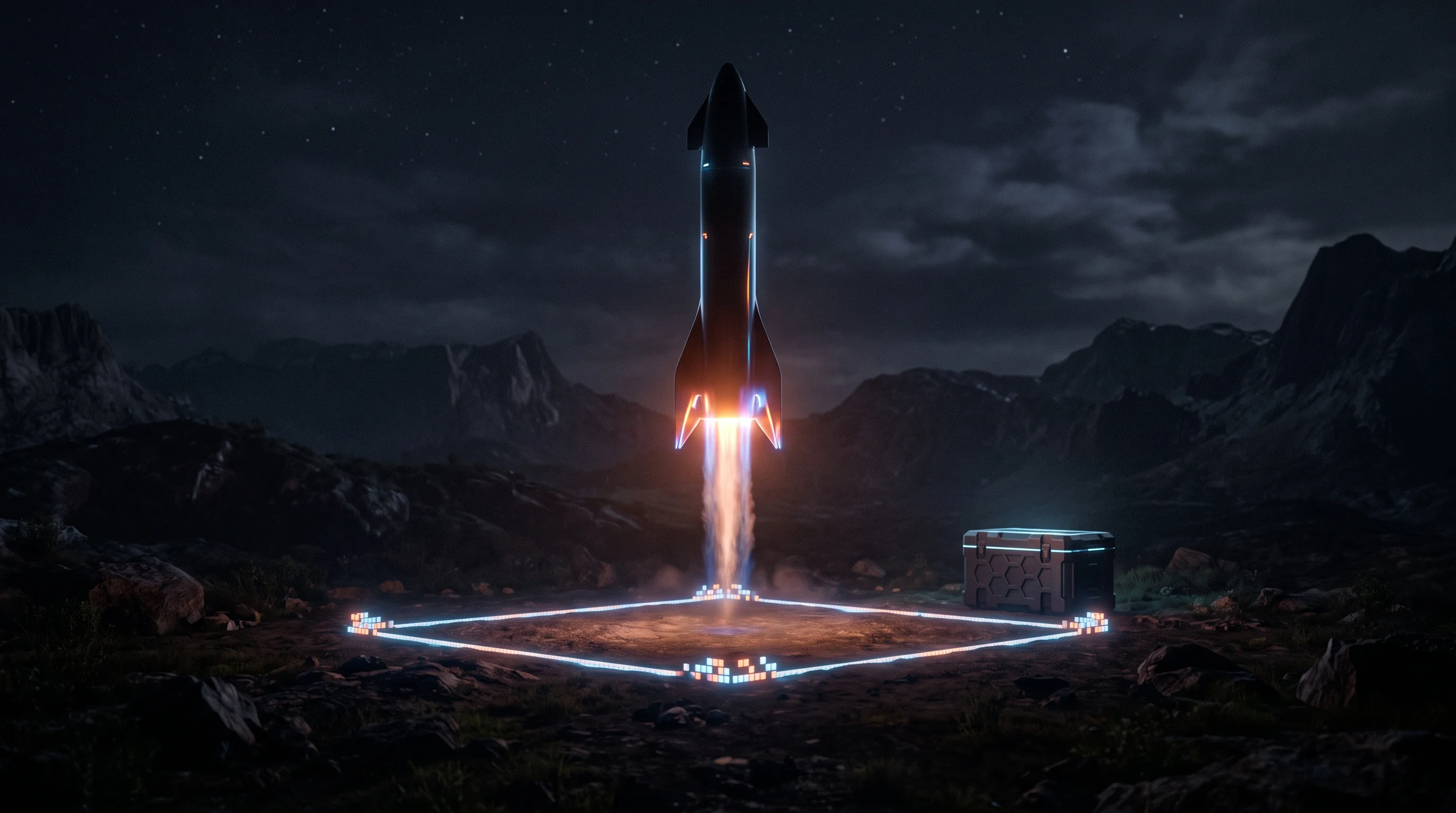
The demand here isn't subtle. The 2024 National Defense Strategy and follow-on Army guidance explicitly flag "contested logistics" as a vulnerability—the ability, or lack thereof, to sustain forces when adversaries systematically target supply lines, ports, and traditional airfields. A rocket that can circumvent those chokepoints and put thirty tons of gear on a remote landing zone in under an hour? That's what military planners call an asymmetric advantage. It changes the calculus.
According to SpaceNews reporting from 2024, U.S. Space Command has expressed interest in Rocket Cargo's potential, though officials noted the need to mature operational concepts—military-speak for "we need to figure out who's actually going to run this thing." The Air Force's REGAL program, launched under the Rocket Cargo Vanguard banner, has issued a cluster of study contracts and is preparing for what it calls a Neutron demonstration flight. Rocket Lab's medium-lift Neutron vehicle was tapped in May 2025 to test cargo survivability and reentry dynamics on a mission tentatively planned for sometime in 2026 or later.
The technical building blocks are starting to align. Thermal protection systems—historically a constraint for anything coming back from space at hypersonic speeds—are improving through both passive and active cooling techniques, though reusability across large surface areas remains an engineering challenge, according to a research review published in ScienceDirect last July. Precision guidance and landing, critical if you're trying to set down on an unimproved strip or a grid coordinate in the middle of nowhere, benefit from SpaceX's thousands of booster recoveries and Blue Origin's propulsive landing heritage.
Export controls, of course, complicate everything. ITAR's U.S. Munitions List Category IV covers launch vehicles and their components. MTCR Category I thresholds capture complete rocket systems and reentry vehicles that meet certain range and payload criteria—300 kilometers, 500 kilograms. Any startup eyeing international partnerships or allied customers will spend a lot of time with lawyers.
Still, the money is flowing. Hermeus, which is developing hypersonic aircraft for defense applications, raised $350 million in April at roughly a $1 billion valuation. Industry analysts peg the hypersonic systems market somewhere between $7 billion and $8.5 billion this year, with double-digit annual growth projected through the early 2030s. For context, IATA forecasts global air cargo revenue at $158 billion in 2026—underscoring that even if rocket cargo's initial customers are military, the commercial hunger for faster, more flexible logistics is very real.
Who's Building It
Hop Aero is emblematic of this new wave. Founded in 2024 and accepted into Y Combinator's cohort last summer, the company describes its mission as "rocket cargo delivery to contested environments"—a phrase that sounds like something out of a defense contractor brochure, which is more or less the point. The six-person team, split between Los Angeles and Orange County, includes Jacob Balaj, who logged time at SpaceX working on Falcon 9 and Heavy booster refurbishment, Virgin Orbit's LauncherOne program, and Masten Space Systems on a NASA lunar lander project. His co-founder, Matija Milenović, previously led porkchop, an electric propulsion startup that flew hardware on SpaceX's Transporter-3 rideshare in early 2022, and worked as a systems engineer at Destinus, a European supersonic UAV outfit.
Hop Aero's Air Force SBIR Phase II award—formally titled "Rapid Operations Over Kilometers" and dated September 24, 2025—clocks in at just under $1.25 million. The company remains mostly in stealth; no vehicle specs, payload details, or operational concepts have been made public. A job posting from around mid-2026 listed a Mechanical Design Engineer position at $90,000 to $150,000, suggesting hardware development is actively underway, but beyond that, details are scarce.
The Air Force's REGAL program, by contrast, has attracted a more varied group. Sierra Space's October 2024 award explores something called "Ghost," a concept that would leverage the Dream Chaser spaceplane and its Shooting Star cargo module to deliver five to ten tons anywhere on the globe in 90 minutes. Rocket Lab's Neutron vehicle, selected in May 2025, is slated to demonstrate a survivability and reentry experiment—tentatively scheduled for 2026 or later. Blue Origin received approximately $1.37 million last August to study cargo delivery concepts. Anduril, better known for counter-drone systems and autonomous ground vehicles, secured around $1 million for a parallel study in the same window.
SpaceX, predictably, holds what amounts to the anchor contract: a $102 million Other Transaction Authority award signed back in January 2022 to gather data on whether Starship could realistically handle heavy rocket cargo, piggybacking on the vehicle's ongoing test campaign. U.S. Transportation Command formalized Cooperative Research and Development Agreements with SpaceX in March 2020 and Blue Origin in December 2021, establishing a framework for collaboration that stops short of direct procurement.
Inversion Space occupies a slightly different niche. The startup, which focuses on orbital return technology, unveiled its Arc capsule last October with the stated aim of delivering cargo anywhere on Earth in under an hour. The company is targeting its first Arc flight by the end of this year, though schedules in aerospace tend to be aspirational. Unlike Hop Aero's focus on austere-site delivery, Inversion's model assumes orbital insertion via a separate launch vehicle, followed by a deorbit burn and precision landing. The pitch serves both military and high-value commercial customers—semiconductor fabs needing emergency spare parts, for instance, or pharma companies rushing critical supplies.
What Could Go Wrong (And What's Next)
The Air Force had originally hoped to demonstrate cargo delivery to an austere site in late fiscal 2025 or early 2026, according to a May 2024 solicitation and subsequent reporting by Breaking Defense. That timeline has slipped, as timelines often do. The Department of the Air Force filed a Notice of Intent last March to conduct an Environmental Assessment for Rocket Cargo testing at Johnston Atoll, a tiny coral reef about 800 miles southwest of Hawaii. Then in July, the department placed that review "in abeyance" while evaluating alternative sites. Environmental reviews under the National Environmental Policy Act, plus FAA reentry licensing requirements, remain gating factors for anything approaching routine operations.
Regulatory complexity extends well beyond individual test sites. FAA Part 450 licensing covers both launch and reentry, with each license potentially spanning multiple vehicle configurations and landing zones. But public safety analyses, hazard area coordination, and airspace integration with traditional aviation get exponentially more complicated as launch cadence rises. The FAA noted in a 2026 report that managing the overlap between commercial space operations and the National Airspace System remains an evolving challenge—bureaucratic understatement for "we're still figuring this out."
Technical risk, of course, remains substantial. A 2025 Government Accountability Office report on hypersonic programs flagged cost overruns, schedule delays, materials constraints, and gaps in test infrastructure. Thermal protection for large reentry vehicles, precise terminal guidance in contested or GPS-denied environments, and the sheer logistics of refueling and turning around a rocket cargo vehicle at a remote dirt strip—these are all open engineering problems. A February 2024 essay in The Space Review argued for clearer cost-benefit models and operational concepts before the Defense Department commits to large-scale procurement, a sentiment that hasn't aged poorly.
Yet the momentum is undeniable. Rocket Lab's $190 million MACH-TB 2.0 contract signals sustained government investment in hypersonic test infrastructure through at least 2027. If Neutron's reentry demonstration succeeds—whenever it flies—it would provide the first operational data on cargo survivability during a medium-lift return. Sierra Space's Dream Chaser, already under contract for NASA ISS cargo missions, offers a near-term platform for runway-based experiments. And the heavy-lift maturity curve continues to improve: Starship reliability, New Glenn's booster recovery, Terran R's impending debut. The vehicle capacity for large payloads is only getting better.
For startup founders, the opportunity lies less in building entire rockets—that's capital-intensive and crowded—and more in subsystems and enabling technologies. Advanced thermal protection materials. Autonomous landing systems for unimproved surfaces. Rapid payload handling equipment designed for austere sites with zero ground support. Software for real-time mission planning in contested electromagnetic environments where GPS might be jammed or spoofed. Venture capitalists are clearly interested: Hermeus' $350 million raise last April and the steady stream of SBIR awards to small teams like Hop Aero suggest appetite for both hypersonic aviation and rocket logistics plays.
The commercial case, it must be said, remains speculative. Defense applications justify the current R&D spending, but the long-term vision—overnight delivery of semiconductors, emergency medical supplies, disaster relief—depends on cost trajectories that are difficult to model with confidence. SpaceX drove launch costs down by roughly an order of magnitude. Whether rocket cargo can achieve anything close to similar economies is an open question, and one that won't be answered for years.
What's certain is this: the Air Force is treating Rocket Cargo as more than a science experiment. It's designated a Vanguard program, funded multiple parallel development paths, and committed to flight demonstrations over the coming year. The technology is no longer trapped in concept studies. Startups are hiring engineers, machining parts, competing for Phase II contracts. Established aerospace primes are adapting orbital vehicles for terrestrial logistics, which would have sounded absurd five years ago.
The race to build hypersonic rocket cargo systems is happening now. The next eighteen months will start to reveal whether this becomes a niche capability for contested military theaters—useful but limited—or the leading edge of something larger. A logistics revolution, perhaps, though revolutions tend to take longer than anyone expects.


