The pitch sounds almost too tidy: take the carbon dioxide pouring out of cement kilns and steel furnaces, feed it to microbes, and harvest biochemicals. Yet Intrinsic Foundries, a startup based in industrial Jharkhand, India, just convinced Transition VC to back exactly that vision with $1.4 million in seed funding announced between February 23–25, 2026.
Timing, as they say, is everything. Just weeks earlier, India's government unveiled a ₹20,000 crore outlay—roughly $2.4 billion over five years—to subsidize carbon capture, utilization, and storage across the country's dirtiest industries. For founder Shreyansh Jain, a BITS Pilani and Cornell alum who spent the last year running proof-of-concept trials at a thermal power plant, the policy shift felt less like luck than vindication. "Carbon is not waste. It is a resource waiting to be transformed," he told investors during the fundraising process. Whether the economics bear that out remains an open question, but the convergence of policy support, tightening European import rules, and maturing biotechnology has made carbon conversion a suddenly crowded—and suddenly viable—space.
When Policy and Physics Align
India's industrial decarbonization challenge is enormous. Cement, steel, refining, and petrochemicals generate the bulk of the country's industrial CO₂, and those emissions are notoriously hard to eliminate. Unlike power plants that can swap coal for solar panels, heavy industry is locked into chemical processes that inherently produce carbon dioxide. The February 2026 budget allocation represents the first serious attempt to subsidize capture at scale, targeting exactly the sectors where Intrinsic hopes to deploy its modular systems.
At the same time, Europe's Carbon Border Adjustment Mechanism entered full enforcement on January 1, 2026. CBAM, as it's known in trade circles, now requires anyone importing cement, steel, aluminum, fertilizers, or hydrogen into the EU to surrender certificates tied to the embedded carbon in those goods. For Indian exporters, the math just got uncomfortable. A ton of steel with high embedded emissions now carries a financial penalty that shows up on balance sheets. That creates urgent demand for on-site capture—and if you're going to capture the CO₂ anyway, the logic goes, why not turn it into something valuable?
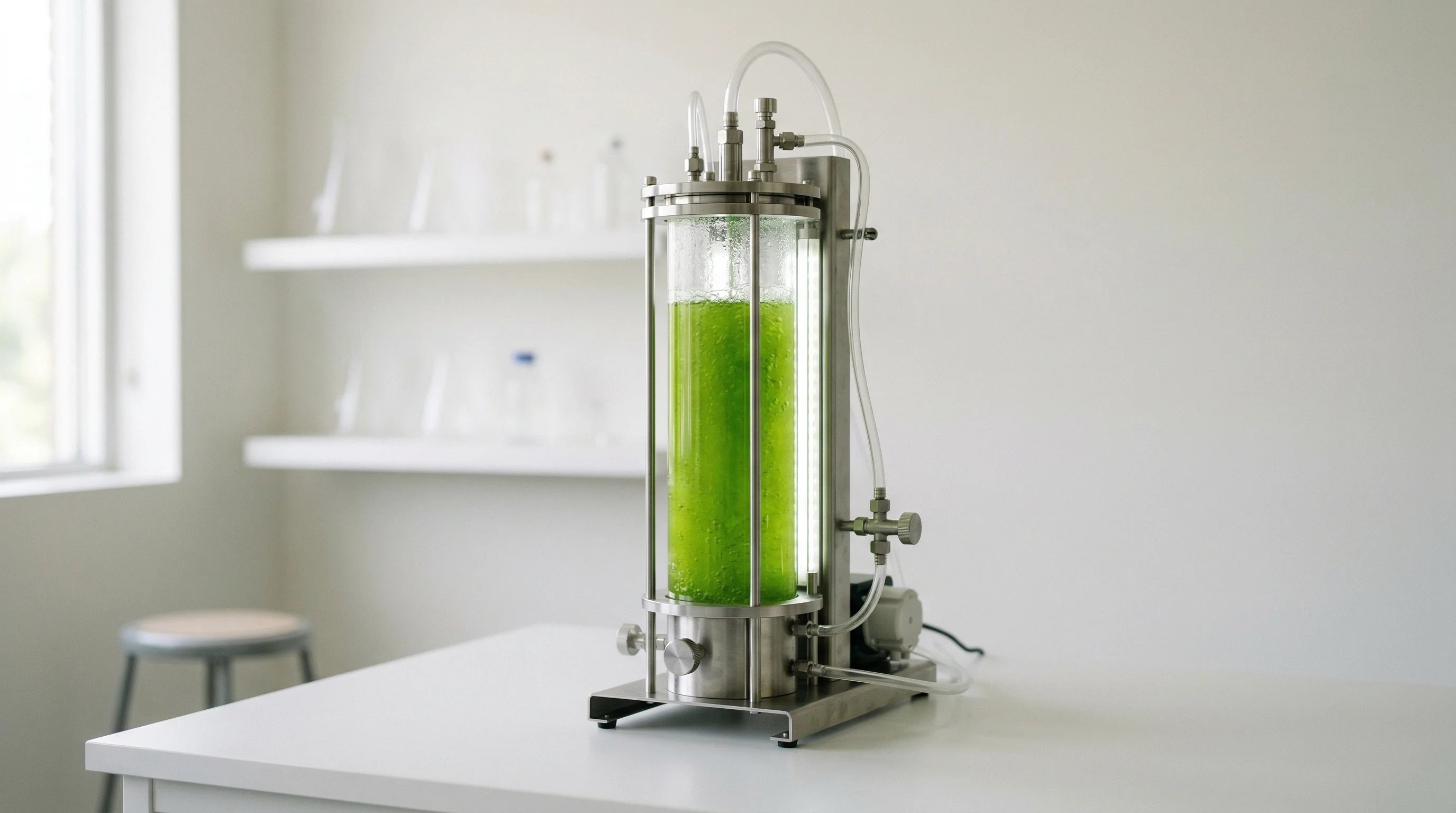
Intrinsic's approach centers on photobioreactors—essentially clear tubes or tanks where microalgae grow under controlled light—fed with flue gas from industrial stacks. The company also deploys yeast and other microbial platforms to convert the captured carbon into biochemicals for food, pharmaceuticals, cosmetics, agriculture, and materials. It's a factory-in-a-box model: modular units that can be dropped onto existing industrial sites without overhauling the host facility. The seed funding will finance industrial pilots, patent filings, team hires, and—interestingly—the setup of a U.S. entity, signaling ambitions beyond India's borders. Jain's stated goal is aggressive: commission multiple pilots and a one-ton-per-day commercial plant within 12 to 24 months.
The 2025 proof-of-concept at a thermal power plant showed the system can handle real-world flue gas over extended periods, but power plants and cement kilns are different beasts. Cement exhaust runs hotter, dirtier, and with more particulates. Steel mill gas carries high carbon monoxide concentrations, which favor fermentation pathways over photobioreactors. Intrinsic claims its platform adapts across phototrophic, heterotrophic, and mixotrophic cultivation modes—industry jargon for different ways of feeding microbes—but proving that versatility at actual steel and cement plants is the real test ahead.
The Biochemical Gamble
Here's where Intrinsic diverges from most carbon conversion startups: instead of chasing bulk fuels like ethanol or methanol, the company is targeting high-margin biochemicals. The reasoning is sound, if not original. Specialty lipids, proteins, biostimulants, and pharmaceutical intermediates command prices that make pilot-scale economics work, even when the technology is still immature. Ethanol sells for pennies per liter; a pharmaceutical precursor might fetch hundreds of dollars per kilogram. That margin cushion buys time to optimize the biology and scale production.

The global biostimulants market alone has been pegged around $4.0 to $4.5 billion in recent years, with projections suggesting growth toward $6 to $8 billion by decade's end. But India's regulatory environment for agricultural inputs tightened sharply in 2025, when authorities canceled some 9,000 provisional product registrations under the Fertiliser Control Order. As of September 2025, only 146 products held full approval under Schedule VI. Any algae-derived biostimulant Intrinsic develops will need robust efficacy, toxicity, and chemistry dossiers—months or years of work, and not cheap. On the other hand, that regulatory thicket also weeds out less rigorous competitors.
Intrinsic's automation-heavy "Carbon Biofoundry" platform, which features real-time process controls and adaptive cultivation, should generate the kind of data regulators demand. Whether it generates the data fast enough to hit Jain's 12-to-24-month timeline is another matter. First-of-a-kind industrial biotech projects have a way of slipping schedules, particularly when dealing with finicky microbes and contaminated industrial gas streams.
A Crowded Field, and Getting Crowder
Intrinsic is hardly alone in this space. LanzaTech, the publicly traded gas fermentation pioneer, has spent years proving that industrial off-gases can be converted to fuels and chemicals at commercial scale. The company's Steelanol facility in Ghent, Belgium, processes steel mill exhaust into 80 million liters of ethanol per year, with barge-scale shipments announced in late 2024 and early 2025. In China, LanzaTech's Shougang demonstration consumes roughly 0.5 tons of CO₂ per ton of ethanol produced. LanzaTech's approach—flexible microbial platforms that can be tuned to produce different molecules—mirrors Intrinsic's multi-organism strategy, though LanzaTech has a decade-plus head start and far deeper pockets.
Then there's the electrochemical route. OCOchem commissioned what it described as the world's first pilot using multiple industrial-scale CO₂ electrolyzer cells in May 2025, targeting formate and hydrogen at 60 tons per year. Twelve, a U.S. company backed by airline offtake agreements and a $6 million Department of Energy grant announced in 2025, converts CO₂ to syngas for sustainable aviation fuel production. Carbon Recycling International has licensed e-methanol technology for plants with cumulative capacity exceeding 200 kilotons per year. Econic Technologies is collaborating with Saudi Aramco Technologies on CO₂-based polyols, with an 80-kiloton-per-year plant under construction in China as of 2025.
What might distinguish Intrinsic is geographic. The company is based in Jharkhand, a heavily industrialized state thick with steel mills and cement plants. Flue gas is free at the source, but transporting it is prohibitively expensive. Co-locating conversion systems on-site collapses logistical friction and taps into existing waste heat and wastewater infrastructure. If Intrinsic can demonstrate stable economics at one plant, replication across India's industrial belt becomes straightforward—in theory. The practice will be messier.
The Technical Reality Check
Academic literature from 2025 confirms both the promise and the constraints. A paper in Sustainable Energy & Fuels examined photobioreactor pilots fed with 3–5% CO₂ flue gas, concluding that biomass conversion to fuels and bioproducts is technically feasible, though mass transfer bottlenecks and operating costs remain stubborn problems. Another study in Frontiers in Chemical Engineering explored microbubble-assisted hybrid photobioreactors with real-time pH feedback, reporting CO₂ fixation rates around 1.83 to 1.88 grams of CO₂ per gram of dry biomass under optimal conditions. Those numbers sound promising until you run the economics: photobioreactor capital expenses are high, energy inputs are nontrivial, and flue-gas contaminants can poison cultures.
Still, progress is real. Closed photobioreactors with advanced controls are improving yields. Co-product strategies—selling multiple outputs from the same biomass—strengthen the business case. LanzaTech, Mibelle Group, and Fraunhofer IGB announced a dual-stage biological route in 2025 that generates palm-oil-like fats from CO₂-derived alcohols, demonstrating that higher-value molecules beyond fuels are achievable at scale.
One market analysis published in January 2026 projected CO₂ utilization chemicals growing from 25.13 million tons in 2025 to 90.11 million tons by 2035, a compound annual growth rate of 13.6%, with Asia-Pacific leading at 46.1% of volume in 2025. Vendor forecasts always merit skepticism, but the directional trend is hard to dispute: as carbon costs rise, industrial emitters are scrambling for utilization pathways that turn a liability into revenue.
Financing the Scale-Up
The $1.4 million seed round is a starting gun, not a finish line. Scaling carbon conversion to meaningful throughput demands blended financing—venture capital, government grants, and strategic corporate partners willing to co-invest. Transition VC, Intrinsic's lead investor, specializes in climate-focused early-stage bets, suggesting confidence in near-term milestones. But getting to hundreds or thousands of tons per day will require far larger checks.
The Global CCS Institute reported a 54% year-over-year rise in operational carbon capture projects as of October 2025, with deployment concentrating in cement, chemicals, and energy. DNV, the risk management consultancy, has projected capture capacity will quadruple by 2030, with cumulative investment around $80 billion over the next five years. That capital is chasing a limited pool of proven technologies and credible teams. Intrinsic's challenge is proving it belongs in that cohort.
The company's decision to establish a U.S. entity is strategic. Section 45Q tax credits offer up to $60 per ton of CO₂ for qualified utilization, though lifecycle analysis requirements introduced in 2024 and tightened under IRS and Department of Energy guidance in 2025 have added documentation burdens. Europe's CBAM and India's new CCUS scheme create demand pull, but U.S. federal funding volatility—the Department of Energy canceled $3.7 billion in clean-energy projects in 2025—adds execution risk for startups counting on public support. Perhaps more than Jain initially expected, navigating subsidy regimes across three continents may consume as much management bandwidth as optimizing the biology.
What Happens Next
If Intrinsic hits its 12-to-24-month commissioning target, it will have something few carbon conversion startups possess: operating data from real industrial sites in a high-growth emerging market. That data becomes the foundation for financing larger deployments. It also becomes a calling card for strategic acquirers or corporate partners scrambling to meet decarbonization commitments.
The broader industrial decarbonization wave is undeniable. India's CCUS funds are beginning to flow. Europe's carbon border tax is already reshaping trade. China continues piloting conversion at state-owned steel mills. Airlines are locking in sustainable aviation fuel offtake agreements, creating demand for CO₂-derived intermediates. The question isn't whether carbon utilization scales—it's which pathways and which companies get there first, and at what cost.
Intrinsic Foundries is placing a bet that biochemicals, modular biology, and proximity to India's industrial heartland form a winning combination. The biology is real. The policy tailwinds are real. Whether the economics pencil out at commercial scale is the part nobody knows yet. The next year will deliver answers, one pilot plant at a time.