

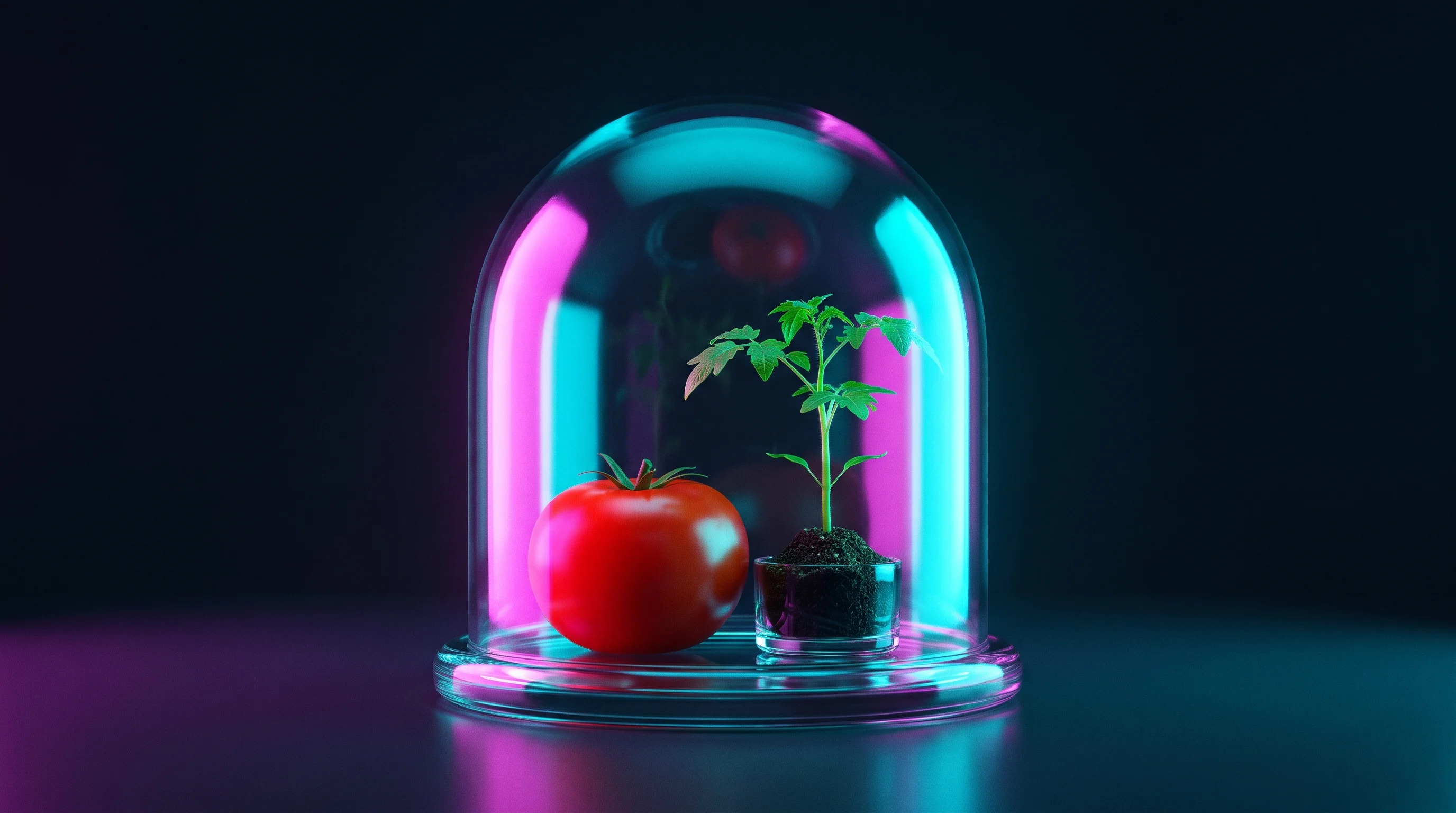
Lux Foods, a Y Combinator startup, is growing early tomato batches on sugar with far less light than conventional indoor growing, and says the approach uses 90% less light. The company has not verified that figure.
The distinction matters because indoor farming's economics have failed more often than they have worked, by some assessments. Lux's own science page concedes as much, saying the target is a competitive delivered-fruit cost, "not simply lower lighting consumption."
What Lux says it does
According to its Y Combinator profile, which lists the company as active in the YC directory, Lux is developing a platform for sugar-fed produce. Its platform page describes a pilot that combines plant development, tissue culture and robotic manipulation.
The company said it is growing early tomato batches while it builds out workflows and a biological inventory. It did not disclose robot throughput, intervention rate, contamination rate or operating uptime.
The commercial side is thinner still. Lux publishes no confirmed customers, contracted volumes, delivery dates, product prices or verified nutritional outcomes.
The science behind the claim
The scientific foundation is the founding team's 2022 Nature Food research on artificial photosynthesis. Lux's science page says that work does not measure the performance of its current facility, and the Nature Food article does not establish profitable, full-cycle commercial tomato production in complete darkness.
Nor is the sugar-fed process a clean electricity-to-food chain. Lux's science page names the agricultural inputs behind its sugar supply as part of the system's costs.
A second figure that circulates often, 94% less land, is a scenario estimate published in Joule. It is not a measured Lux result.
Lux's team page says the founder's university laboratory runs research programs in artificial photosynthesis, acetate metabolism and compact crops for controlled environments. It also lists recognition as a Regeneron Science Talent Search semifinalist and an iGEM silver medalist. None of that establishes that the institutions or advisors it names are equity investors.
Funding, and what remains unverified
CB Insights reports $500,000 raised in total across one round, though an earlier Dealroom record differs. No verified public valuation turned up in the research.
Two other pieces of funding history should not be mistaken for Lux's capital. A Gates Foundation grant tied to the university research is more than 12 months old and supported the university's work, not Lux. A NASA award was likewise historical and is not equity financing.
Indoor farming's mixed record
The sector has had a rough run. AgFunderNews reported on August 3, 2026 that 80 Acres Farms would cease operations, which stands in contrast to early-2026 analyses that treated its 2025 combination with Soli Organic as a consolidation success.
Plenty restructured to focus on premium strawberries. Reporting on August 31, 2026 said it had appointed the creative agency Bakery for a premium and ultra-premium strawberry launch. That points to continuing commercial plans, though not to profitability.
Contain, a sector financier, forecast in January 2026 that venture capital would be scarce, credit financing more creative and mergers and acquisitions ongoing through the year. It was an early-year forecast, not a final outcome.
Oishii sits at the other end of the spectrum. AgFunderNews interviewed the company on May 15, 2026, under a headline saying it had crossed the chasm of unit economics in vertical farming after fresh funding. Oishii's website lists Omakase, Koyo and Nikko strawberries and the Rubī tomato. It competes in premium indoor fruit.
In an October 5, 2026 commentary in npj Sustainable Agriculture, Francesco Orsini anticipated selective, context-dependent roles for vertical farming rather than universal replacement of greenhouse horticulture.
Adjacent players and regulation
Pairwise announced its Fontana blackberry on October 14, 2026, but it is not a disclosed sugar-fed vessel-culture system. Mibelle Group Biochemistry has submitted an EU novel-food application for an ingredient derived from apple cells of the Uttwiler Spätlauber variety. That is processed cell material rather than a whole apple, which makes it a regulatory comparator and not a direct competitor.
The research found no Lux-specific FDA completion record. As an adjacent precedent, the FDA's public meeting inventory lists J.R. Simplot strawberry material with altered flowering, dated December 4, 2024. That shows engagement over an edited fruit trait, not clearance of Lux's process.
An EU regulation was adopted in 2026, but as of November 10, 2026, adoption does not mean the full new market-access framework already applies. Lux's eligibility would depend on its specific genetic modifications and product characteristics.
What researchers say is unresolved
A review in Trends in Biotechnology identifies light-independent development, industrial scaling, sugar sourcing, product quality and equitable access as open questions for cultured fruit.
A separate paper discusses micropropagation, the lab technique of growing plants from small tissue samples, as a reference point for industrial scaling, and warns about concentrated control of food-production technology. It discloses that Jinkerson is a co-founder and chief scientific advisor of Chi Botanic and an inventor on a minimized-biomass plant patent. That makes it thought leadership, not independent validation of Lux.
Looking ahead
Lux describes its near-term work as pilot development, early commercial relationships for tomatoes, robotic tissue handling and repeatable batch production. It has not announced a dated national rollout. Until it publishes throughput, contamination and cost data, the 90% figure remains a claim.


