

The partnerships read like a who's-who of the construction supply chain. ABB Robotics, the industrial automation titan. Shimizu Corporation, one of Japan's oldest and largest general contractors. Sika, the Swiss materials specialist. And PERI, the formwork company that's been building scaffolding systems since 1969.
All four now appear as strategic partners on the website of MESH Robotics, a three-year-old spin-off from ETH Zurich that's trying to convince the construction world it can automate one of the industry's most stubborn problems: bending and tying reinforcement steel.
The Birr, Switzerland-based company has said little publicly about what these partnerships entail—no press releases, no announcements detailing investment terms or collaboration scope. But the roster itself tells a story. MESH is assembling the pieces needed to move construction robotics from clever university research into the messier reality of job sites, where reliability matters more than elegance and where contractors care less about technology for its own sake than whether it solves their labor crisis.
And construction does have a labor crisis. Perhaps more urgently than the founders initially expected.
Money Rushes Toward Robots on Building Sites
Construction robotics, a category investors mostly ignored a decade ago, has become something close to fashionable. According to Zacua Ventures' Construction Robotics Report, the sector attracted roughly $1.36 billion in the first three quarters of 2025—more than double the total for all of 2024. Installation and MEP (mechanical, electrical, plumbing) robots, the category MESH occupies, are pulling in especially large checks as companies demonstrate they can actually deploy these systems beyond controlled pilot projects.
MESH confirmed its first institutional backing in mid-2022, when Sika and PERI took equity stakes at terms the company declined to disclose. Sika later explained the logic in its 2022 annual magazine: MESH's 3D steel-mesh structures eliminate the need for conventional formwork, which means less construction waste and—crucially for a chemicals company—a better substrate for Sika's specialty concrete mixes. It's efficiency wrapped in a sustainability pitch.
ABB Robotics and Shimizu now sit alongside those earlier backers. ABB runs an active corporate venture arm that has invested in robotics startups including Molg, which secured seed funding last year. Shimizu, meanwhile, has pursued robotics under its Smart Site initiative since 2017, part of a broader Japanese construction industry push to offset demographic decline and chronic labor shortages.
Neither ABB nor Shimizu has publicly detailed what their MESH relationship involves or whether it includes equity. MESH hasn't said either. What's clear is the lineup itself: a robot supplier, two materials and systems providers, and a major contractor. The full stack, in other words.
A Decade of Research Meets a Century-Old Factory
MESH was founded in 2022 by Ammar Mirjan, an architect-turned-automation-specialist, and Mattis Koh. The company commercializes research Mirjan helped develop over roughly ten years at ETH Zurich's Digital Building Technologies group. Mirjan earned his PhD from ETH in 2016, but his automation background traces back earlier—to an apprenticeship at ABB, coincidentally or not.
The company now employs about ten people and operates from a repurposed Brown, Boveri & Cie. industrial hall in Aargau. (Brown Boveri, for those who've forgotten their Swiss industrial history, merged with Sweden's ASEA in 1988 to form ABB. The symbolism is almost too neat.)
MESH's software manages the entire rebar workflow: design, production planning, robotic bending, cage assembly, automated tying. As of mid-2025, the company was renting systems to Swiss reinforcement manufacturers and had landed a contract on the second Gotthard road tunnel—a high-profile infrastructure project where MESH robots are knotting steel for approximately 10,000 prefabricated concrete elements.
The company has also supplied robotic reinforcement for Tor Alva, billed as the tallest 3D-printed concrete structure built to date, and showed off its work at the 2025 Venice Architecture Biennale installation titled "A Robot's Dream." Which is either cheeky marketing or a very literal description of what MESH is trying to build.
Two Crises, One Automation Pitch
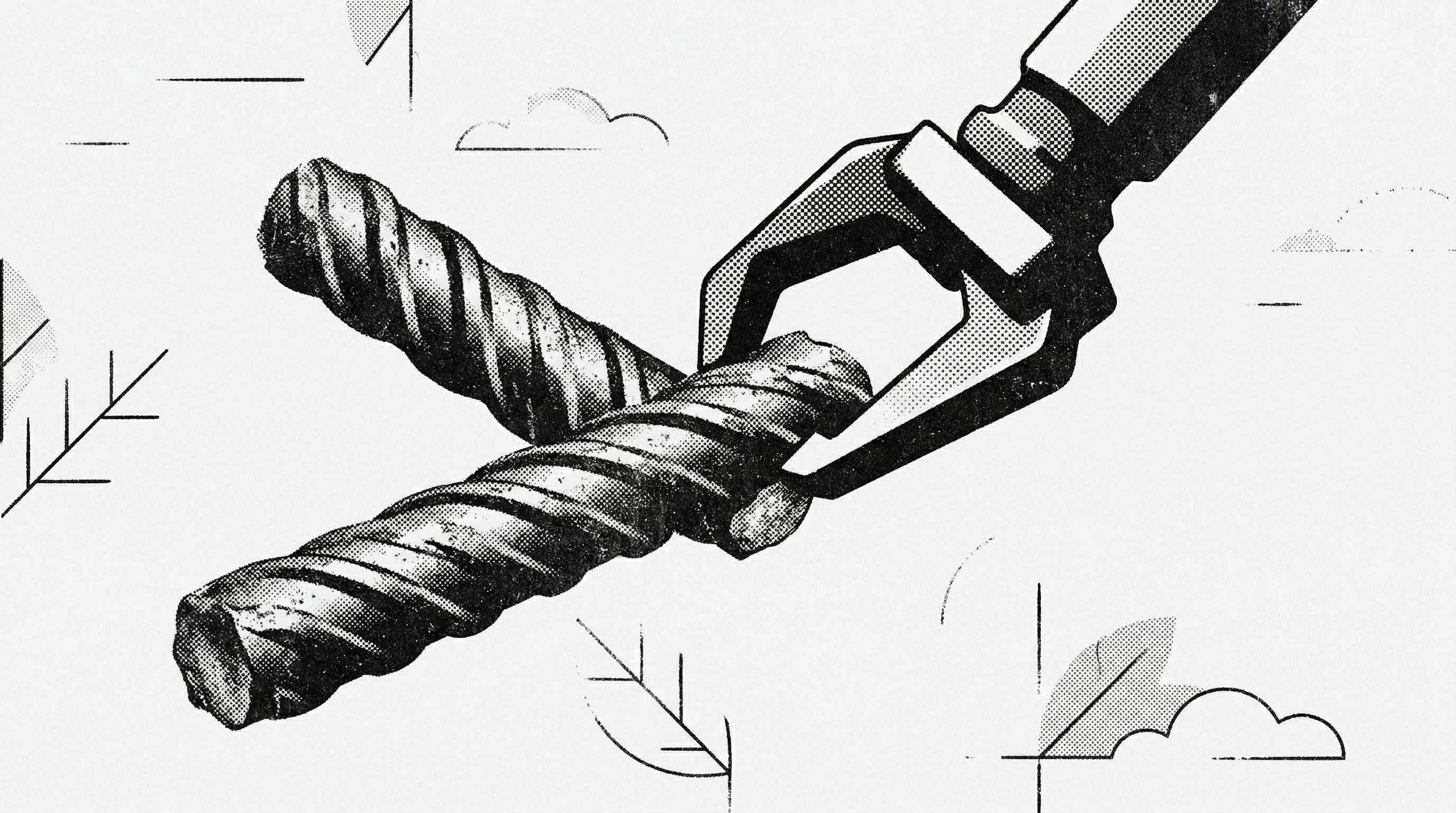
Construction is hunting for technologies that address two problems simultaneously: a shortage of skilled labor that's gotten worse, not better, over the past decade, and mounting pressure to decarbonize an industry responsible for nearly 40% of global carbon emissions. Rebar work sits awkwardly at the intersection. It's physically demanding, requires skill, and is critical to structural integrity—the kind of task you can't easily offshore or skip.
MESH's approach—using 3D mesh as formwork rather than just reinforcement—cuts material waste and accelerates prefabrication for complex, repetitive components. Sika emphasized the climate benefits when it announced its investment, noting the technology reduces formwork costs and waste while enabling new applications for low-carbon concrete mixes.
Competitors are seeing similar investor interest. Toggle, a U.S.-based rebar automation startup, added $3 million to its balance sheet in early 2023. Raise Robotics, working on facade and bracket installation, closed a $7.75 million seed round last summer. Zacua's report notes that corporate investors are increasingly co-leading early-stage deals in this space as proof points accumulate—fewer university demos, more actual deployments.
Proving Grounds and Production Scale
MESH's updated partner roster and its Gotthard tunnel contract suggest the company is attempting to cross the chasm from pilot projects to production scale. The Gotthard tunnel, Switzerland's showcase infrastructure project in a country synonymous with precision engineering, offers both opportunity and risk. Get it right, and MESH has a reference that opens doors across Europe and Asia. Stumble, and the company becomes another cautionary tale about robotics that work in labs but falter on-site.
For ABB and Shimizu, the partnership (whatever its formal structure) offers early visibility into automation that could eventually reshape concrete construction. For MESH, it's validation—tentative, perhaps, but meaningful—that corporate giants view rebar robotics not as a curiosity but as infrastructure for the next generation of building.
Whether that bet pays off will depend less on the elegance of the technology than on whether MESH can deliver the unglamorous reliability that construction demands. Robots that work most of the time aren't good enough. On a job site, they need to work every time.


