

There's an evolutionary irony at play in the offices of Ditto Biosciences, tucked somewhere in the San Francisco Bay Area. While the pharmaceutical industry scrambles to defend twenty-first-century biologics from biosimilar erosion, this Y Combinator-backed startup is rifling through the molecular arsenals of organisms humanity has spent centuries trying to eradicate: ticks, hookworms, and the parasites that cause river blindness.
The pitch sounds almost perverse. Take proteins perfected by parasites over millions of years to hijack human immunity, reverse-engineer them into drugs, and deploy them against the autoimmune conditions—rheumatoid arthritis, Crohn's disease, lupus—that afflict some 50 million Americans. It's a gambit that asks investors to believe in evolutionary biology where clinical trials have faltered, and to see elegance in creatures most people regard with revulsion.
Yet timing matters in biotech as much as science does. And right now, as AbbVie's Humira empire crumbles under biosimilar assault and the industry confronts a brutal repricing cycle, Ditto's contrarian thesis is finding an audience.
When a $21 Billion Drug Becomes a Commodity
The numbers tell the story of an industry in flux. When Humira lost U.S. exclusivity in January 2023, it wasn't just AbbVie's problem—it was a bellwether for the entire $190 billion autoimmune therapeutics market. IQVIA now projects U.S. biosimilar spending will hit $129 billion by 2027. Net prices on legacy biologics are dropping 18% to 50% as pharmacy benefit managers discover newfound negotiating leverage.
Stelara, Johnson & Johnson's IL-12/23 inhibitor, faces its own biosimilar reckoning starting mid-May 2025. Multiple copycat versions will hit the market under settlement agreements, compressing margins in psoriasis and inflammatory bowel disease indications worth billions. Even success stories show the strain: Novartis' Cosentyx managed $6.7 billion in 2025 sales, growing 8% in constant currency, while AbbVie keeps revising upward its projections for Skyrizi and Rinvoq—now expected to exceed $31 billion combined by 2027—as it frantically pivots away from its declining Humira franchise.
This is the backdrop against which Ditto Biosciences emerged from Y Combinator's Winter 2026 batch. The company claims to have already analyzed over one million proteins across primate-infecting parasites, identifying thousands predicted to bind validated human immune targets at nanomolar affinities. Whether that computational work translates into actual drugs remains an open—and expensive—question.
An Old Epidemiological Puzzle, Now Computationally Tractable
The scientific foundation isn't new, exactly. For decades, researchers have puzzled over what's called the "old friends" hypothesis: populations with chronic parasite exposure show dramatically lower rates of allergies and autoimmune conditions. Strip away those ancient co-evolved relationships—through modern sanitation, antibiotics, and deworming campaigns—and immune systems seem to lose their calibration, attacking pollen, gluten, and eventually the body's own tissues.
What's changed is the ability to do something about it.
Tick salivary proteins called evasins bind and neutralize multiple chemokines simultaneously—the signaling molecules that orchestrate inflammatory cell recruitment. A 2026 review in ACS Accounts of Chemical Research argues that recent structural advances now enable rational engineering of these evasins into multi-target chemokine inhibitors with selectivity profiles impossible to achieve through conventional antibody approaches. (Whether "impossible" proves true in practice is another matter; antibody engineers tend to be resourceful.)
Helminth-derived molecules show equally sophisticated mechanisms, if you can get past the ick factor. ES-62, a glycoprotein secreted by the filarial nematode Acanthocheilonema viteae, suppresses inflammatory networks while promoting regulatory T cells. Preclinical studies dating back to 2012 demonstrated protective effects in rheumatoid arthritis and lupus models. The phosphorylcholine modifications decorating ES-62 appear critical to its activity—illustrating the biochemical complexity these organisms evolved to avoid immune clearance during chronic infections lasting years.
It's the kind of molecular subtlety that makes drug developers simultaneously excited and nervous.
Why Live Worms Don't Work (But Their Proteins Might)
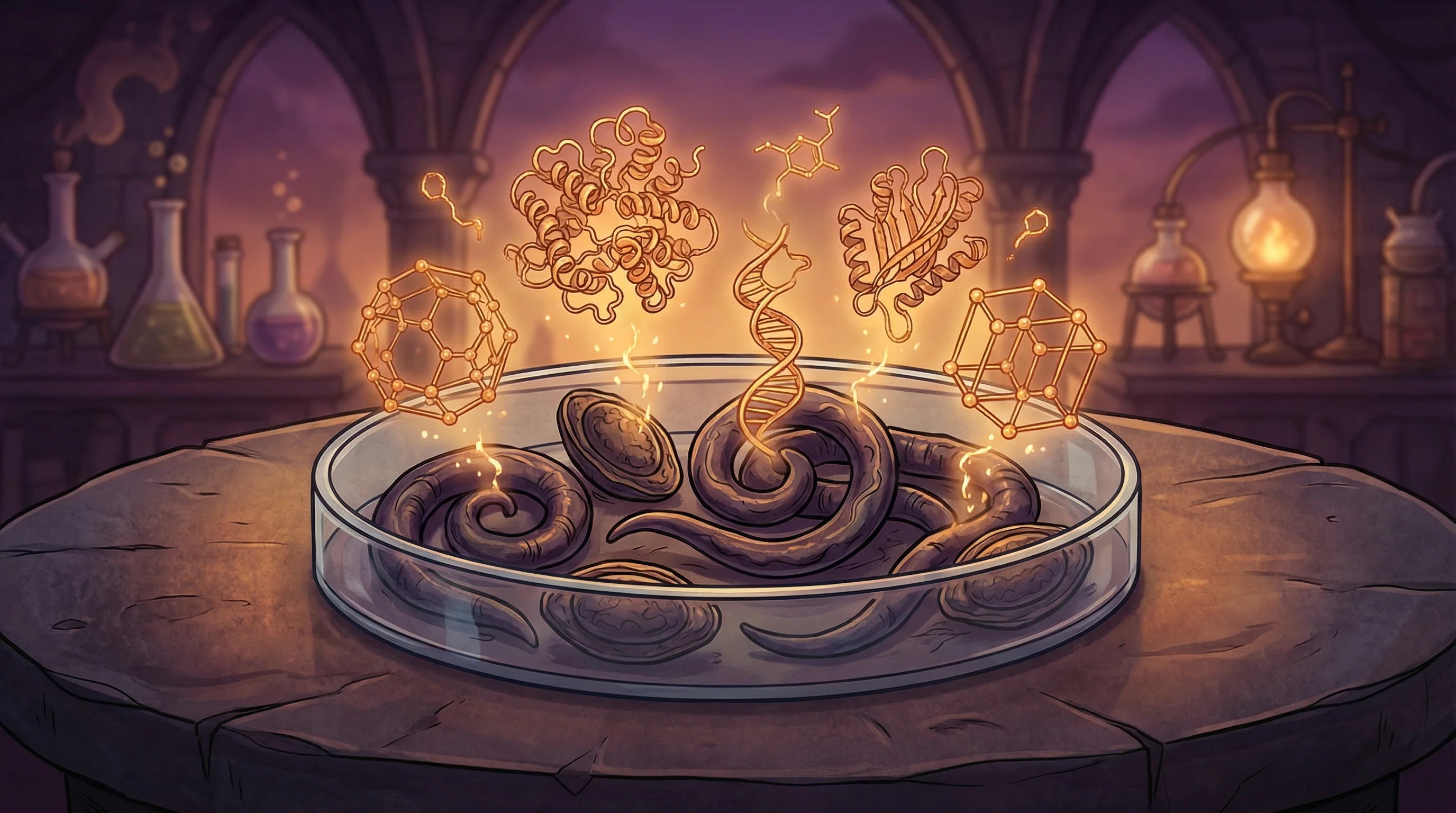
If parasite proteins are so immunosuppressive, the obvious question arises: why not just administer the parasites themselves?
That experiment has been tried. It largely failed.
Multiple trials testing live hookworms and Trichuris suis ova—pig whipworm eggs, for those keeping score at home—in Crohn's disease, ulcerative colitis, and multiple sclerosis showed acceptable safety but inconsistent efficacy. The 2024 PROCTO trial testing T. suis in ulcerative colitis missed its primary endpoint: 30% remission in the treatment arm versus 34% in placebo at 24 weeks. There was transient symptomatic improvement, the kind of signal that keeps hope alive in research labs but doesn't impress FDA review committees.
The failure arguably validates Ditto's approach, though the company would probably phrase it more diplomatically. Whole organisms introduce uncontrolled variability in protein expression, immune response heterogeneity, and manufacturing complexity. Defined, engineered proteins offer reproducibility, dose control, and the ability to optimize for specific immune pathways—precisely the attributes regulators and payers demand.
The challenge, of course, is extracting the signal from the noise. Evolution is a brilliant chemist but a terrible quality control manager.
AlphaFold and the Compression of Discovery Time
Ditto's timing benefits from convergent advances in computational structural biology that would have seemed like science fiction a decade ago. AlphaFold 3, released by DeepMind in May 2024, predicts protein-protein, protein-nucleic acid, and protein-ligand complexes with unprecedented accuracy. The freely available server enables rapid screening of candidate parasite proteins against human immune targets—work that would have required years of crystallography a generation ago.
Newer models like FlowDock add protein-ligand docking and affinity prediction. Meta's ESM Atlas catalogs "dark proteome" regions in understudied organisms. A 2025 preprint applied deep learning pipelines to annotate previously uncharacterized protein families in Wuchereria bancrofti, the filarial worm behind lymphatic filariasis, expanding the druggable space in parasitic genomes.
For companies like Ditto, these tools compress discovery timelines and lower the capital required to build meaningful preclinical datasets. Whether they compress them enough—whether software can truly shortcut the messy biology of drug development—is what the next few years will reveal.
A Crowded Field of Tolerance Seekers

Ditto is hardly alone in pursuing immune tolerance over blunt suppression. The autoimmune space is witnessing a broader strategic pivot toward therapies that aim to restore homeostasis rather than chronically blocking inflammatory pathways.
The most dramatic intervention? CAR-T cells, borrowed from cancer therapy and repurposed against the immune system itself.
A 2024 New England Journal of Medicine case series reported drug-free remissions in 15 patients with lupus, inflammatory myopathies, and systemic sclerosis after a single infusion of CD19 CAR-T therapy. Bristol Myers Squibb's Phase 1 Breakfree-1 trial, presented at ACR Convergence 2025, showed 94% of 71 patients across three autoimmune diseases off chronic immunosuppression at data cutoff. Kyverna Therapeutics is targeting a 2026 BLA submission for its CD19 CAR-T candidate in stiff-person syndrome.
One infusion. No chronic medication. The kind of outcome that makes incumbent biologics look like incremental tinkering.
Engineered regulatory T cell therapies represent another tolerance modality, with Quell Therapeutics securing an $85 million upfront deal with AstraZeneca in 2023 for CAR-Tregs targeting type 1 diabetes and inflammatory bowel disease. The partnership exercised an option in 2024; first-in-human trials for QEL-005 are slated for the first half of 2026. Sonoma Biotherapeutics inked a 50/50 partnership with Regeneron for IBD-focused Treg programs.
Antigen-specific approaches offer precision without genetic engineering. Anokion's KAN-101, which targets autoantigen-loaded nanoparticles to liver endothelial cells, has shown Phase 2 signals in celiac disease and earned FDA Fast Track designation. COUR Pharmaceuticals' tolerogenic immune-modifying particles have attracted partnerships with Takeda and Genentech, with mechanistic data published in Science Advances in 2026.
The common thread? All are betting that fixing the immune system beats suppressing it indefinitely.
Safety Shadows and Shifting Prescribing Patterns
Market dynamics are accelerating the pivot toward tolerance-focused therapies. The FDA's 2021 class-wide boxed warnings for JAK inhibitors—covering cardiovascular events, malignancy, and thrombosis—pushed physicians and payers toward biologics or, increasingly, toward therapies promising disease modification rather than indefinite suppression.
A 2024 Nature Reviews Drug Discovery article framed a "sequential immunotherapy" paradigm: control inflammation acutely, eliminate pathogenic immune memory via CAR-T or B-cell reset, then maintain tolerance with regulatory agents. Parasite-inspired proteins could plausibly serve that maintenance function, assuming they prove durably immunomodulatory without chronic immunosuppression.
That's a lot of assumptions.
The Derisking Gauntlet

The journey from parasite genome to marketed therapeutic carries substantial hurdles, and this is where evolutionary elegance meets pharmaceutical reality.
Novel protein scaffolds—especially glycoproteins with post-translational modifications essential to activity—face immunogenicity risks. FDA's 2014 guidance on immunogenicity assessment for therapeutic proteins mandates risk-based strategies for anti-drug antibody development. Regulators will scrutinize any foreign-origin protein for neutralizing antibody formation, and with good reason. The human immune system didn't spend millions of years learning to recognize parasites only to ignore their proteins when administered therapeutically.
Manufacturing adds complexity. Evasins and helminth excretory-secretory proteins often contain disulfide-rich folds and glycosylation patterns difficult to reproduce in standard CHO cell lines. The phosphorylcholine modifications on ES-62 are critical to function but represent non-standard glycoengineering challenges. Companies will need to demonstrate stable, scalable production while preserving bioactivity—a non-trivial proposition for proteins that evolved in tick salivary glands or nematode secretory systems.
There's also the matter of patient psychology. Convincing someone to take a drug derived from intestinal worms requires a certain... reframing. (One imagines the marketing teams are already workshopping euphemisms.)
The Next 18 Months Matter
If Kyverna's timeline holds, 2026 could bring the first BLA submission for a CAR-T therapy in autoimmune disease, fundamentally resetting expectations around "cure" in severe subsets. Payers facing one-time costs exceeding $400,000 will demand evidence that such interventions durably eliminate disease and reduce lifetime healthcare utilization. This sets a high bar but also creates space for complementary tolerance agents that can maintain remission post-reset.
Between now and 2030, expect multiple tolerance-focused modalities to enter early clinical trials across rheumatoid arthritis, multiple sclerosis, type 1 diabetes, and inflammatory bowel disease. Engineered Tregs, antigen-specific nanoparticles, and parasite-derived immunomodulators will compete on differentiation vectors: manufacturing scalability, safety, durability of response, and ultimately health-economic value.
For Ditto Biosciences and its cohort, the clinical translation test is straightforward: can defined parasite proteins retain the immunoregulatory elegance evolved over millennia while meeting pharmaceutical-grade reproducibility and safety standards?
The answer will determine whether this wave of tolerance-focused startups represents a genuine paradigm shift or another scientifically compelling hypothesis that stumbles in the messy reality of human disease. The pharmaceutical graveyard is littered with elegant mechanisms that didn't translate.
Medicine Versus Evolution
The $190 billion autoimmune market has room for disruption, particularly as biosimilar commoditization squeezes established biologics. But the path from evolutionary biology to approvable therapy remains unproven, and perhaps more treacherous than optimistic founders anticipate.
AlphaFold can accelerate discovery. It cannot shortcut clinical validation. For investors and executives watching this space, the next 18 to 24 months of preclinical data disclosure will matter: binding affinities in primary human cells, in vivo efficacy in humanized models, lead optimization against immunogenicity. That's where genuine contenders separate from well-told stories, where the slide deck meets reality.
Parasites may have spent millions of years solving immune evasion. Translating that solution into medicine is a distinctly human challenge—one that requires not just computational biology and venture capital, but the patient, expensive work of proving that what evolution designed for worms can be redesigned for people.
The worm has turned, perhaps. Whether it turns into a drug remains to be seen.


