

The announcement came more than a year late—though the reasons for the timing remain unclear.
In June 2026, the San Francisco webcam maker disclosed that OpenAI had led a $40 million Series B—a round that actually closed back in the first quarter of 2025. By the time the news went public, Opal was no longer just a webcam company. It had rebranded to Opal Electronics and was already deep into developing AI-powered audio devices, according to Wired, which first reported the funding on June 2.
The gap between closing and disclosure is unusual, though not unheard of in hardware circles where product timelines dictate everything. More revealing, perhaps, is what happened to the deal size. Back in August 2024, The Information had reported OpenAI was expected to lead a $60 million round into what was then still called Opal Camera. The actual close several months later came in at $40 million—a third less than anticipated.
No one involved has explained the discount publicly.
Samsung, Thiel, and a YouTuber Walk Into a Cap Table
The investor list reads like a cross-section of who's bullish on AI hardware right now—or at least willing to hedge. Samsung joined the round, as did Peter Thiel and Seven Seven Six, the venture firm started by Reddit co-founder Alexis Ohanian. Tech YouTuber Marques Brownlee also participated, according to a source familiar with the deal cited by Wired.
For OpenAI, the investment signals something beyond capital deployment. Opal is in active discussions with OpenAI, Anthropic, and xAI about powering its forthcoming AI audio device, Wired reported. The company plans to launch with one AI lab as its default partner but wants to give users the ability to switch between models—a relatively novel stance in a hardware category where tightly controlled ecosystems are the norm.
How the AI labs will respond to that flexibility remains an open question.
The Webcam Business Was Fine. Until It Wasn't.
Opal made its name, such as it was, in webcams. The company launched its C1 in December 2021, pitching it as the professional-grade option for people who cared about how they looked on Zoom calls and had $300 to spend on the problem. The ultraportable Tadpole followed in November 2023—smaller, cheaper, designed for the laptop bag. Both devices won design awards from AIGA and Red Dot, the kind of recognition that looks great in pitch decks and does less to move volume in a market where Logitech controls refresh cycles and enterprise buyers default to whatever's already in the approved vendor catalog.
The webcam opportunity, in other words, had a ceiling. And Opal appears to have found it.
By mid-2026, job listings on the company's site told a different story. The openings emphasized wireless protocols—Bluetooth, Wi-Fi, GSM—alongside audio engineering and low-power embedded systems. The rebrand to Opal Electronics wasn't just cosmetic. It was a signal that the roadmap had widened considerably beyond cameras clipped to monitor tops.
Hardware Graveyards and Competency Bets
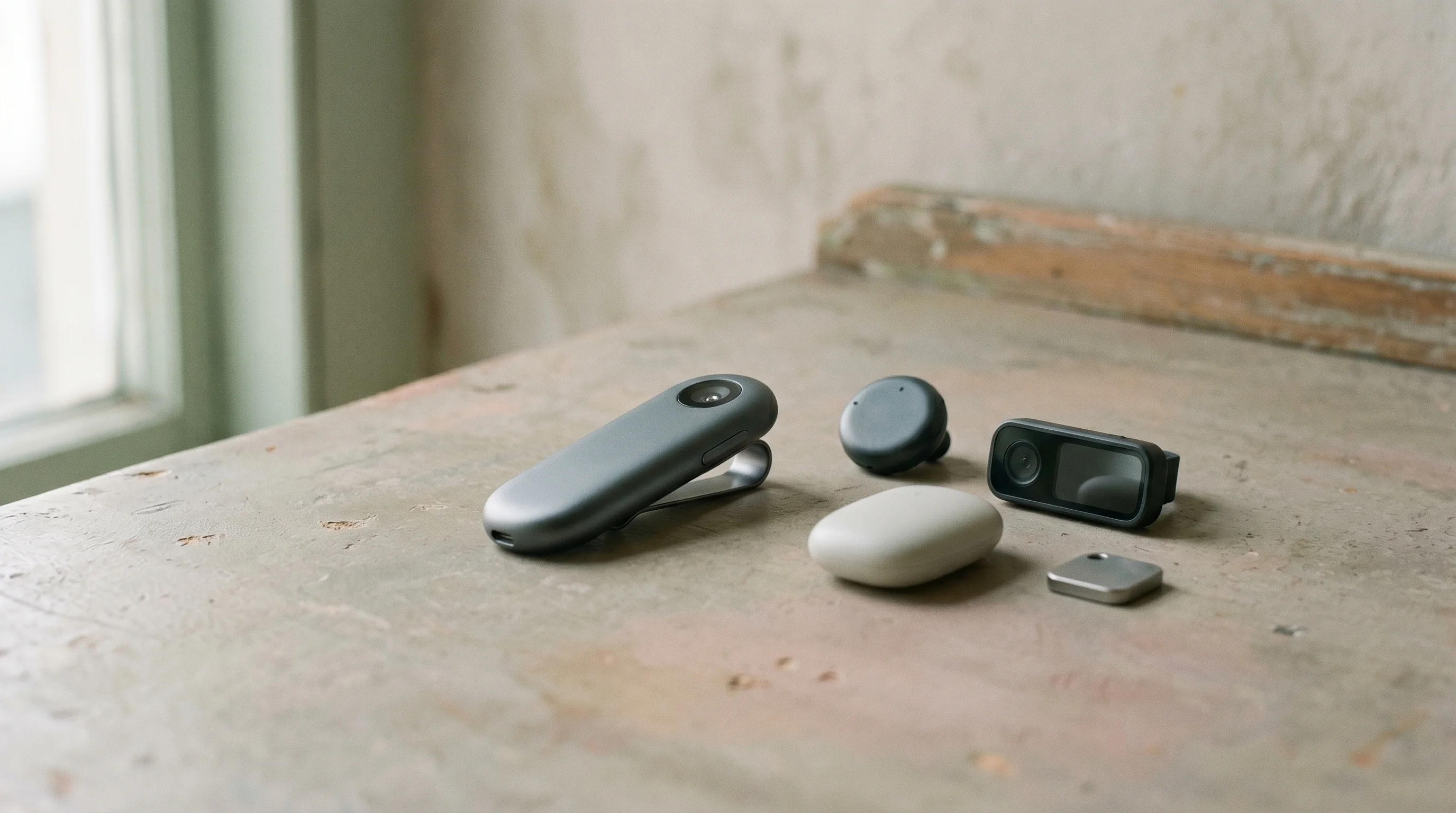
The timing of Opal's pivot matters, and not just because OpenAI put money behind it. The AI hardware graveyard is already crowded. Humane's AI Pin launched in 2024 to reviews that were, charitably, brutal; the company sold to HP in February 2025 after failing to find a sustainable path forward. Rabbit's R1 device faced similarly harsh criticism and spent much of late 2025 fighting operational fires.
So why would a webcam startup think it can succeed where better-funded efforts stumbled? Opal's bet seems to hinge on starting from a position of hardware credibility rather than AI-first ambition. The team includes David Kalinowski, an early engineer on Apple's Vision Pro, who joined in 2023 to lead hardware development. Industrial designer Akifusa Nakazawa, formerly with Sharp Japan's design group, is also on board.
The idea, presumably, is that knowing how to ship physical products—supply chains, manufacturing tolerances, thermal management, the unglamorous stuff—gives Opal a different entry angle than companies that started with a chatbot and worked backward to a form factor.
Whether that theory holds is another question entirely.
OpenAI's Physical Layer Play
OpenAI's decision to lead the round fits a broader pattern. The company has been taking strategic stakes in firms operating at adjacent layers of its technology stack—infrastructure plays, application builders, now hardware makers trying to translate AI models into physical interaction.
And OpenAI isn't just investing in the space. TechCrunch reported in January 2026 that the company is working on its own hardware, with plans to ship a device—rumored to be earbuds—later in the year. That makes the Opal investment particularly interesting. Is this about learning? Hedging? Creating a portfolio of bets on different form factors to see what sticks?
Probably all three.
For Opal, the capital arrives at a moment when the webcam business is commoditizing fast. Logitech launched its MX Brio in March 2024, and by 2026, buyer guides still skew overwhelmingly toward established players with mature distribution and enterprise support infrastructure. The company had raised a $17 million Series A in October 2023, led by Founders Fund partner Trae Stephens, with participation from Kindred Ventures and individual backers including Brownlee, filmmaker Casey Neistat, and Liam Casey of PCH International.
That round was framed around expanding the webcam line. Less than 18 months later, Opal was repositioning entirely. In hardware terms, that's a sharp turn.
The Unknowns

What the actual device looks like—and which AI lab will ship as the default partner—remains undisclosed. Opal operates with somewhere between 11 and 50 employees, according to LinkedIn data from late May 2026, and still runs out of San Francisco. Public updates from the company have been sparse in recent months.
Not much to go on, in other words.
The open question is whether Opal can bridge the gap between hardware competency and AI-first interaction design—a space where the requirements are still being written in real time. The webcam pivot bought the company credibility and cash to build. The OpenAI partnership gives it access to models and a lane in an increasingly crowded race.
What comes next will determine whether that's enough, or just another well-designed dead end in the AI hardware pile.


