

There's a certain audacity to what David Hochman and Darren R. Sherman proposed back in 2017. Most medtech startups dream of becoming the next Medtronic or Boston Scientific. Hochman and Sherman had a different idea: Why compete when you could collaborate—on your own terms?
Their company, Orchestra BioMed, would innovate without the corporate bloat. The giants would handle what they excel at: navigating byzantine regulatory pathways and deploying global sales armies. Orchestra would collect revenue shares and royalties. Everyone wins.
Except, as Orchestra's seven-year journey demonstrates, even elegant strategies encounter messy realities.
The 70-person company based in New Hope, Pennsylvania has secured over $111 million in recent financing and partnerships with Medtronic and Terumo. It went public via SPAC in January 2023—timing that now feels either brave or unfortunate, depending on your view of the biotech market. Today, Orchestra is advancing two cardiovascular therapies targeting massive patient populations while simultaneously proving whether its partnership-enabled model can survive contact with real-world economics.
The verdict isn't in yet. Two pivotal trials will determine that. But the architecture Orchestra has constructed—part innovation lab, part deal-making apparatus—offers a case study in what happens when founders try to thread an impossibly narrow needle.
Building the Portfolio
Orchestra didn't emerge fully formed. Its origin story involves what securities filings euphemistically call "Formation Mergers"—the May 2018 combination of three separate medical device companies into one portfolio entity. Caliber Therapeutics had been developing its Virtue balloon since 2008. BackBeat Medical had been working on cardiac neuromodulation therapy since 2010. FreeHold Surgical rounded out the trio.
The logic was straightforward: bundle complementary technologies under shared infrastructure, pool investor relationships, and create enough critical mass to attract strategic partners. Think of it as the medtech equivalent of a studio system.
Hochman brought the M&A chops—he'd previously co-founded PROLOR Biotech and Corbus Pharmaceuticals. Sherman supplied the technical credibility: 85-plus U.S. patents from stints at Cordis Neurovascular, Baxter, and other device makers. Both had served as Managing Partners at Orchestra Medical Ventures, the venture firm that incubated the concept.
The pitch they made to partners was deceptively simple. Orchestra would shepherd high-impact cardiovascular devices through early development and clinical validation. Industry leaders would then step in to handle global regulatory mazes and commercialize at scale. Orchestra would collect revenue shares, royalties, and—crucially for recurring income—supply proprietary drug formulations.
On paper, it's capital-efficient. In practice, as we'll see, it's complicated.
The Medtronic Wager
BackBeat's AVIM therapy became Orchestra's first major test case, and perhaps its most intriguing asset. It's an elegant idea, the kind engineers appreciate: Instead of inventing new hardware, why not reprogram existing devices?
AVIM—which stands for Atrial-based Ventricular Intrinsic Modulation—works by tweaking the timing sequences in dual-chamber pacemakers to reduce blood pressure. It's software, essentially, running on someone else's hardware. Early European trials showed encouraging results: a 14.2 mmHg reduction in 24-hour ambulatory systolic blood pressure at three months in the MODERATO I study, followed by an 8.1 mmHg net treatment effect in the double-blind MODERATO II trial.
Those numbers got Medtronic's attention. In July 2022, Orchestra closed a $110 million Series D financing round with $40 million from Medtronic, along with an exclusive collaboration for the hypertensive pacemaker population. Medtronic would provide development support, clinical expertise, and regulatory muscle. If AVIM gets approved, Medtronic commercializes it. Orchestra shares in the revenue.
What Orchestra gained was something money can't easily buy: access to Medtronic's 300-person cardiac rhythm management regulatory team and its enormous installed base. Medtronic implants hundreds of thousands of pacemakers annually, and more than 70 percent of those patients have hypertension. It's a built-in addressable market.
The FDA granted an Investigational Device Exemption in September 2023 for the pivotal BACKBEAT study—a global, randomized, double-blind trial using Medtronic's Azure and Astra pacemaker platforms. By April 2024, the FDA awarded AVIM therapy Breakthrough Device Designation. Then, in August 2025, regulators approved protocol amendments that expanded the eligible patient population 24-fold, including both new implants and pacemaker replacements.
The collaboration has since expanded further. There are now discussions about integrating AVIM into Medtronic's leadless Micra pacemakers, which would extend the therapy's reach considerably.
It looks, from the outside, like the partnership model working exactly as designed. But Orchestra's other major partnership tells a different story.
When Partnerships Fray
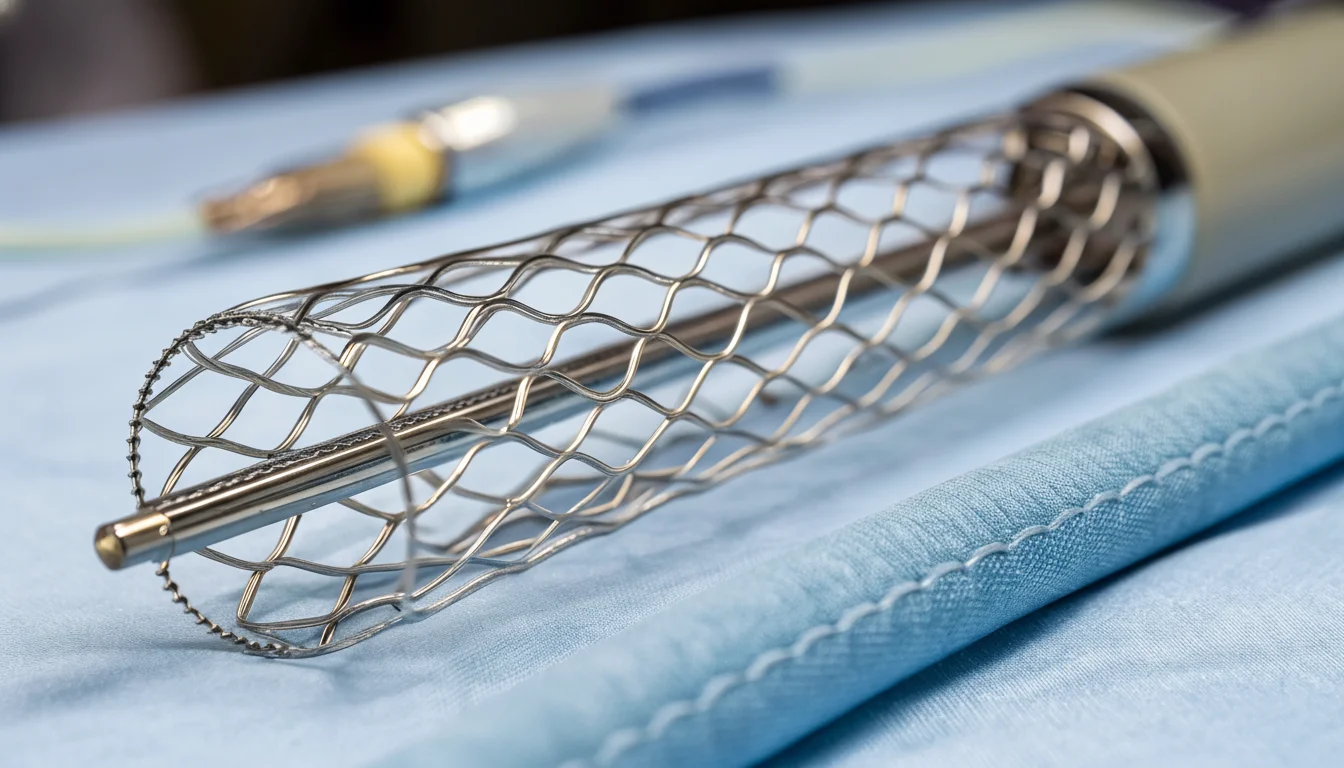
The Virtue sirolimus angioplasty balloon program followed a rockier path, one that illustrates why partnership models aren't foolproof.
Virtue targets in-stent restenosis—the scar tissue that regrows inside coronary stents in roughly 10 percent of the 1.5 million percutaneous coronary interventions performed annually in the U.S. Unlike drug-coated balloons that rely on surface coatings, Virtue uses what Orchestra calls "AngioInfusion" technology: micropores that deliver a proprietary extended-release sirolimus formulation directly into vessel walls.
European feasibility data from the SABRE trial looked competitive: late lumen loss of just 0.31 mm at six months. Orchestra secured three FDA Breakthrough Device Designations for Virtue across coronary ISR, small vessel disease, and below-the-knee peripheral artery disease.
In 2019, Orchestra announced what appeared to be a second validation of its model: a global partnership with Terumo covering coronary and peripheral indications. The terms included $30 million upfront, $5 million in equity, plus milestones and royalties. Orchestra would remain the exclusive supplier of its SirolimusEFR formulation—a recurring revenue stream. It checked all the boxes.
Then the competitive landscape shifted. In March 2024, Boston Scientific won FDA approval for AGENT, the first paclitaxel drug-coated balloon cleared in the U.S. for coronary ISR. AGENT showed superiority over plain balloon angioplasty, creating a new benchmark. Orchestra amended its U.S. pivotal trial to go head-to-head with AGENT in a 740-patient non-inferiority study.
Behind the scenes, things with Terumo were unraveling. The company's 2024 financial disclosures mentioned "restructuring discussions" and "mediation"—corporate speak for strained relationships. In October 2025, Orchestra and Terumo terminated their distribution agreement.
The new arrangement: Terumo paid $10 million for a Right of First Refusal on global coronary rights, plus $20 million in preferred equity. Orchestra reclaimed full control of Virtue across all indications, free to pursue different partners for peripheral artery disease or small vessel applications.
CEO statements framed it as strategic flexibility regained—and that may be partially true. But it's also a reminder that even well-structured partnerships can fracture when timelines stretch and competitors move faster than expected. The question now is whether Orchestra can find better partners or go it alone in certain indications, and whether that flexibility is worth the disruption.
The Capital Treadmill
Partnership-enabled models are supposed to be capital-efficient. That's the theory, anyway.
In practice, Orchestra burned through approximately $61 million in 2024 while generating just $2.64 million in revenue. The company closed the year with $22.3 million in cash and $44.6 million in marketable securities—a cushion, but not enough to fund two global pivotal trials through completion.
Enter the complex financing machinery. In August 2025, Orchestra executed a multifaceted deal: a $40 million public offering, combined with $16.2 million in private placements from Medtronic and Ligand Pharmaceuticals. Ligand also provided $35 million in royalty-based financing tied to future revenues—essentially a bet on Orchestra's success. Medtronic added a $20 million subordinated note (think of it as a prepaid revenue share if AVIM gets approved) and committed another $10 million in equity linked to a future offering.
The combined package exceeded $111 million. Impressive, but it came with strings: revenue commitments, increasingly complex capital structures, and dilution.
Then the Terumo settlement added $30 million in October. Altogether, Orchestra has been raising capital aggressively—because it has to. Each new financing round, however, adds another layer of obligations and expectations.
The Pivotal Moment

Orchestra now faces its defining chapter. Two global pivotal trials are in motion, and both need to deliver.
The BACKBEAT study is enrolling hypertensive pacemaker patients across up to 100 sites in the U.S., Europe, and the U.K. The amended protocol aims for enrollment completion by 2026, with results potentially landing in 2027. The Virtue ISR-US trial is set to launch in the second half of 2025, testing sirolimus against Boston Scientific's paclitaxel standard at up to 75 U.S. sites.
Success would validate more than just the technologies. It would prove that the partnership model—dancing with giants without getting crushed—can actually work. If AVIM gets approved, Medtronic's commercial infrastructure could deliver sustained revenue for Orchestra. If Virtue demonstrates non-inferiority to AGENT, Orchestra could either activate Terumo's Right of First Refusal or pursue alternative partners for what could be a lucrative drug supply and royalty stream.
Failure, or even prolonged delays, would leave Orchestra hunting for capital in a hostile biotech financing environment. The company has bolstered its ranks recently with industry heavyweights: Vivek Reddy as Executive Chairman of the BACKBEAT Steering Committee; John Mack, former Medtronic President of Cardiac Surgery; and Christopher Cleary, former Medtronic SVP of Corporate Development, added to the board.
Industry credibility isn't the issue. The company has that in abundance.
The question is simpler and more fundamental: Do these devices work well enough, consistently enough, to justify the elaborate partnership structures Orchestra has constructed?
Two trials will answer that. Until then, the high-wire act continues—capital raised, protocols amended, enrollment targets adjusted. It's a bet that the giants will ultimately pay for innovation they didn't develop themselves, assuming Orchestra can deliver the clinical proof.
Hochman and Sherman's contrarian thesis rested on the idea that you could stay nimble while partnering with behemoths. Seven years in, that thesis is still being tested. The data will decide whether it was audacious or merely ambitious.


