

The paratroopers barely noticed them at first.
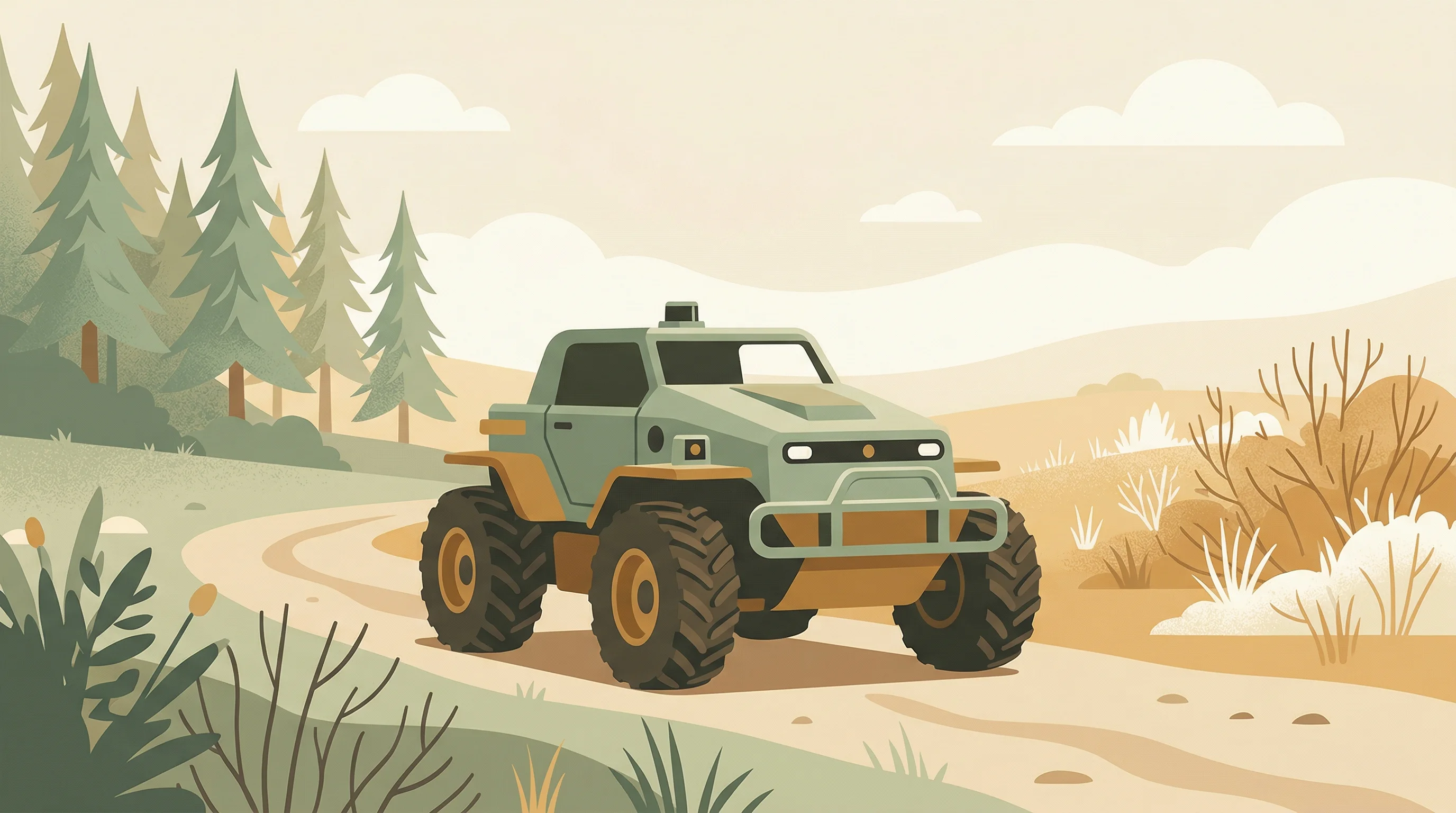
Four squat, boxy robots—each about the size of a golf cart—threaded through the Louisiana swamp in late spring, delivering ammunition, water, and rations to soldiers from the 82nd Airborne Division scattered across the Joint Readiness Training Center. No steering wheels. No GPS signal guiding them through the pines and mud. For most of the month-long exercise, no human hands touched the controls at all.
When the rotation concluded, Army Chief of Staff Gen. Randy George had seen enough. The vehicles, built by a Seattle startup called Overland AI, had cut logistics delivery times roughly in half compared to conventional supply runs—the kind of operational gain that doesn't come along often in military innovation. It was, by several accounts, the first time fully autonomous ground vehicles had been fielded at brigade scale in a combat training environment.
Whether GPS-free robotics can handle actual warfare remains an open question. But the results from Fort Polk suggest the technology may finally be approaching readiness for something messier than controlled demonstrations.
Built for Places Where the Maps Don't Work
Overland AI introduced its ULTRA vehicle on April 14, 2025, marketing it specifically for scenarios where GPS fails and radio communications go dark—conditions increasingly common in modern combat. The specifications are utilitarian rather than flashy: 35 mph top speed, roughly 100 miles of range, capacity for about 1,000 pounds of cargo. At just over 13 feet long and 6 feet wide, with 14.5 inches of ground clearance, ULTRA resembles a stripped-down utility vehicle more than a futuristic war machine.
What matters isn't the chassis. It's what you can bolt onto it.
The platform uses a flat deck studded with L-track mounting points, vertical hitch receivers, and side rails—a Lego-like modularity that allows operators to swap payloads in the field. Overland has demonstrated mine-clearing trailers, tethered surveillance drones, and autonomous weapons turrets on the same frame. By late 2025, the company had partnered with AimLock to add autonomous targeting systems and with Anduril to integrate counter-drone sensors and electronic warfare packages into what both firms described as coordinated air-ground responses.
"ULTRA integrates and deploys multiple modular payloads, including UAS for reconnaissance and breaching operations," the company said at launch. The flexibility is tactical: a single vehicle can shift from hauling supplies to launching drones to jamming enemy communications, depending on mission requirements.
The GPS Problem
Here's what makes Overland's pitch distinct in a crowded tactical robotics market: its OverDrive autonomy system claims to operate without GPS, without pre-loaded maps, and without constant communication links.
Most autonomous military platforms treat GPS as foundational infrastructure. When jamming occurs—which has become routine in Ukraine, parts of the Middle East, and any contested environment where adversaries bring electronic warfare tools—these systems either halt in place or revert to manual control. Overland's argument is that ULTRA keeps rolling.
The technical approach relies on what the company calls "no-signature passive-only sensing." That's industry jargon for cameras and sensors that don't emit detectable signals, reducing the vehicle's electronic footprint while allowing it to build a real-time understanding of terrain. No LIDAR pulses. No active radar. Just optical sensors processing the landscape as it unfolds.
The OverWatch command interface lets operators draw routes, define restricted zones, retask vehicles mid-mission, and coordinate multiple robots in formation. But once tasked, the vehicles are designed to execute independently even if communications degrade or disappear entirely. The system supports mesh networking, 5G, and satellite uplinks, though degraded connectivity is treated as baseline rather than exception.
During the Fort Polk rotation, soldiers used ULTRA for autonomous convoy operations. Perhaps more telling: they also ran what Overland described as "deception resupply" missions, sending a robot down one route as a decoy while actual supplies moved along a different path. Counter-drone payloads mounted on some vehicles tracked aerial threats throughout the exercise.
It's the kind of tactical nuance that suggests soldiers were treating the robots as tools rather than novelties.
Testing in Georgia, California, and Wildfire Country
The Louisiana deployment didn't appear out of nowhere. Overland spent much of the previous two years field-testing variants of its autonomy stack across military exercises and, unexpectedly, civilian emergencies.
An earlier version of the software ran on General Dynamics' Squad Multipurpose Equipment Transport platform during Project Convergence Capstone 5 at Fort Irwin, California—an April 2025 demonstration that showcased mine-clearing and drone-launching capabilities. By summer, the Army had assessed an ULTRA prototype during Exercise Agile Spirit on July 29, 2025, in Vaziani, Georgia. Late in the year, Overland and Anduril were running integrated demos showing ULTRAs coordinating with overhead drones to detect and respond to simulated enemy unmanned aircraft.
Then came the wildfire test.
On January 20, 2026, Overland partnered with CAL FIRE for an evaluation at Camp Pendleton, outfitting vehicles with PTZ cameras for situational awareness and fire hoses for remote suppression work. GPS-denied autonomy, it turns out, has applications beyond military logistics. Dense smoke obscures visual navigation; communications fail in rugged terrain; firefighters need supplies delivered to shifting frontlines. The same technical constraints.
Overland also completed DARPA's RACER program in late 2025, validating its autonomy stack at speeds approaching 35 mph across varied off-road terrain. The company has since integrated its software onto Textron's Ripsaw M5 tracked vehicle and demonstrated breaching operations using the M58 MICLIC mine-clearing system—essentially a rocket-propelled line of explosives designed to detonate buried landmines.
Ramping Production (Eventually)
Overland AI opened a 22,000-square-foot production facility in south Seattle in early 2025. At the ULTRA launch that spring, CEO Byron Boots told Axios the company was testing "several" units and aimed to "build dozens by the end of the year."
Actual production numbers? Undisclosed.
The company has raised $122 million, including venture debt, since its 2022 founding as a University of Washington spinout. That includes a $100 million Series B round announced in February 2026—$80 million in equity plus $20 million in venture debt from TriplePoint Capital. The round was led by 8VC, with participation from Valor Equity Partners and StepStone Group. Earlier investors include Point72 Ventures, Overmatch Ventures, and Ascend.
Overland also holds a Defense Innovation Unit Other Transaction agreement capped at $18.6 million for work tied to the Army's Robotic Combat Vehicle program. According to the company's funding announcement, its technology is under evaluation or deployment with units including the 82nd Airborne, 1st Cavalry Division, 173rd Airborne Brigade, 36th Engineer Brigade, 2nd Marine Logistics Group, and elements of Special Operations Command.
Whether that translates to major contracts depends on variables Overland hasn't disclosed: unit cost, maintenance burden, training timelines. And perhaps most important—how well the autonomy holds up when soldiers aren't operating in a controlled training rotation with engineers nearby.
A Market Full of Competitors, But Few Without GPS
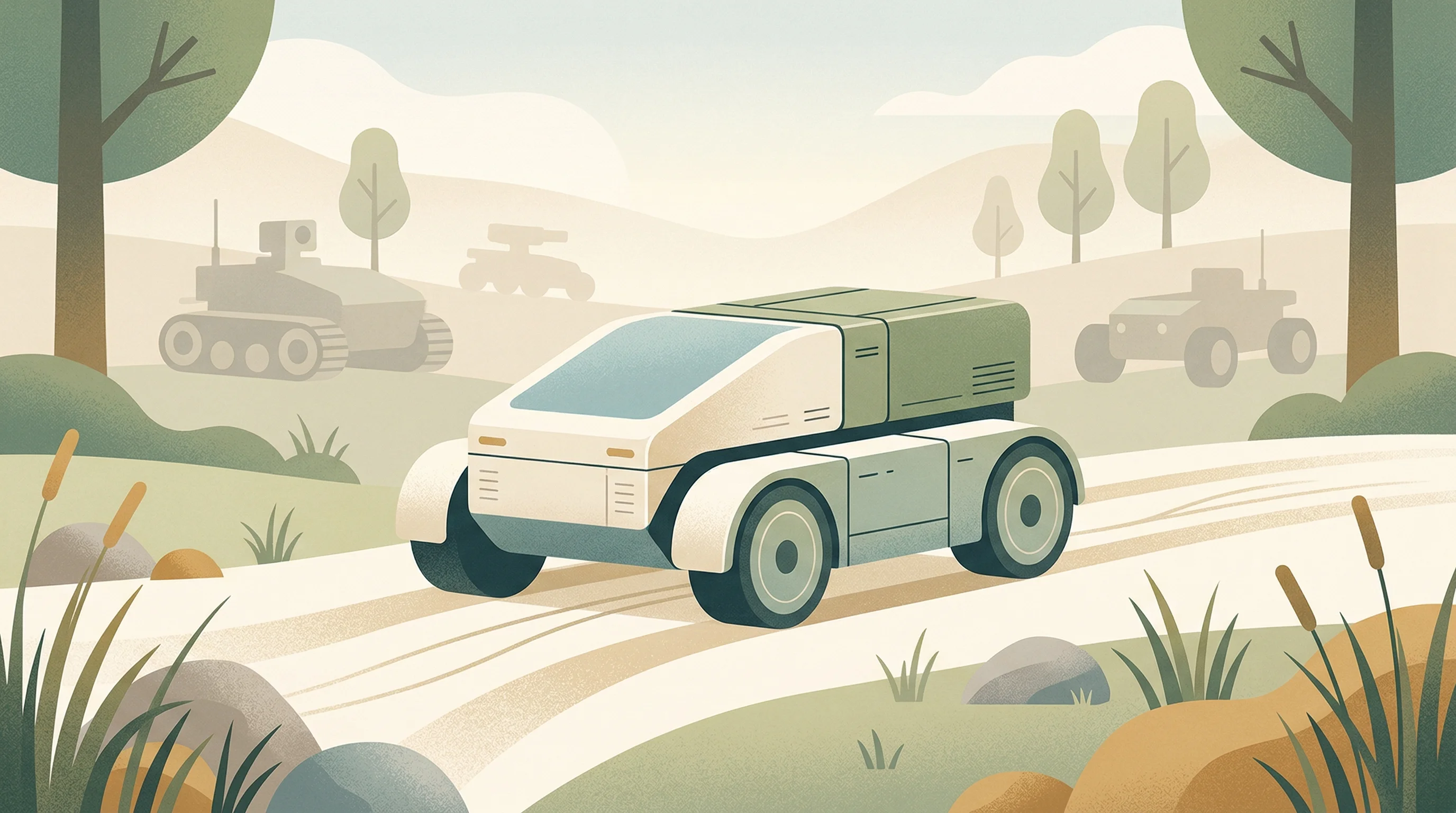
ULTRA enters a tactical robotics landscape already populated by tracked platforms like Estonia's Milrem THeMIS and wheeled systems like Rheinmetall's Mission Master family. Both carry similar payloads. Both emphasize modularity.
What differentiates Overland—at least in its marketing—is the focus on GPS-denied operation at tactically relevant speeds, paired with an interface designed for soldiers rather than robotics specialists. No advanced training. No dedicated operator cadre. Just troops who need supplies delivered under fire.
The Fort Polk results offer something defense buyers need but rarely get: operational data from a brigade-level exercise showing measurable performance gains. Halving logistics delivery times isn't a marginal improvement.
But skepticism is warranted. Training rotations are scripted. Engineers troubleshoot in real time. Maintenance requirements are often understated in early demonstrations. The difference between a promising prototype and a fieldable system often comes down to what breaks at 3 a.m. in the rain, and whether a 19-year-old sergeant can fix it without calling tech support.
Still, cutting distribution time in half suggests the technology may have moved past proof-of-concept. Whether it's ready for the unscripted chaos of actual combat is a question only deployment will answer. The Army, apparently, is interested in finding out.


