

The numbers Vivek Raghavan heard from the stage weren't encouraging. ChatGPT, Sam Altman had just announced, was pulling in more than 100 million weekly active users across India. This was mid-February at the AI Impact Summit, and Raghavan—co-founder of Bengaluru-based Sarvam AI—was about to do something that might have seemed quixotic: launch a direct competitor.
Two days later, on February 20, Sarvam released Indus, a multilingual chat app built on infrastructure OpenAI and Google don't have and probably can't easily acquire. A 105-billion-parameter language model, trained from scratch on Indian languages, running on Indian servers. Whether sovereignty sells remains an open question. But Sarvam is betting that linguistic depth and data residency will matter more than the scale advantages of Silicon Valley.
Built Different
Sarvam-105B isn't a tweaked version of someone else's model. It's a Mixture-of-Experts transformer with 128 sparse experts and north of 105 billion total parameters, pre-trained on 12 trillion tokens. The architecture employs Multi-head Latent Attention, which allows the system to handle up to 128,000 tokens in a single conversation—roughly the length of a modest novel, all held in working memory.
For context: Sarvam's earlier work involved fine-tuning existing models like Mistral. The 105B represents a departure, the startup's first fully independent foundation model, trained under compute allocations from India's IndiaAI Mission. Technical documentation released in early March claims the model scores 88.3 on AIME-25 (96.7 with tools enabled) and 98.6 on Math500. Take those benchmarks with the usual grain of salt—self-reported numbers always deserve scrutiny.
What happened on March 6 might prove more consequential. Sarvam open-sourced both the 105B and a smaller 30B variant under Apache 2.0 licenses, making the weights available on AI Kosh and Hugging Face. That move reframes the company's positioning. Less a proprietary AI vendor gunning for ChatGPT's user base, more infrastructure provider for India's developer ecosystem.
Twenty-Two Languages, One App
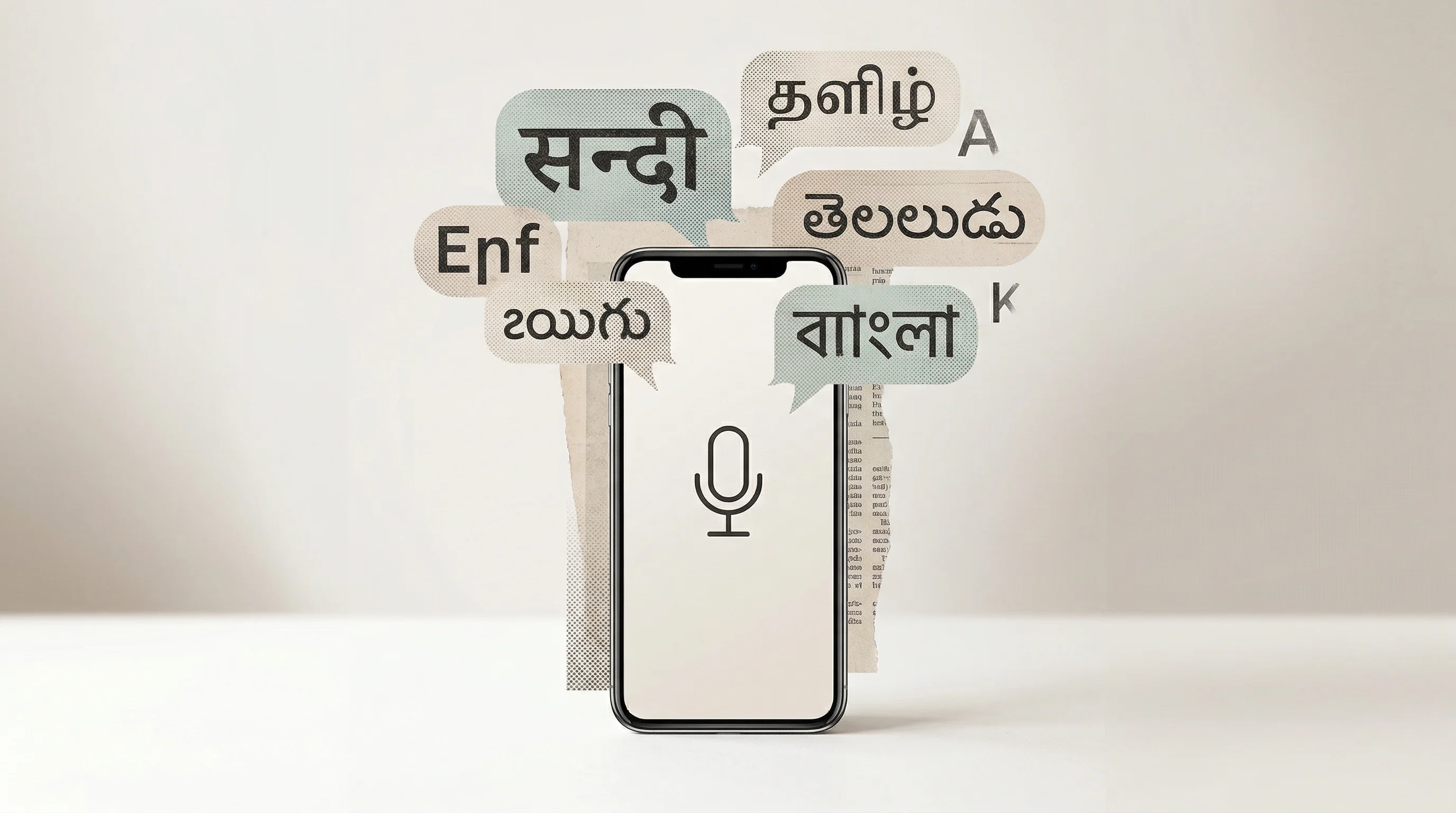
The Indus app—available on iOS, Android, and web at indus.sarvam.ai—supports 22 Indian languages with code-mixing capabilities. Users can toggle between Hindi, Tamil, Telugu, Bengali, and English mid-conversation, or lean on voice input to speak queries and receive spoken responses. According to a hands-on published by Business Today on February 21, the app identified its knowledge cutoff as June of the previous year during testing.
Document handling is baked in. Upload a PDF or image, and Indus will analyze content, answer questions, generate summaries. The pitch is productivity assistant, though early reviewers were frank: if you work primarily in English and need power-user features, ChatGPT isn't losing sleep yet.
Sign-in flows through phone number, Google, Microsoft, or Apple ID. The App Store listing showed 354 ratings averaging 4.7 stars as of early March, with the developer—listed as Axonwise Private Limited, Sarvam's registered entity—pushing several updates between launch and early March. Dark mode arrived. Onboarding got smoother.
The app launched with India-only access, though a March 6 update noted that users outside the country could sign in directly using Google, Apple, or Microsoft credentials. A waitlist still manages demand, a function of compute capacity constraints that most startups serving inference at scale eventually hit.
Friction Points and Privacy Posture
Some roughness remains. Users can't selectively delete individual chat histories without wiping their entire account. There's no toggle to disable the model's "reasoning" mode. TechCrunch flagged these limitations in its February 20 coverage, though Sarvam's rapid iteration cycles suggest the team views the beta as exactly that—a work in progress.
The privacy angle leans hard into data sovereignty. The App Store description emphasizes that infrastructure is "built and hosted in India," a message calibrated for a market increasingly wary of foreign data practices. Whether this becomes a genuine competitive edge or simply table stakes depends on how seriously Indian regulators and enterprises prioritize data residency. The jury's still out.
The Weight of Competition

Sam Altman's 100 million weekly active users claim landed the same week Sarvam launched Indus. Anthropic's Claude, meanwhile, draws 5.8% of its global usage from India, according to available metrics. Those numbers frame both the opportunity and the challenge: India is already a critical AI market, dominated by models that lack deep Indian language capabilities but benefit from massive global training budgets and distribution muscle.
Sarvam's founders aren't novices. Pratyush Kumar co-led AI4Bharat at IIT Madras, focusing on open datasets and models for Indic languages. Vivek Raghavan spent years in applied AI before the two launched the startup in August 2023. They've raised $41 million across seed and Series A rounds from Lightspeed, Peak XV, and Khosla Ventures, with the last publicly disclosed equity round closing in December 2023.
Business Today's assessment in late February was measured: Indus matters for users who think and read in Indian languages. But for English-dominant workflows? Not displacing the incumbents. Not yet.
Enterprise Moves Beyond the App

The consumer app is the showcase. It's not the entire business model.
On February 20, Bosch Global Software Technologies signed an MoU with Sarvam to collaborate on secure, scalable enterprise AI across automotive, medical, and wearables. HMD Global announced plans to bring Sarvam's AI chat to Nokia feature phones, a distribution play targeting hundreds of millions of users still on basic handsets. Qualcomm's name surfaced in connection with edge compute enablement for on-device scenarios.
An earlier case study from January of the previous year showed Tata Capital deploying Sarvam's Samvaad platform for multilingual voice AI, evidence of enterprise traction predating the consumer launch.
The smaller Sarvam-30B model, built for real-time use with a 32,000-token context window, seems designed precisely for these edge deployments. It's lighter, faster, optimized for scenarios where latency trumps reasoning depth.
---
Sarvam's wager is straightforward enough: India's AI future won't be written entirely in San Francisco. The Indus app—waitlist, early quirks and all—reads less like a finished product than a declaration of intent. Whether that intent converts to market share hinges on execution, distribution, and whether Indian users care enough about linguistic nuance and data residency to choose a local alternative over the global heavyweights.
The 105B model is in the wild now, open-sourced and available to any developer willing to build on it. That might turn out to be the more durable legacy, regardless of how the consumer app fares.


