

The numbers from 2024 told a story utilities already knew in their bones: something had shifted. Customers lost power for an average of 11 hours—nearly double the previous decade's baseline. Climate wasn't asking permission to slow down, and neither could the inspections meant to keep 450,000 miles of transmission line from becoming the next catastrophe.
Enter a peculiar arms race. Not just more drones—everyone's already flying those—but drones that theoretically never need to come back down.
Voltair, five people strong and fresh from Y Combinator's Winter 2026 cohort, is making that bet. Their pitch sounds almost too elegant: drones that charge by landing directly on transmission lines, roaming rural corridors indefinitely without human intervention. It's the kind of idea that won them top prizes at University of Washington competitions last spring, and it taps into a genuine industry obsession: automating the grinding, expensive, increasingly urgent work of keeping the grid intact.
But here's the thing—Voltair isn't alone in chasing this vision, the technology has been demonstrated in academic settings but remains unproven at commercial scale, and the path from winning a college competition to hanging off a live 500-kilovolt conductor is, to put it mildly, steep.
The Inspection Problem That Won't Wait
Utility inspection demand has gone from urgent to relentless. Weather caused roughly 80% of major U.S. outages between 2000 and 2023—severe storms, winter freezes, hurricanes chewing through infrastructure. Then came 2024. Hurricanes Beryl and Helene pushed outage durations to nearly double the 2014–2023 average, according to Energy Information Administration data released that December. Major weather events accounted for some 80% of total customer-hours lost.
Regulators weren't subtle in their response. NERC's FAC-003-5 vegetation management standard went live in April 2024, tightening clearance rules. California ramped up wildfire mitigation mandates and CPUC undergrounding initiatives, forcing inspection cadences higher across fire-prone zones. Pacific Power expanded drone deployments for wildfire season watch in mid-2024. PG&E kept flying aerial inspections over high-risk communities through December 2025. Nebraska Public Power District, Duquesne Light, Southern Company—the list of utilities announcing or expanding drone programs through 2024 and into 2025 grew steadily longer.
The common denominator? Utilities need more eyes on assets, more often, in harder-to-reach places, with fewer people involved. Traditional helicopter and ground patrols remain slow and expensive. Short-endurance multirotor drones help, but batteries die in 20 to 40 minutes. Frequent swaps or returns to base become their own logistical headache.
Four Ways to Stay Airborne
Industry's endurance bottleneck has spawned competing solutions, each trading different advantages against different limitations.
Drone-in-a-box autonomy has claimed the most commercial ground so far. Percepto's platform—deployed at Florida Power & Light starting in 2022 in what the company termed the world's largest autonomous commercial drone rollout—combines weatherproof docking stations with pre-scheduled inspection routes. The EPA approved Percepto's autonomous optical gas imaging solution for federal emissions compliance last December, giving the model stronger regulatory legitimacy. Skydio released its Dock for the X10 platform in September 2025, aiming at similar substation and distribution cases. These systems sidestep the endurance problem by staying close to infrastructure, recharging between flights. But they need significant ground hardware and don't wander far.
Long-endurance platforms offer a different trade. Southern Company became the first U.S. utility to deploy SwissDrones' SDO 50 unmanned helicopters last June—machines capable of more than three hours of flight for beyond-visual-line-of-sight corridor work. Hybrid VTOL fixed-wing designs push range even further, though with higher costs and operational complexity attached.
Wireless in-flight charging remains in the experimental category. Global Energy Transmission markets resonant magnetic coupling stations that create eight-meter charging zones; drones hover inside to top off batteries within minutes. PowerLight Technologies announced kilowatt-class laser power beaming with flight tests planned for early 2026, building on a 2025 DARPA demonstration that beamed 800 watts across 5.3 miles. Both promise to cut the cord from fixed pads, but neither has scaled to utility operations yet.
Line-perching and inductive recharge—Voltair's stated approach—sits furthest out on the technical frontier. A University of Southern Denmark team published a March 2024 arXiv preprint showing autonomous perching on live three-phase lines and inductive energy pickup through a split-core transformer embedded in the drone's gripper. The system completed repeated fly-land-recharge cycles outdoors, with recharge times ranging from 30 minutes to six hours depending on line current for a 4.3-kilogram UAV. It's the strongest published evidence the concept works under real-world conditions, not just simulation. Munich-based Nomadic Drones, which raised a $1.6 million pre-seed round last October, markets a similar vision: perching on high-voltage conductors to harvest energy from ambient electromagnetic fields.
The University of Southern Denmark demonstration validated the technical feasibility of autonomous perching and inductive recharging in a real-world environment—a significant proof of concept. But as of this March, no independently verified commercial deployments of line-perching drones on energized U.S. transmission infrastructure have emerged publicly. The gap between academic demonstration and utility production line? Still wide.
Messaging vs. Reality
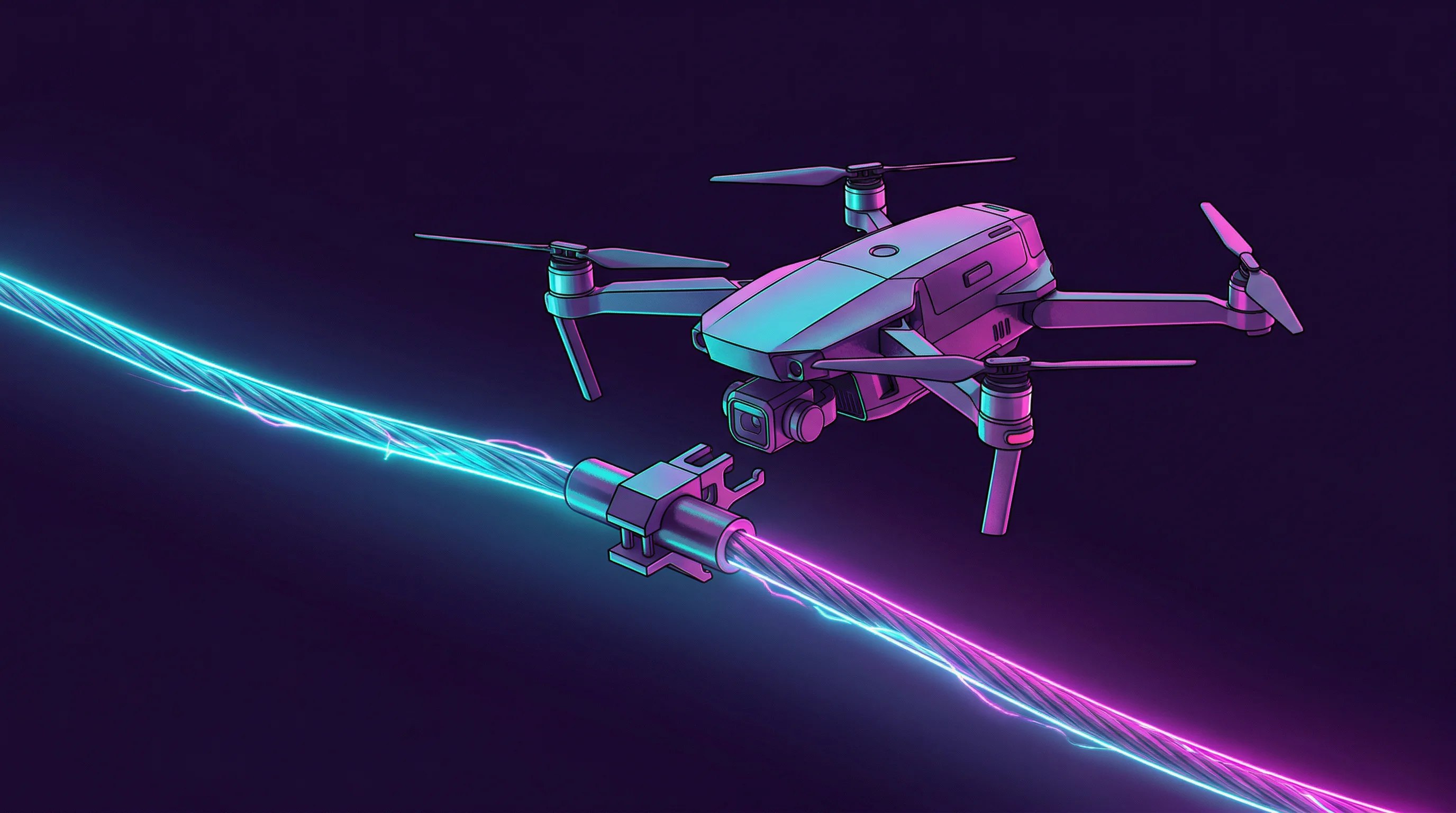
Voltair's public positioning reveals the tension. The company's Y Combinator launch materials from roughly a month before this March described drones that "charge directly on transmission lines." Its wins at University of Washington competitions last April and May centered on precisely that premise. CEO Ronan Nopp told GeekWire the goal was ensuring 100% grid uptime through proactive detection—vegetation creep, insulator wear—with self-charging enabling rural coverage without recall to base.
Yet Voltair's current website, as of early March 2026, emphasizes something slightly different: a "network of fixed-wing VTOL drones and inductive charging pads" for on-demand data collection. The utility page describes drones that "recharge in the field on inductive charging pads"—language that sounds more like Percepto's dock model than like perching on energized conductors.
The discrepancy might reflect parallel product tracks, a phased development roadmap, or repositioning for broader infrastructure markets. Voltair hasn't publicly clarified. What's certain is that physically contacting live transmission lines introduces electromagnetic compatibility risks, fault-case exposure, insulation requirements, and regulatory hurdles that ground-based pads don't. Utility safety protocols typically mandate conservative standoff distances around energized equipment. A 2024 study published in MDPI found magnetic fields during faults can spike more than 18 times normal levels; a December 2025 paper in Scientific Reports established 320 kV/m electric field and 290 µT magnetic flux density thresholds for safe substation UAV operations. Perching systems must prove they can survive contingencies that would destroy conventional drones.
Academic researchers have done the hard engineering—the SDU team validated perching mechanics, inductive coupling, and autonomous flight control outdoors, on real infrastructure. Turning that into a product utilities will trust at scale, though, requires certification rigor, fail-safe design, and risk acceptance that no startup has secured yet.
Two Policy Shifts Reshaping the Field
Regulatory developments are altering the competitive landscape as much as any technical breakthrough.
The FAA's long-awaited Part 108 rule—intended to normalize beyond-visual-line-of-sight operations—advanced through a notice of proposed rulemaking mid-2025. The agency reopened the comment period January 27, 2026, to address specific questions around right-of-way operations and electronic conspicuity, targeting a final rule for spring 2026. Once implemented, Part 108 would allow routine BVLOS flights without case-by-case waivers—the bottleneck that's constrained corridor-scale inspection. Xcel Energy flew FAA-approved BVLOS transmission inspections near Denver as early as September 2018; New York Power Authority secured a BVLOS waiver running through 2028 in April 2024. But waivers are slow, narrow, and don't scale industry-wide. A performance-based regulatory framework would fundamentally change economics.
Simultaneously, procurement is tilting domestic. The FCC added DJI's new products to its Covered List on December 23, 2025, blocking authorization of future models in the U.S. The Defense Department's Blue UAS trusted list transitioned to DCMA management December 3, 2025. Together, these moves signal broader supply-chain realignment: critical infrastructure operators, already wary of foreign-made platforms, are actively hunting for U.S. or allied alternatives. Skydio has benefited from this shift; Percepto too. But the disruption also creates openings for startups like Voltair that can position as domestic, secure, and purpose-built for regulated industries.
There's another data point worth noting: the EPA's December 2025 approval of Percepto's autonomous OGI system for federal emissions inspections suggests regulators are warming to fully automated operations when vendors demonstrate compliance rigor. That precedent matters for any company pitching utilities on drones operating unattended for days or weeks at a stretch.
Market Size and the Trillion-Dollar Grid
Market sizing firms peg the utility drone sector somewhere between $1 billion and $3.16 billion by the early 2030s, depending on how you draw boundaries. Fortune Business Insights estimated the global utility drone market at $1.02 billion in 2025, forecasting growth to $3.16 billion by 2034 at a 13.5% CAGR, with North America representing roughly 35% of revenue. The Insight Partners projected the broader inspection drone market—spanning energy, infrastructure, and industrial applications—from $11.69 billion in 2024 to $34.48 billion by 2031.
The variance reflects definitional murkiness (hardware? software? services?) and aggressive growth assumptions that may or may not materialize. What's harder to dispute: utilities are spending more on aerial data, and the spend is shifting from ad hoc helicopter contracts toward scalable, software-driven platforms. Oak Ridge National Laboratory demonstrated an automated drone inspection system last August that responded to grid sensor anomalies without human dispatch. Skydio and AEP Ohio showcased AI-driven defect detection in a January 2026 webinar. NYSEG and RG&E deployed statewide comprehensive vegetation inspection via drones in November 2024.
So the question isn't whether drones will inspect more grid assets—that train has left the station. It's which architectures dominate, and how quickly utilities adopt each.
The Path Forward (and Its Obstacles)
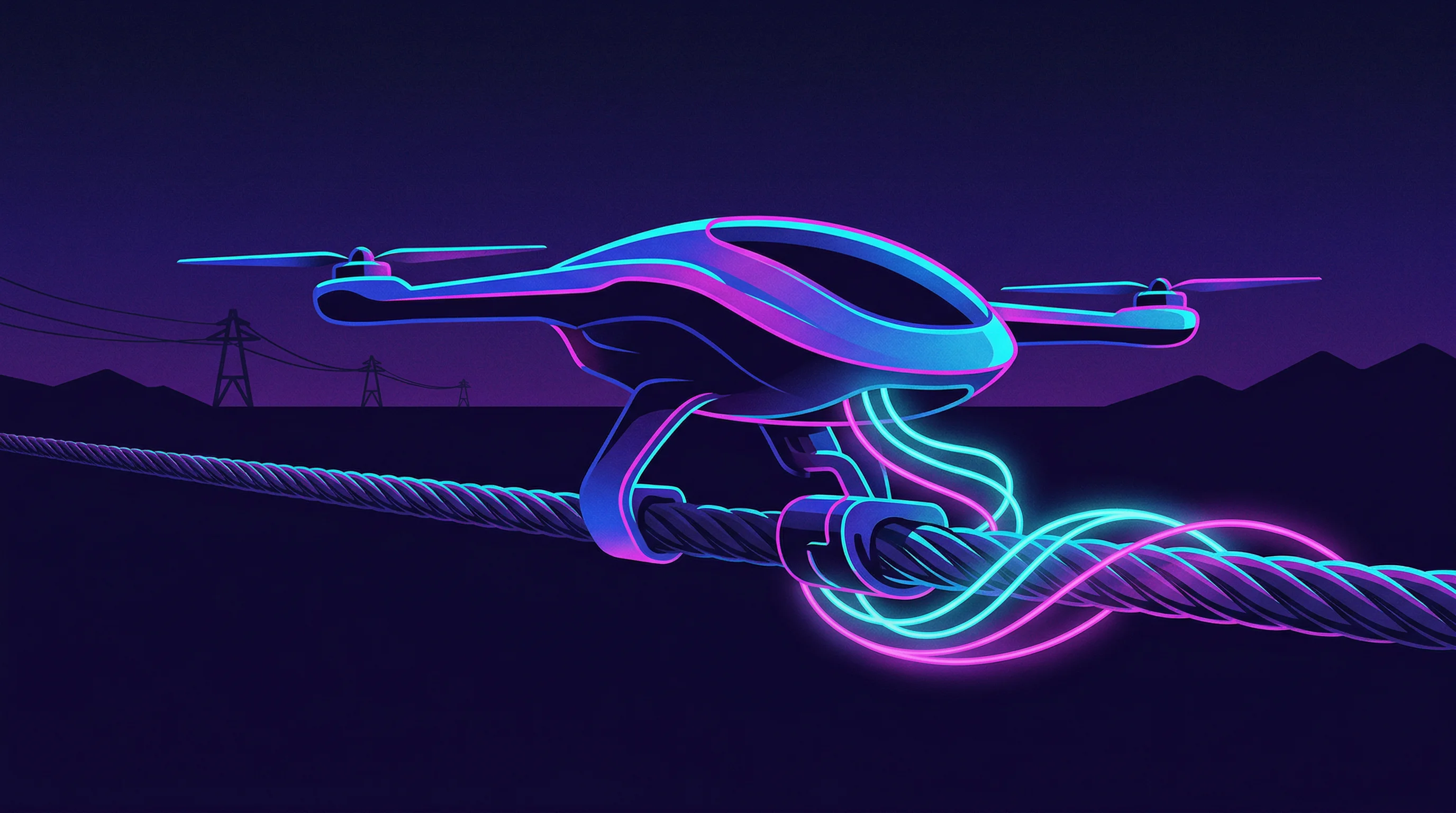
If self-charging drones that perch on transmission lines prove viable at scale, they unlock something current platforms genuinely cannot: persistent patrol over remote, high-risk corridors without ground infrastructure. A drone recharging indefinitely on a 230-kilovolt line could, in theory, fly hundreds of miles of right-of-way, detect vegetation encroachment or insulator cracks in real time, and dispatch repair crews before failures cascade into outages. The SDU demonstration showed it's technically feasible under controlled conditions. Nomadic Drones and Voltair are betting it's commercially viable beyond the lab.
But the gap between feasible and deployed gets measured in certifications, not just prototypes. Utilities need proof that line-perching systems won't trigger faults, won't fail under contingency loadings, won't introduce new risks to crews or the public. They need regulatory clarity on airspace and electromagnetic compatibility. And they need business cases that pencil out against proven alternatives—dock systems scaling right now, and hybrid VTOL platforms already flying BVLOS corridors under waiver.
Voltair's five-person team brings credible technical backgrounds: CTO Hayden Gosch from Seattle City Light and electrical engineering, COO Warren Weissbluth with operations research and SBIR experience, CEO Nopp with manned eVTOL controls experience. They've won early validation through competition. But they're racing academic labs, European startups with capital, and well-resourced incumbents toward a finish line that keeps moving as the industry evolves.
The grid inspection market is real. Demand is accelerating, outages are climbing, inspection backlogs are growing. Regulatory pieces are falling into place, slowly but visibly. Whether the winning solution ultimately lands on power lines or next to them remains genuinely open.
For utilities watching storms intensify and infrastructure age, though, the answer can't arrive soon enough. The 11-hour outage average from 2024 wasn't an anomaly—it was a warning shot.


