

In a cramped hotel back office somewhere—OS3 won't say where yet—a semi-humanoid robot with arms and wheels is doing something most hospitality robots never attempt: manipulating real objects, in real time, for real customers. Not rolling down hallways with room service trays balanced on its head. Not polishing floors in a predetermined loop. Handling things. Moving carts. Maybe even restocking shelves.
The company behind it is OS3, which emerged from Y Combinator's 2026 cohort. Their website, last refreshed in late May, makes an unusual pitch for a robotics startup. No glossy product videos. No animated renders of a frictionless future. Just "field logs, not a showreel"—grainy, unedited clips of their machines operating in what appear to be actual working environments. The implication is clear, if unproven: these things are already deployed.
It's the kind of claim that invites skepticism in a field littered with demos that never leave the trade show floor. But something about the moment feels different this time, even if cautious optimism is the most you can muster.
What's Actually Out There
Start with the numbers. The International Federation of Robotics tallied more than 42,000 service robots shipped into hospitality settings in 2024. That sounds impressive until you notice the fine print: it's an 11% drop from the year prior. Early adoption curves stall out. They always do. Still, hospitality trails only logistics in service robot deployments, and market watchers—Business Research Insights among them—expect the segment to balloon from $1.13 billion this year to $8.7 billion by 2035. That's a 25.5% annual growth rate, though with forecasts like these, the spread between bullish and bearish scenarios can be wide enough to drive a delivery bot through.
The robots that have found traction stick to narrow, well-understood tasks. Pudu Robotics and KEENON have carved out dominant positions in delivery and cleaning—KEENON reports over 100,000 units shipped as of mid-last year. Relay Robotics' wheeled couriers run nearly 400 deliveries a week at Chicago's Hotel EMC2, a gig that's held steady for over five years now. Bear Robotics reports more than 16,000 Servi units in commercial operation. Tailos's Rosie vacuum clocks 40-plus autonomous hours weekly in housekeeping departments. These machines work, reliably, inside tightly drawn boundaries.
What they can't do—what almost nothing in the current install base can do—is pick things up with any real dexterity, adapt on the fly to back-of-house chaos, or handle the sort of variable manipulation tasks that define much of hospitality labor. That gap is where OS3 and a handful of semi-humanoid upstarts are placing their bets.
Why Hotels Might Finally Bite

The labor crunch in hospitality isn't easing. If anything, it's calcifying into something structural. The Bureau of Labor Statistics' latest JOLTS release, published in June, shows leisure and hospitality job openings still running well above pre-pandemic norms. Turnover is brutal, wages are climbing, and operators keep circling back to the same refrain: they can't fill housekeeping roles, kitchen prep slots, or overnight front-desk shifts. It's the kind of grinding pressure that makes even expensive, imperfect automation start to pencil out.
The technology, meanwhile, is inching closer to useful. Vision-language-action models, reinforcement learning trained on human demonstration video—these aren't just academic parlor tricks anymore. They're narrowing the gap between what robots can manage in a pristine lab and what they might handle in a chaotic linen closet or hotel kitchen. OS3's tagline captures the prevailing wisdom: "human video first, real robots last, RL for everything in between." Deploy early, learn from messy field data, iterate fast. Whether that approach accelerates progress or just burns cash faster is the open question.
Infrastructure is cooperating, sort of. Otis and KONE now offer standardized APIs so robots can summon elevators without a human chaperone. UL issued its first UL 3300 certification for a public-facing service robot back in March—a signal that safety standards are beginning to catch up with ambition. Robot-as-a-service models, which Bear and others have adopted, lower the upfront capital bite for hotel operators hesitant to drop six figures on unproven hardware.
And then there are the projections, which vary wildly but all point the same direction. Goldman Sachs sees a $38 billion humanoid robot market by 2035, led by industrial use cases but with service applications creeping in. Bank of America Institute floats up to 10 million humanoid units by then. Morgan Stanley expects 8 million in the U.S. alone by 2040, with a cumulative wage displacement impact north of $350 billion. Take those numbers with whatever grain of salt feels appropriate, but the direction of travel seems set.
Who's Actually Doing It
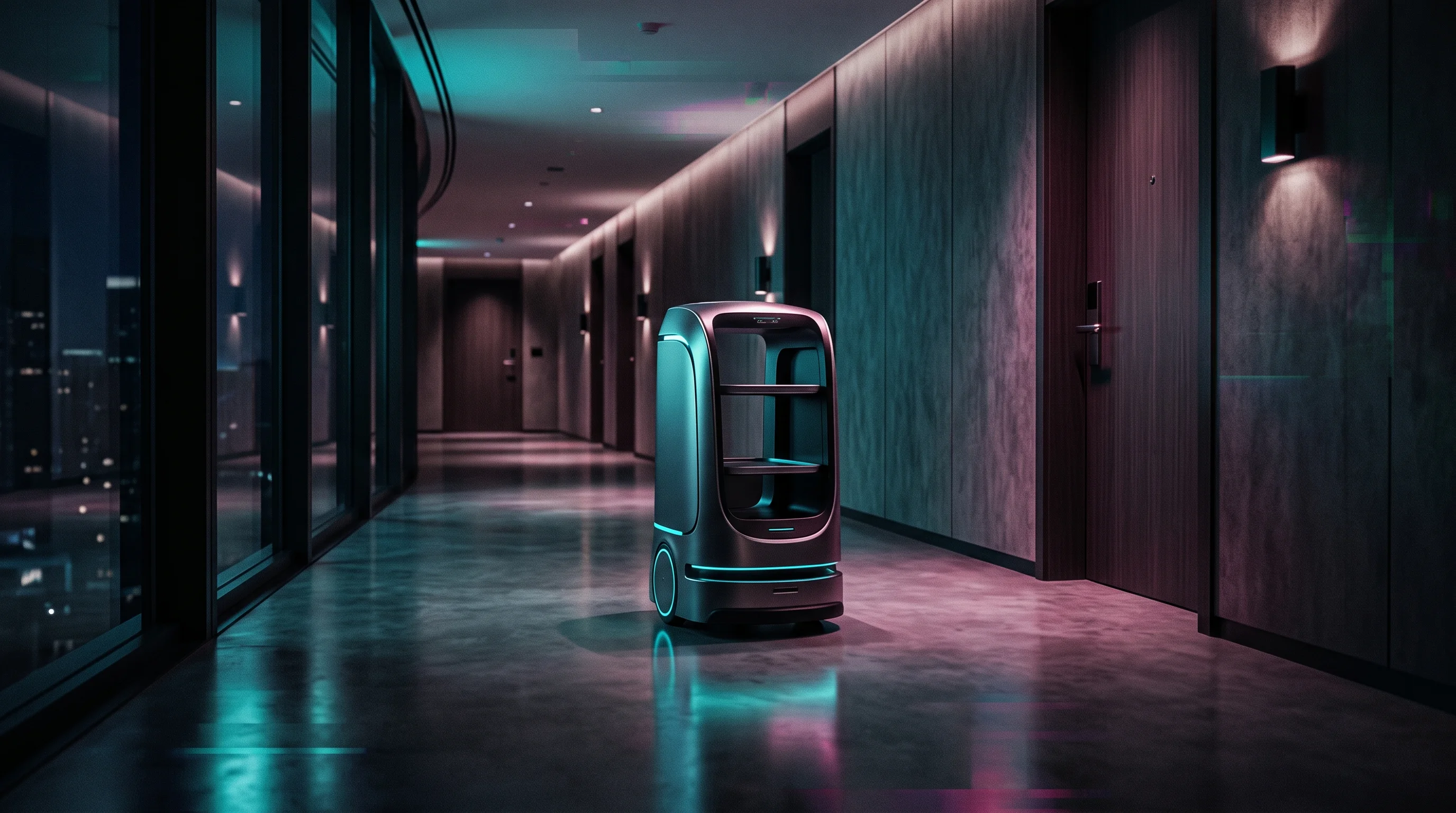
Pudu Robotics, one of the category leaders, announced a partnership in June with Shenzhen CTID to deploy what it's billing as "the world's first full-scenario robot-serviced hotel." The setup includes reception, in-room delivery via FlashBot, cleaning with the CC1, food service, guest support—an integrated suite built around Pudu's embodied AI foundation model, PuduFM 1.0. Austria's Parkhotel Eisenstadt runs a similar multi-bot operation across front- and back-of-house. Whether "full-scenario" means genuinely seamless or just "a lot of robots in the same building" is harder to verify from the outside.
Chef Robotics, which came through YC's 2021 batch, offers an instructive counterpoint. After raising $43.1 million in a Series A early last year, the company quietly pivoted away from restaurants and into food manufacturing—controlled environments, repetitive tasks, faster ROI. As of April, they'd logged over 100 million servings. That decision reflects a hard truth: dynamic hospitality settings are brutal proving grounds compared to factory floors. But the playbook Chef is refining—vision-based manipulation at scale, trained on wildly diverse ingredients—could eventually transfer back to commercial kitchens. Maybe.
OS3 sits somewhere in the middle of this spectrum. Their semi-humanoid form factor—arms mounted on a mobile base—suggests they're targeting tasks that need both manipulation and mobility: moving linen carts, handling trays, restocking supplies. The emphasis on field deployment from day one implies a belief that real-world data, even from imperfect early pilots, beats prolonged simulation. It's a defensible bet. Whether it accelerates learning or just accelerates burn rate depends entirely on execution, and the company's opacity about customer names makes it hard to judge momentum.
Others are circling the opportunity. Richtech Robotics markets ADAM, a dual-arm bartender, alongside Matradee delivery bots for front-of-house work. StarBot's Nova humanoid, built on the Unitree G1 platform, targets restaurants and hotels, though concrete deployment details remain thin. The landscape is thick with prototypes and press releases. Separating genuine traction from noise requires looking past the demos—at actual install bases, at customer retention rates, at whether pilots expand beyond single-site vanity projects.
The Hard Parts Remain
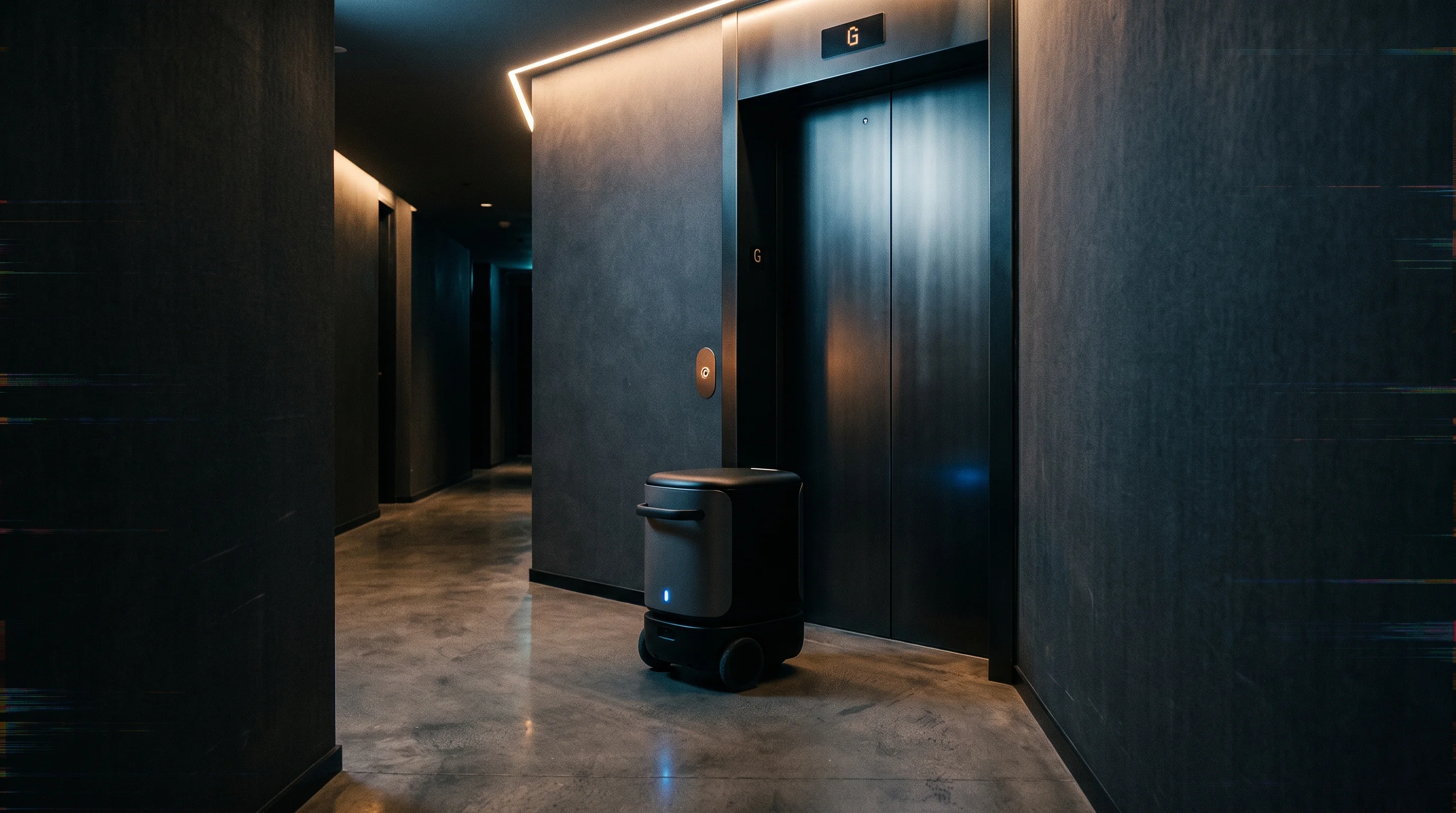
The constraints are well understood, even if they're not easily solved. Narrow hotel hallways. ADA clearance requirements. Elevator dwell times that can bottleneck throughput. High-variance back-of-house tasks that resist standardization. Bear Robotics tacitly acknowledged these realities when it introduced the Servi Q in May—a compact model designed explicitly for tight hospitality spaces. Safety certification under UL 3300 and ANSI standards will gate broader adoption, especially in guest-facing roles. And customer acceptance remains nuanced. Peer-reviewed studies published over the past couple of years show that robot appearance, perceived social cues, and the quality of human-robot collaboration all affect guest satisfaction and willingness to pay. Getting the user experience right isn't a secondary concern; it's table stakes.
For founders and investors eyeing this space, the hospitality robotics opportunity is real but conditional. Delivery and cleaning robots have proven they can work in specific contexts. Semi-humanoid and humanoid systems are entering pilot phases for manipulation-heavy tasks, but they're facing higher technical, regulatory, and economic hurdles. The companies that scale will be those that pair strong field execution with tight feedback loops, accept narrow initial scopes—perhaps narrower than their pitch decks suggest—and resist the temptation to oversell capabilities before the machines can deliver.
OS3's early deployment claim, vague as it is, suggests the founders understand the imperative. Whether their semi-humanoid robots can navigate the gulf between demo and dependable at-scale operation is the test ahead—not just for them, but for an entire cohort of startups betting that the hospitality labor crunch will finally make physical AI pencil out. The robots are in the field, or so they say. Now comes the hard part: proving they can stay there.


