

For the better part of a generation, the space industry fixated on one number above all others: the cost per kilogram to reach orbit. Lower that figure, the conventional wisdom held, and the rest would sort itself out.
It hasn't quite worked out that way.
Today, as pharmaceutical companies bioprint cardiac tissue aboard the International Space Station and British startups fire up plasma furnaces to manufacture semiconductors in orbit, a different constraint has surfaced. Getting products up there? Relatively straightforward now, at least compared to a decade ago. Bringing them back down safely, quickly, and affordably? That's turned out to be the trickier proposition.
The return logistics crunch has grown acute enough to reshape the economics of the entire nascent industry. Which might explain why 2026 has brought a minor proliferation of new reentry vehicles—some already flying, others approaching first flight—all chasing a market that analysts currently value at $1.5 billion to $1.8 billion in 2026, with projections climbing toward $3.5 billion by 2030 and potentially $6.3 billion by the early 2030s. Assuming, of course, manufacturers can actually get their products home.
Manufacturing in Orbit, Waiting in Line
Space-based manufacturing operates today in an odd limbo. The technical achievements are real enough. Redwire's BioFabrication Facility successfully bioprinted live human cardiac tissue and returned it to Earth by April 30, 2024—a genuine milestone by any measure. Space Forge fired up its plasma furnace aboard the ForgeStar-1 satellite in December 2025, marking what the UK company called "a completely new manufacturing frontier" for semiconductors. NASA campaigns have drawn over 11 kilometers of ZBLAN optical fiber in microgravity.
But here's the catch: all of these accomplishments share a common frustration. The products had to wait for available return capacity.
Dragon cargo capsules, which handle roughly 3,000 kilograms of downmass per mission, operate on schedules dictated by ISS crew rotations and station resupply needs. Manufacturers can't simply call for a ride when their production run completes. They queue. Sometimes for weeks or months.
This mismatch between manufacturing cadence and return availability has kept space-based production firmly in demonstration mode, even as ground-based pharmaceutical and semiconductor companies operate on production timelines measured in days or weeks, not months. It's like having a factory with no loading dock.
Why the Bottleneck Flipped
The calculus started shifting as launch costs collapsed. SpaceX's reusability breakthroughs drove per-kilogram launch prices down dramatically over the past decade—enough that sending payloads to orbit became almost routine for well-funded ventures. What didn't follow as quickly was downmass capacity, particularly independent capacity that manufacturing companies could book on their own schedules rather than waiting for shared Dragon missions.
The technical requirements differ substantially from launch, perhaps more than the early enthusiasm acknowledged. Reentry vehicles need robust thermal protection systems capable of surviving hypersonic plasma. Deceleration systems that keep payloads intact through multi-g loading. Recovery infrastructure to retrieve capsules within hours of landing, not days. These systems must be reliable enough for pharmaceutical-grade materials that might represent millions in production value, yet affordable enough to make the economics work against terrestrial manufacturing. That's a narrow target.
Regulatory frameworks have matured in parallel, though not without friction. The FAA's Part 450 licensing regime now covers commercial reentry operations with defined pathways, moving beyond the ad-hoc approvals that slowed early missions. Varda Space Industries progressed from single-mission authorizations to an expanded reentry license in June 2025, ultimately securing approval for up to 20 reentries through 2028 at Australia's Koonibba Test Range. The UK Civil Aviation Authority established return operator licensing under its Space Industry Act. New FAA user fees for launch and reentry licensing took effect in June 2026—modest costs, but signals of a transition to routine operations.
Then there's the ISS timeline, which hangs over all of this. A June 2026 Government Accountability Office report warned of a potential gap in low Earth orbit access as the station retires around 2030 if NASA does not plan ahead. That uncertainty pushes manufacturing ventures toward free-flying factories with dedicated return capabilities rather than ISS-dependent production. Nobody wants to build a business model around infrastructure that might not exist in four years.
The New Return Fleet
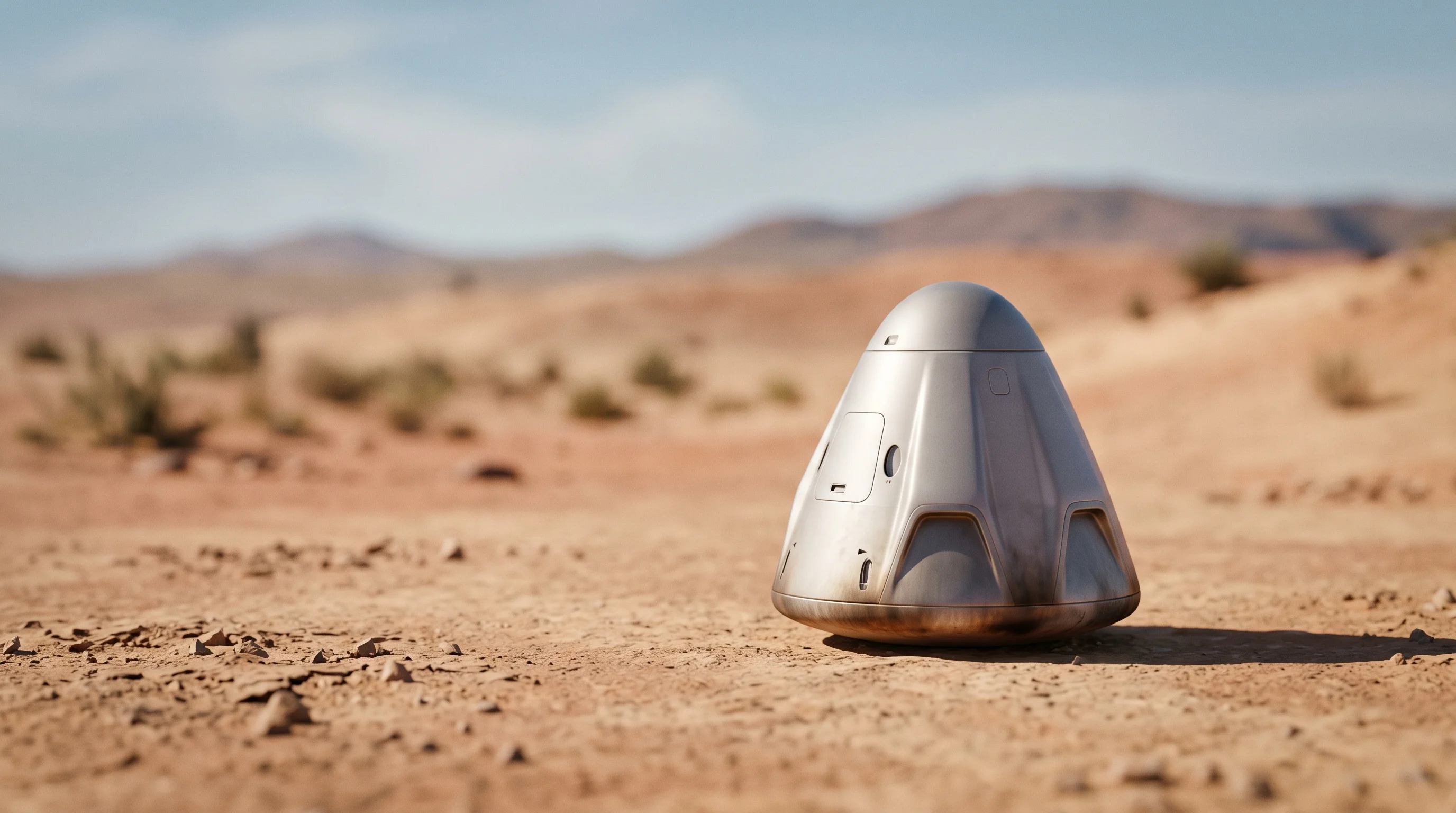
The competitive landscape for return logistics now features multiple approaches at various stages of maturity, some more proven than others.
Varda Space Industries has executed the most reentries to date—four landings at Koonibba in 2025-2026, including the W-5 mission in January 2026 that deployed an in-house manufactured C-PICA heat shield licensed from NASA. The company's focus on pharmaceutical production positions it squarely in the high-value materials market. Its W-1 mission processed ritonavir crystals and published preprint results, establishing at least some proof of concept.
SpaceX launched its first Starfall reentry capsule on June 23, 2026—a disc-shaped vehicle roughly 3.1 meters in diameter designed to return approximately 1,000 kilograms of cargo. FAA documents describe the system's purpose as enabling in-space manufacturing and rapid point-to-point cargo delivery, though the latter application remains more aspirational than operational. Starfall represents SpaceX's entry into uncrewed cargo return separate from its Dragon program, presumably targeting customers who need more schedule flexibility.
Sierra Space's Dream Chaser spaceplane, now targeting a late-2026 debut after years of delays, offers runway landing with up to 3,500 pounds of downmass capacity. The controlled landing profile appeals to manufacturers whose products might be sensitive to water landings or remote recovery operations—which is to say, most of them. ESA's Space Rider follows a similar runway-return concept, with 2026 parafoil drop tests advancing its development toward operational flights, though Europe's space programs have a way of stretching timelines.
Space Forge takes yet another approach with its reusable Pridwen heat shield system, designed for fold-out deployment and multiple reentries. The UK company secured £10 million in June 2026 from ESA and UK agencies to mature the technology for routine materials return from its ForgeStar satellites, betting that reusability will eventually trump single-use economics.
The Technical Details Matter More Than Usual

Heat shield technology has emerged as a key differentiator, which makes sense given that it's the component that determines whether your product vaporizes at 3,000 degrees or arrives intact.
Varda's ablative C-PICA approach prioritizes reliability for single-use missions—the material burns away in a controlled fashion, absorbing heat. Space Forge's reusable Pridwen aims to amortize costs across multiple flights, assuming the refurbishment economics actually work out. Dispatch Space, a Y Combinator-backed startup, claims to have validated "Mach 20+ capable" refurbishable shields through rocket-exhaust testing, positioning itself as a cost-focused challenger building what it describes as "100x cheaper" thermal protection systems manufactured in-house. Whether those cost claims survive contact with operational reality remains to be seen.
The market dynamics favor specialization, at least initially. Pharmaceutical applications—Redwire has announced plans with partners to pursue Investigational New Drug applications for space-processed materials—demand temperature control and gentle deceleration. Semiconductor manufacturing requires contamination-free environments. Bioprinted tissues need even tighter constraints on temperature and handling. One-size-fits-all solutions may struggle against purpose-built return vehicles, though that could change as volumes scale.
Yet commercialization timelines remain uncertain for many applications, perhaps more uncertain than the funding announcements suggest. While NASA's ZBLAN fiber campaigns demonstrated impressive draw lengths, independent analyses in 2026 emphasize that optical quality and attenuation performance—the metrics that actually matter for commercial deployment—still require validation. Similarly, semiconductor uniformity improvements shown in recent microgravity studies of InAsSb and SiGe crystals motivate further work, but don't yet constitute proof of commercial viability. The gap between "works in orbit" and "works better than terrestrial alternatives at a competitive price" is wider than press releases sometimes indicate.
The Next Two Years Will Tell
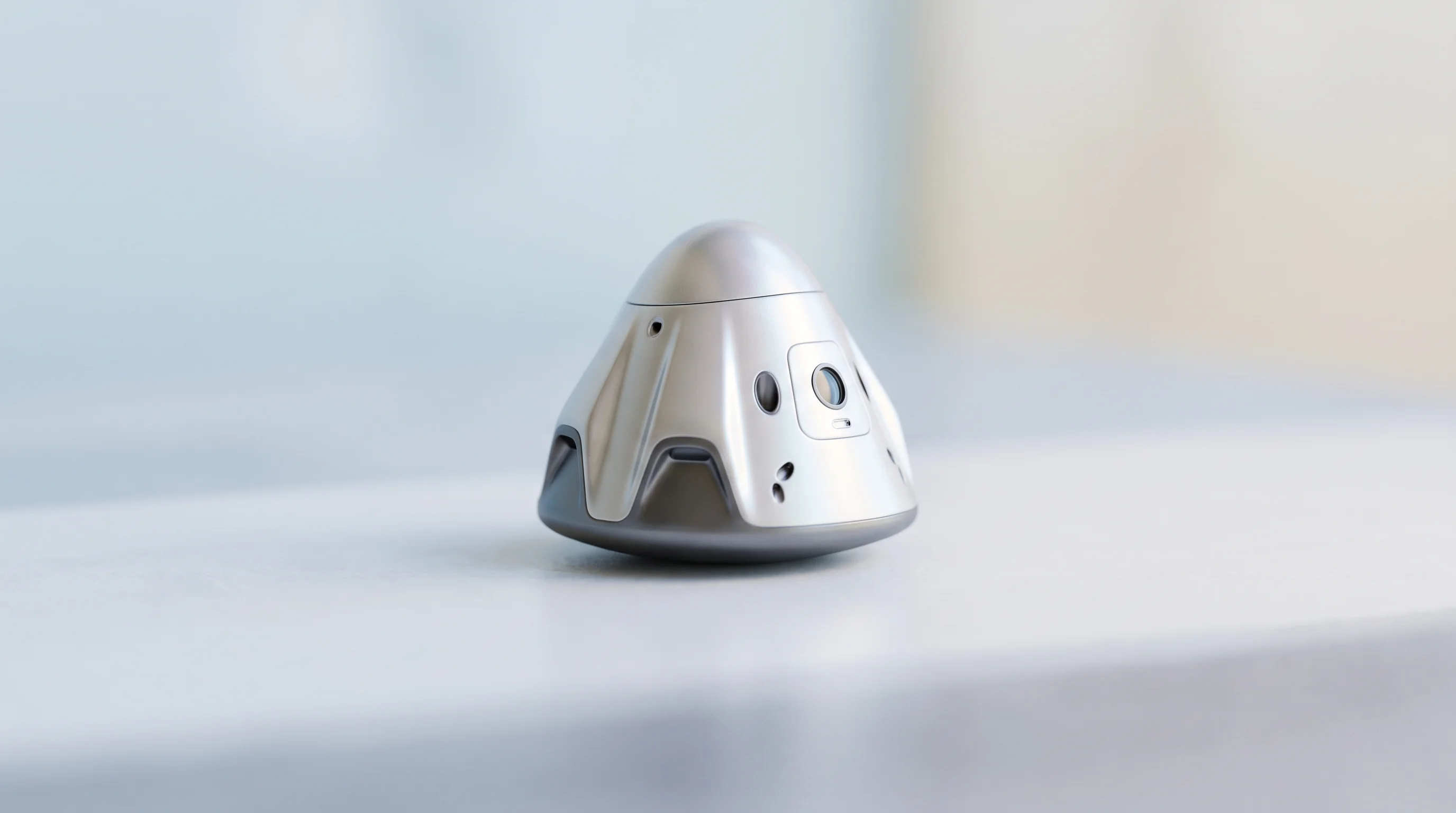
The next 18 to 24 months should clarify whether return logistics can transition from constraint to enabler. Dream Chaser's first flight, additional Starfall tests, continued Varda operations, and Space Rider's progression will add capacity and drive down costs through competition. The question is whether that capacity arrives fast enough to support the manufacturing ventures counting on it—and whether those ventures can deliver products that justify the entire apparatus.
Dispatch CEO Payton Case articulated the thesis in a May 2026 podcast: collapsing launch costs have flipped the bottleneck to return logistics. His company's bet on refurbishable reentry vehicles coupled with autonomous orbital stations represents one version of how this market might scale, assuming the economics hold.
The regulatory environment will matter as much as the hardware, perhaps more. FDA pathways for space-manufactured pharmaceuticals remain conventional—no special track exists for "space-made" drugs. Products must still demonstrate quality, safety, and efficacy through standard Investigational New Drug applications. That means return vehicles need pharmaceutical-grade environmental control, not just structural integrity. The FAA can license your reentry vehicle all day long, but if the FDA doesn't approve what comes back inside it, the business model collapses.
Perhaps the clearest signal comes from where capital flows. Space Capital's Q1 2026 investment tracking shows continued funding toward orbital infrastructure and manufacturing-adjacent segments, though enthusiasm has cooled somewhat from the 2021 peak. Aon's space insurance market reports indicate maturing risk frameworks for higher flight cadences. The pieces are assembling, if not yet fully in place.
What emerges in the next few years will likely determine whether microgravity manufacturing remains a niche research endeavor or becomes a genuine industrial sector. Launch access solved one problem—the easier one, it turns out. Return capacity is proving to be the harder lock to pick.


