

The FDA doesn't usually tip its hand this way. But last year, tucked inside a finalized guidance document that most people skipped over, the agency did something quietly radical: it declared that computational models—simulations of human bodies, organs, blood flow—could serve as primary regulatory evidence for medical device submissions. Not supplementary data. Not academic window dressing. The real thing.
That single bureaucratic shift, technical and dry as it sounds, has triggered a land rush. Billions in pharma capital, device manufacturer budgets, and clinical trial funding are now pouring into what insiders call "human-in-computer models." The premise is both simple and audacious: What if the next decade of medicine gets simulated before it ever gets prescribed?
Call them digital twins if you want. Or physiological simulators. Virtual patients. The nomenclature is still sorting itself out. What's not in question is the infrastructure race now underway.
The Money Is Moving
Start with the numbers, because they tell a story that's hard to ignore. Market analysts peg the healthcare digital twins sector at roughly $1.9 billion this year. By 2035? Try $33.4 billion, which translates to a compound annual growth rate hovering around 30 percent. Some trackers are more conservative—Custom Market Insights puts 2033 at $15.1 billion—while others veer aggressive, with Technavio forecasting nearly 44 percent CAGR through 2029. The dispersion in projections matters less than the consensus underneath: everyone expects a breakout.
What changed? Three forces converged, and none of them arrived smoothly.
First, regulators got serious. The FDA's computational modeling credibility guidance, which leans heavily on the ASME V&V 40 framework, finally gave device makers a clear pathway to submit in-silico evidence without the regulatory ambiguity that used to bog down these submissions. Then came the agency's Predetermined Change Control Plan (PCCP) guidance for AI-enabled software—also finalized in 2025—which allows pre-specified algorithm updates without forcing companies to resubmit entire applications. Meanwhile, the Model-Informed Drug Development (MIDD) paired meeting program, running through 2027, is normalizing the use of computational models in drug submissions. Europe is following the same thread: ICH M15 adoption goes legally effective in July 2026.
Second, and perhaps more important, data infrastructure started catching up. The TEFCA framework designated its first Qualified Health Information Networks late last year and into early 2025: eHealth Exchange, Epic Nexus, Health Gorilla, KONZA, MedAllies, CommonWell, Oracle Health. The FHIR roadmap is staged through 2027. USCDI v3 became mandatory on January 1, 2026. Translation for those outside the health IT trenches: it's finally—finally—getting easier to pull longitudinal EHR, lab, imaging, and wearable data into a single pipeline. Datavant partnered with AWS Clean Rooms to let pharma companies evaluate real-world datasets before acquisition, with OM1, Veradigm, and Ontada already live on the platform. The fragmentation isn't solved. But the plumbing is improving, which is maybe all you can ask for.
Third, the commercial proof points arrived. HeartFlow, the cardiac digital twin company, went public in August 2025 under ticker HTFL, having raised somewhere between $317 million and $364 million depending on which disclosure you trust. Their fractional flow reserve computed tomography platform—cleared via de novo back in 2014 and expanded through multiple 510(k)s since—is scaled, reimbursed, and clinically embedded in cardiology practices. FEops secured de novo authorization for HeartGuide, a planning tool for left atrial appendage occlusion procedures, showing that patient-specific simulation can guide structural heart interventions in real time. These aren't lab curiosities anymore. They're revenue-generating, FDA-cleared products with P&Ls.
What's Under the Hood

Behind those market projections sits a technology stack maturing faster than most people realize. At the foundation: physics-based solvers. Computational fluid dynamics (CFD), finite element analysis (FEA), physiological pharmacokinetics (PBPK), quantitative systems pharmacology (QSP) models—all of it has been around for decades, but it was slow, expensive, and isolated. The new trick is pairing those physics engines with machine learning emulators, neural networks trained to approximate the physics at a fraction of the computational cost. HeartFlow is filing for next-generation clearances that lean heavily on AI-powered plaque analysis. Dassault Systèmes announced a beta this year for AI-powered, configurable heart models under its Living Heart project, aiming to accelerate device testing and shave years off regulatory timelines.
But here's the real unlock, the thing that keeps coming up in conversations with people building these systems: a digital twin is only as good as the data feeding it. You need longitudinal EHR records, lab results, imaging, genomics, wearables—all harmonized, versioned, traceable. That's the problem a New York-based startup called Mantis Biotechnology is trying to solve.
Mantis, part of Y Combinator's Winter 2026 batch, describes itself as "Databricks for biomedical and clinical data." Founder Georgia Witchel, who previously built Louiza Labs (focused on physics-driven AI engines for multi-organ digital twins), positions Mantis as the "world's first domain-aware data platform that encodes biological and clinical meaning directly into reusable datasets." The company ingests data across electronic data capture systems, clinical trial management systems, lab vendors, omics platforms, even CSV files—creating canonical, versioned datasets with full lineage back to sources. According to posts from Menlo Times and LinkedIn, Mantis closed a $6.3 million seed round led by Decibel Partners, with StoryHouse Ventures, Y Combinator, Pioneer Fund, Spot VC, and Fenwick participating, though the company hasn't formally confirmed the figures.
Why does this matter? Because trial delays due to data accuracy and traceability issues are still endemic across the industry. Sponsors burn months wrangling cross-system queries that should be single-query operations. Witchel's argument is that without domain-aware data models—without encoding biological and clinical meaning into the data itself—teams end up rebuilding pipelines for every analytics project, every ML model, every operational report. If you're building a digital twin to predict patient response or simulate device interaction, your first bottleneck isn't the model. It's the data, every time.
The compute side is accelerating too. NVIDIA's Omniverse, Isaac, and Holoscan platforms are powering synthetic data generation, robotics simulation, and edge AI for medical applications. Johnson & Johnson MedTech is using Isaac to simulate operating room environments and rehearse robotic workflows for its MONARCH platform in urology. Siemens Healthineers deployed a digital twin of Mater Private Hospital's radiology department in Dublin to test layouts and workflows in 3D, reporting reductions in patient wait times and improved throughput. These aren't visualization exercises. They're operational optimization tools backed by physics and data, running in production.
Where the Rubber Meets the Road
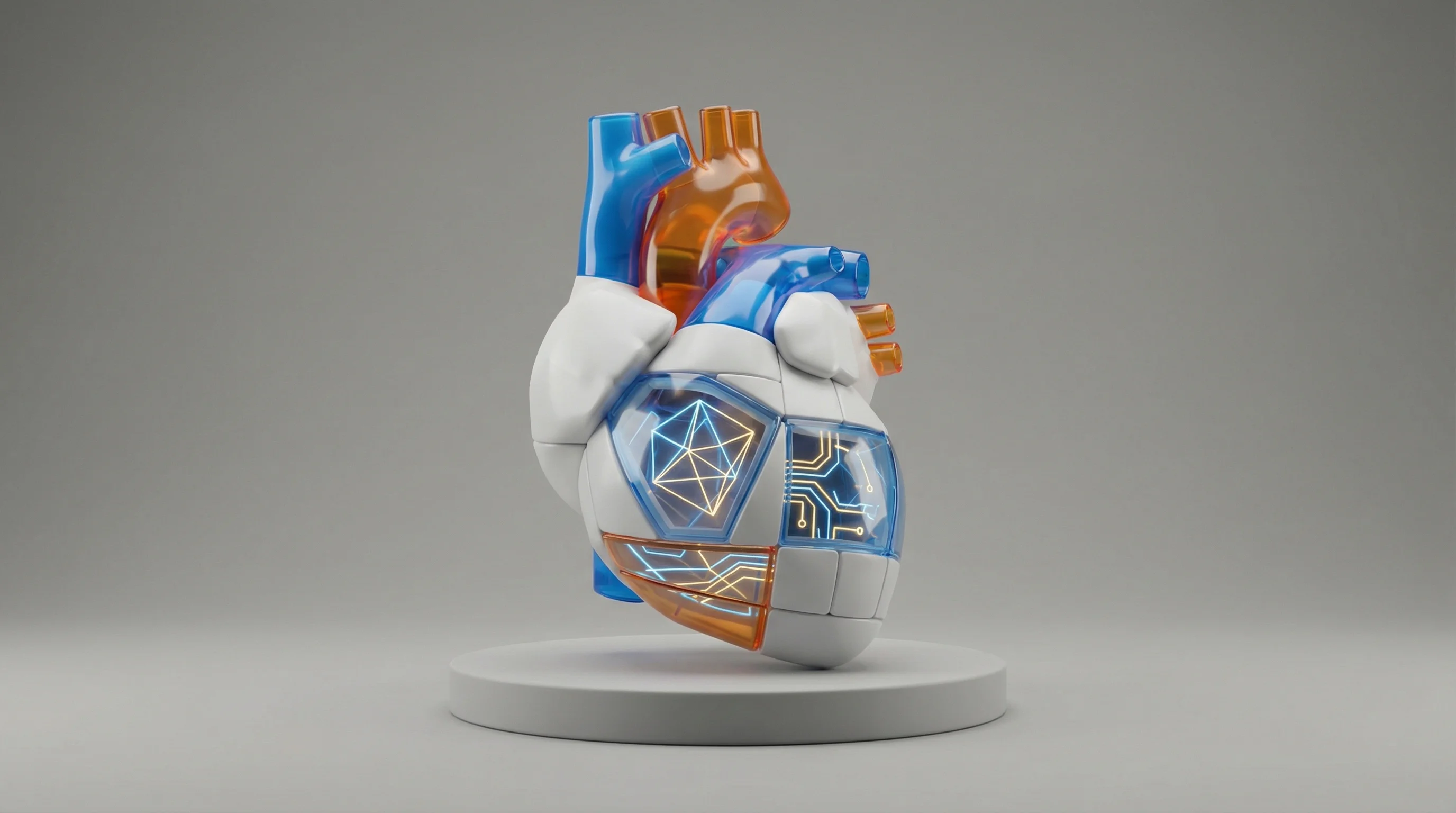
The cardiac space is furthest along, probably because the economics are clearest and the imaging data is richest. HeartFlow's IPO validated the business model, but it's not alone. FEops HeartGuide offers patient-specific planning for transcatheter aortic valve implantation (TAVI) and left atrial appendage occlusion, generating simulated device deployments from pre-procedure imaging. Academic centers like Johns Hopkins are testing digital twins for arrhythmia ablation planning—building patient-specific models from MRI to predict optimal ablation targets before the catheter goes in. The Wall Street Journal profiled the approach last year, noting the shift from research curiosity to clinical practice.
Clinical trials are another frontier, and maybe the most interesting one from a regulatory standpoint. Unlearn published a peer-reviewed pathway in 2024 for using AI-generated digital twins as external controls in regulated trials, aligning with the FDA's "context of use" framework. The approach boosts statistical power and reduces the number of placebo assignments—ethically appealing in diseases with high unmet need. Twin Health, a different kind of twin focused on whole-body metabolic models for precision lifestyle interventions, reported high Type 2 diabetes remission rates in interim randomized controlled trial data compared to standard care. The American Diabetes Association amplified the findings. While figures vary by study stage, the narrative is consistent: personalized simulation can drive clinically meaningful outcomes.
Device development is accelerating across the board. Dassault Systèmes' Living Heart model, used by hundreds of researchers, is entering an AI-powered phase intended to compress device testing cycles and streamline regulatory submissions. Open-source options like Kitware's Pulse Physiology Engine (an Apache 2.0 whole-body simulator) and OpenSim (musculoskeletal modeling) give smaller teams access to validated frameworks without enterprise licensing fees. Q Bio's "Mark I" autonomous scanner concept and digital twin platform aim at consumer-scale physiological profiling, though commercial rollout timelines remain unclear—perhaps deliberately so.
The most telling signal, though, might be this: the infrastructure layer is getting funded. Beyond Mantis, companies like Datavant are securing partnerships with top pharma firms to build privacy-preserving data discovery tools. Oracle's Clinical One EDC is integrating EHR data directly, and Oracle Health's QHIN designation strengthens its interoperability claims, at least on paper. Particle Health joined CommonWell's QHIN to participate in TEFCA exchange. Veeva, Medidata, and other clinical trial incumbents are adding data aggregation and lineage tracking features. No one wants to be left running the old data warehouse playbook when the market shifts to simulation-first design.
What Happens Next
The next 12 to 24 months will test infrastructure readiness in ways that might not be obvious yet. TEFCA's FHIR roadmap stages deeper API-based interoperability through 2027, and USCDI v5 and v6 will expand the standardized data available for modeling. Expect more trial protocols to incorporate model-informed design elements as the FDA's MIDD program matures and pharma sponsors get comfortable with the approach. Those sponsors will demand auditable data lineage and context-of-use validation—exactly the pain point that data platforms are racing to solve, and the reason venture dollars are flowing in.
By 24 to 48 months out, organ-specific twins should be routine in regulated device planning, not experimental. Cardiac and structural heart applications are leading, but orthopedics, neurology, and oncology aren't far behind. Surgical robotics rehearsal will expand from urology (Johnson & Johnson's current focus) to other specialties as the NVIDIA ecosystem matures and more hospitals invest in simulation infrastructure. Hospital operations twins will move beyond radiology to perioperative flow, bed management, staffing optimization. Siemens' Mater Private deployment is just a preview of what's coming.
Regulatory timelines matter more than usual here. The EU AI Act's high-risk provisions kick in August 2, 2026, which means any digital twin with diagnostic or therapeutic impact in Europe needs conformity assessment and post-market monitoring plans now, not later. In the U.S., the PCCP framework will normalize faster iteration cycles for AI-enabled devices post-clearance, which could meaningfully change the economics of continuous improvement. Pharma is watching the MIDD program closely; if modeling reduces Phase 3 timelines or attrition rates even modestly, investment will follow.
The open question—and it's a big one—is validation. Regulators are explicit about this: context-specific validation is non-negotiable. A twin validated for one indication, one population, one device doesn't transfer automatically to another use case. That's why Unlearn's work on prospective performance targets and external validation protocols matters beyond its own commercial success—it's building a roadmap that others will follow. The academic community is pushing for statistically valid post-deployment surveillance of AI models, but many clinical tools still lack it. The infrastructure has to support not just model training but continuous monitoring and re-validation as populations drift over time.
Data fragmentation remains the bottleneck, maybe the only bottleneck that really matters. Cross-system harmonization, provenance tracking, quality constraints—these are hard problems, and most organizations are still in the plumbing stage. Platforms emphasizing canonical datasets and domain-aware modeling, whether it's Mantis or the big EDC players adding similar features, are betting that the winner in this market won't be the one with the fanciest physics engine. It'll be the one that makes the data trustworthy enough to simulate a human and have regulators, clinicians, and payers believe the result.
The Real Bet
The stakes are straightforward, even if the execution isn't. If you can simulate a patient cohort before recruiting, you run smaller, faster trials. If you can simulate a device in a digital heart before manufacturing prototypes, you cut R&D timelines by years. If you can simulate a surgical workflow before cutting, you reduce complications and improve outcomes. The economics are compelling. The regulatory pathways are opening, if unevenly. The compute is there, and getting cheaper.
What's left is proving that the models don't just correlate—they predict. That they generalize. That they fail gracefully when they do fail, and that someone is watching when they do.
Pharma, device makers, and clinical trial operators are placing their bets regardless. The race isn't to build the perfect digital human, a goal that remains science fiction. It's to build the infrastructure that makes the imperfect ones useful enough to matter. Useful enough to change how drugs get approved, how devices get tested, how patients get treated.
The FDA made its bet last year, quietly, in a guidance document. The market is making its bet now, loudly, with capital and talent and partnerships. What happens when those bets pay off—or don't—will shape medicine for the next decade.
And it all started with a paragraph in a regulatory document that most people never read.


