

The night shift at a nursing home is when the arithmetic turns brutal. One aide for thirty residents, sometimes forty if someone called in sick. When Mrs. Chen needs repositioning at 2 AM or Mr. Davis drops his medication cup, that aide is three rooms away, attempting the impossible calculus of being everywhere at once. It's a staffing equation that simply doesn't work—and it's deteriorating.
The numbers tell part of the story. Census Bureau estimates published in June 2025 showed that by 2024, more than 61 million Americans had crossed the threshold into 65-plus territory, representing 18 percent of the population. The 80-to-84 and 85-and-older cohorts—the groups most likely to need intensive care—are expanding fastest through 2030, according to a McKinsey analysis from February of last year. Meanwhile, the Bureau of Labor Statistics has projected the need for nearly 740,000 additional home health and personal care aides between 2024 and 2034, a 17 percent jump in a field already stretched past its breaking point.
Into this widening gap has stepped an emerging category of technology: semi-humanoid robots designed not merely to ferry meal trays or vacuum hallways, but to engage with residents, remember their preferences, and provide what their creators characterize as "social intelligence." Startups like Y Combinator-backed Twolabs are building machines capable of conversation, overnight supply restocking, and something more elusive—companionship. These are tasks that occupy an uncertain space between hard automation and human connection. Whether facilities will actually adopt these robots in meaningful numbers, and whether residents and their families will truly accept them, remains very much an open question. The demographic pressure, though, is forcing the conversation whether the industry is ready or not.
The Capacity Crisis
The infrastructure looks like this: 2022 CDC figures showed roughly 14,700 nursing homes with 1.6 million licensed beds serving approximately 1.2 million residents. Layer on more than 32,000 assisted living communities, according to trade association estimates that circulated through 2025 and into last year. The assisted living sector alone employed over 512,000 people as of mid-2026, National Center for Assisted Living data showed.
The facilities are losing staff faster than they can recruit them. OECD reports from the 2023-2025 period described persistent workforce shortages across member countries in long-term care—deficits made worse by COVID-19 and rooted in low pay and punishing working conditions. Then came regulatory pressure. A Centers for Medicare & Medicaid Services rule issued April 22, 2024, now mandates minimum staffing levels: 3.48 hours per resident day in total, including at least 0.55 hours from registered nurses and 2.45 hours from nurse aides, plus a round-the-clock RN presence. Non-rural facilities face compliance deadlines this year; rural ones have until next year.
The rule aims to improve care quality. It also intensifies pressure on operators already struggling to fill positions. Some facilities qualify for exemptions. Many don't. The chasm between what regulators require and what the labor market can supply keeps widening.
Where Three Pressures Converge

The crisis sits at the intersection of demography, regulation, and technological capability.
First, scale. Globally, one in six people will be 65 or older by 2050, per UN projections. In the U.S., Census Bureau analysis from April last year underscored the ongoing shift toward older cohorts. The 80-plus population—the segment most likely to require intensive care—is growing fastest. McKinsey's chartbook flagged this as a capacity crunch in the making, and it's difficult to see how they're wrong.
Second, those new CMS staffing standards establish a baseline many facilities simply cannot meet. The rule may be necessary, perhaps even overdue. It's also expensive and operationally daunting in markets where qualified aides are scarce. Operators are exploring every available lever that might return time to licensed staff or reduce the chaos driven by constant turnover.
Third, AI and robotics have advanced enough to attempt tasks that would have seemed implausible a decade ago. Large language models enable natural conversation, memory of past interactions, multilingual dialogue. Vision-language-action models allow robots to perceive environments and manipulate objects with steadily improving dexterity. The result: machines that can theoretically handle low-touch assistance—fetching items, delivering meals, monitoring hallways overnight, even providing conversational presence.
The International Federation of Robotics reported around 200,000 professional service robot units sold worldwide in 2024, up 9 percent year-over-year, with logistics applications dominating by volume. Healthcare and medical robots remain a smaller slice but are growing. Social robots for elder care represent a niche within that niche. Interest is climbing, though, as the workforce crisis shows no sign of abating.
Enter the Robots
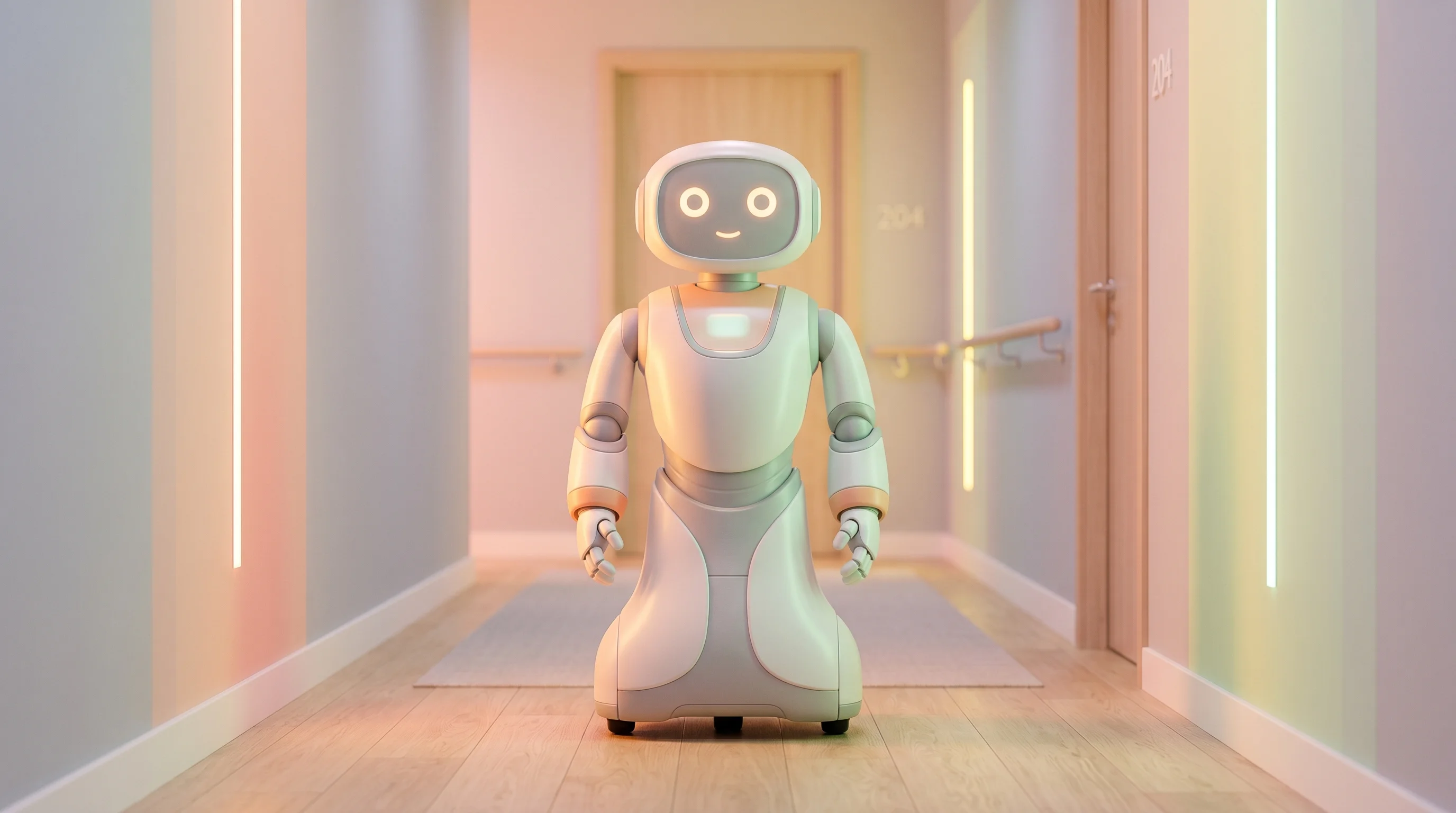
Twolabs is building "Tobi," a semi-humanoid robot aimed at nursing homes and senior living communities. The San Francisco company, part of Y Combinator's batch from earlier this year, describes its focus as "useful + social." According to its website and YC profile, Tobi is designed for night shifts—restocking, repositioning residents, observation—and low-touch tasks like picking up dropped objects, delivering items, serving meals. Companionship also makes the list: conversation, presence, the sense of not being entirely alone at 3 AM.
Co-founders Sardor Rahmatulloev, who led a nationally ranked autonomous combat robotics team at Cornell and joined Meta's Superintelligence Labs at 23, and Danyal Ahmad, a former Salesforce principal engineer with a master's in AI from Georgia Tech, are training vision-language-action models and constructing what they call a "social intelligence layer." The company has credited Almond Robotics for robot embodiment in demo posts, suggesting they're using third-party hardware during the prototyping phase. Funding amounts, pricing, and customer names haven't been publicly disclosed.
Andromeda Robotics, based in Australia with U.S. expansion underway, offers "Abi," a humanoid roughly 110 to 120 centimeters tall that speaks 90 languages. Australian aged care provider mecwacare deployed 22 Abi robots across all its facilities last April, according to an April 17 press release. Around the same time, Eskaton, a Northern California memory care operator, had introduced Abi in one of its neighborhoods. The company reportedly raised $23 million in a Series A round in September 2025.
Intuition Robotics' ElliQ—a tabletop companion device rather than a humanoid—warrants mention for its scale. New York State's Office for the Aging began deploying ElliQ units in 2022, with updates through last year showing ongoing rollouts. Intuition Robotics raised $25 million in August 2024, led by Woven Capital. The device provides wellness coaching, conversation, reminders—addressing isolation, which affects a substantial portion of older adults living alone.
In Europe, PAL Robotics' ARI humanoid has appeared in geriatric day care pilots, including a 2025 mixed-methods study published in JMIR Human Factors on April 16. The Paris-based deployment integrated large language models for more natural interaction. Results suggested cautious optimism on acceptability and usability, though sample sizes were small—a recurring limitation in this literature.
Meanwhile, non-social robots are gaining traction in operational efficiency. Real estate investment trust Sabra Health Care, working with Direct Supply, scaled SoftBank Robotics' Whiz autonomous vacuums across its senior living portfolio in 2025, logging "100-plus robot hours in a single day" across managed communities. Diligent Robotics' Moxi, a mobile manipulator handling hospital logistics and pharmacy deliveries, surpassed 100,000 autonomous elevator rides in hospitals by late 2024. (Serve Robotics acquired Diligent the following January.) These examples demonstrate operational integration and measurable time savings, even if the tasks involved are less emotionally complex than companionship.
What the Research Actually Shows

Academic literature on socially assistive robots in elder care has expanded considerably from 2023 through 2025. Systematic reviews and meta-analyses suggest potential reductions in agitation, anxiety, and loneliness among residents, particularly those with dementia. Robots like PARO (a therapeutic seal) and Pepper (a humanoid from SoftBank) have appeared in multiple studies. A pilot randomized controlled trial published last October in the Journal of the American Medical Directors Association compared PARO to human visits in hospitalized older adults with dementia.
The evidence, though, remains uneven. Many studies are short-term, with small samples and varying outcome measures. A systematic review in JMIR Aging from last year noted that effects vary by cognitive function, staff presence, robot type, and intervention schedule. Longer randomized controlled trials in actual nursing homes are limited—a significant gap.
Acceptance is decidedly mixed. A Nature perspective published April 25, 2024, captured skepticism from some gerontologists and outright resistance in certain care homes. Concerns about robots being "creepy" or manipulative haven't disappeared. Participatory design—involving residents, families, and staff early in the process—appears critical. Staff perspectives, documented in qualitative studies from the past two years, emphasize the need for role clarity, adequate training, and reassurance that robots will complement rather than replace human caregivers. That reassurance, it should be noted, is not always convincing when facilities are simultaneously cutting positions.
Regulatory frameworks are beginning to catch up. The EU's AI Act, published in the Official Journal on July 12, 2024, and entering force August 1, imposes transparency obligations on conversational agents and stricter requirements on high-risk AI systems, including those using emotion recognition. Staggered application timelines run through this year. In the U.S., robots that create, receive, or transmit protected health information must comply with HIPAA, requiring business associate agreements and adherence to the Security Rule. Japan's Ministry of Economy, Trade and Industry revised its priority fields for long-term care technology last June, with new policies taking effect this past April, potentially opening pathways for subsidies and pilots.
The Next Act
The next three to five years will test whether social robots can scale beyond controlled pilots. The technology is advancing—large language models make conversation more fluid, vision systems improve object recognition, and costs may decline as production ramps up. But deployment in elder care brings unique challenges: regulatory scrutiny, ethical landmines, fragmented procurement across thousands of independent facilities, and the need to prove not just engagement metrics but actual operational return on investment.
For founders and investors, the opportunity sits at the convergence of three trends: an aging population that will only grow larger, a workforce that cannot expand fast enough, and AI capabilities finally approaching usefulness in unstructured social contexts. Twolabs and its peers are betting that "social intelligence" can be engineered—that a robot can recognize when a resident is anxious, adapt its tone, remember yesterday's conversation, and in doing so, lighten the load on overstretched aides. Whether that bet pays off is another question.
For healthcare executives and senior living operators, the calculus is more immediate. The CMS staffing rule's deadlines loom. If a robot can handle even a fraction of non-clinical tasks—restocking linens, delivering medications to nurse stations, monitoring hallways at night—it might free enough human hours to meet the mandate. The question is whether residents and families will accept that tradeoff, and whether the upfront cost makes sense against already tight margins. Many operators remain skeptical, understandably so.
For policymakers, the rise of social robots in elder care raises uncomfortable questions about dignity, autonomy, and what constitutes adequate care. Should public programs subsidize companion robots, as New York has done with ElliQ? Should regulations require transparency when a resident is interacting with AI? How do you balance innovation incentives against the risk of dehumanizing vulnerable populations? There are arguments on both sides, and no easy answers.
What seems clear is this: the demographic math is unforgiving, the staffing crisis is worsening, and the robots are already here, in early deployments across multiple continents. Whether they become a standard fixture in elder care or remain a niche experiment depends on whether the technology can deliver not just social intelligence, but something harder to quantify and far more elusive—trust. That's the real test, and one that won't be answered by engineering alone.


