

Somewhere in the hills above Los Angeles, a camera picked up the first wisps of smoke at 2:47 on a Thursday afternoon. Three minutes later, fire crews were rolling. The blaze was snuffed out before it touched a single home.
A decade ago, that same fire might have smoldered unnoticed for half an hour or more—long enough to become the kind of inferno that devours entire neighborhoods before anyone realizes what's happening.
That shrinking window between ignition and intervention represents the new battlefield in wildfire response. And it's being fought with an arsenal of AI-powered cameras, orbital sensors, ground-based detection networks, and—perhaps most ambitiously—autonomous aircraft that can attack fires without waiting for human pilots to strap in. The technology is varied, the pace of deployment is quickening, and venture capital is pouring in behind it.
Whether any of this arrives fast enough to outpace the fires themselves remains an open question. But the infrastructure is moving from concept to reality with a speed that even optimists didn't anticipate three years ago.
Cameras Everywhere
Pano AI has become something of a poster child for the camera-detection boom. The company pulled in $44 million in a Series B round last June, pushing total funding past $89 million, and has scattered AI-driven 360-degree camera towers across much of the western U.S. Xcel Energy planned 38 systems for Minnesota as of last October. Arizona Public Service installed cameras in March. New Mexico moved toward more than 40 stations by November. Washington State's Department of Natural Resources went live with a public-facing camera feed in July, all powered by Pano's platform.
The setup pairs mountaintop cameras with human verification—an analyst reviews alerts before dispatching crews—and triangulates signals across multiple stations to pinpoint ignition sites. In February, Pano announced it would integrate with Technosylva's fire modeling software, effectively linking real-time detection with predictive simulation. What's burning now meets what could burn next.
Pano isn't operating in a vacuum. ALERTCalifornia runs more than 1,100 publicly accessible cameras statewide, feeding AI detection algorithms that CAL FIRE relies on for early warnings. A report from January found that AI cameras flagged 38% of incidents before anyone dialed 911—a sobering reminder of how often fires start in places where no one's looking. ALERTWest is pushing the network into neighboring states. FireScout offers AI-powered smoke detection as a service for existing camera networks, including the long-running ALERTWildfire feeds.
What was experimental infrastructure just a few years back is now showing up in utility wildfire mitigation plans from Minnesota to Arizona, embedded in the operational fabric.
Sensors That Smell Trouble
Cameras can see smoke. Sensors can detect it earlier—sometimes before flames even appear.
Dryad Networks, a German startup, has deployed solar-powered gas sensors arranged in a LoRaWAN mesh designed to catch smoldering fires in their earliest stages. The company raised €6.3 million last October and is developing an AI-equipped drone prototype called Silvaguard, intended to autonomously confirm and suppress fires. A public demo in Germany last March showed the drone working in tandem with Dryad's Silvanet sensor array.
N5 Sensors took a different tack. Its N5SHIELD mesh network detects smoke and combustion gases and has been piloted by the Department of Homeland Security, with deployments scattered across Maui, Colorado, and California's wildland-urban interface zones. This January, N5 acquired KNOW-WILDFIRE, a decision-support platform—a clear signal the company is expanding from detection into operational intelligence.
SenseNet blends gas sensors with optical and thermal cameras in a hybrid network. Last August, the company partnered with Rogers to deploy systems across ten Canadian communities. A Brazil rollout with iez! followed in March.
The underlying bet: chemical signatures arrive before visual ones, buying critical minutes. Whether that advantage translates into measurable suppression gains at scale is still being proven out. But the technology has moved decisively from lab bench to forest floor.
Satellites Join the Fight
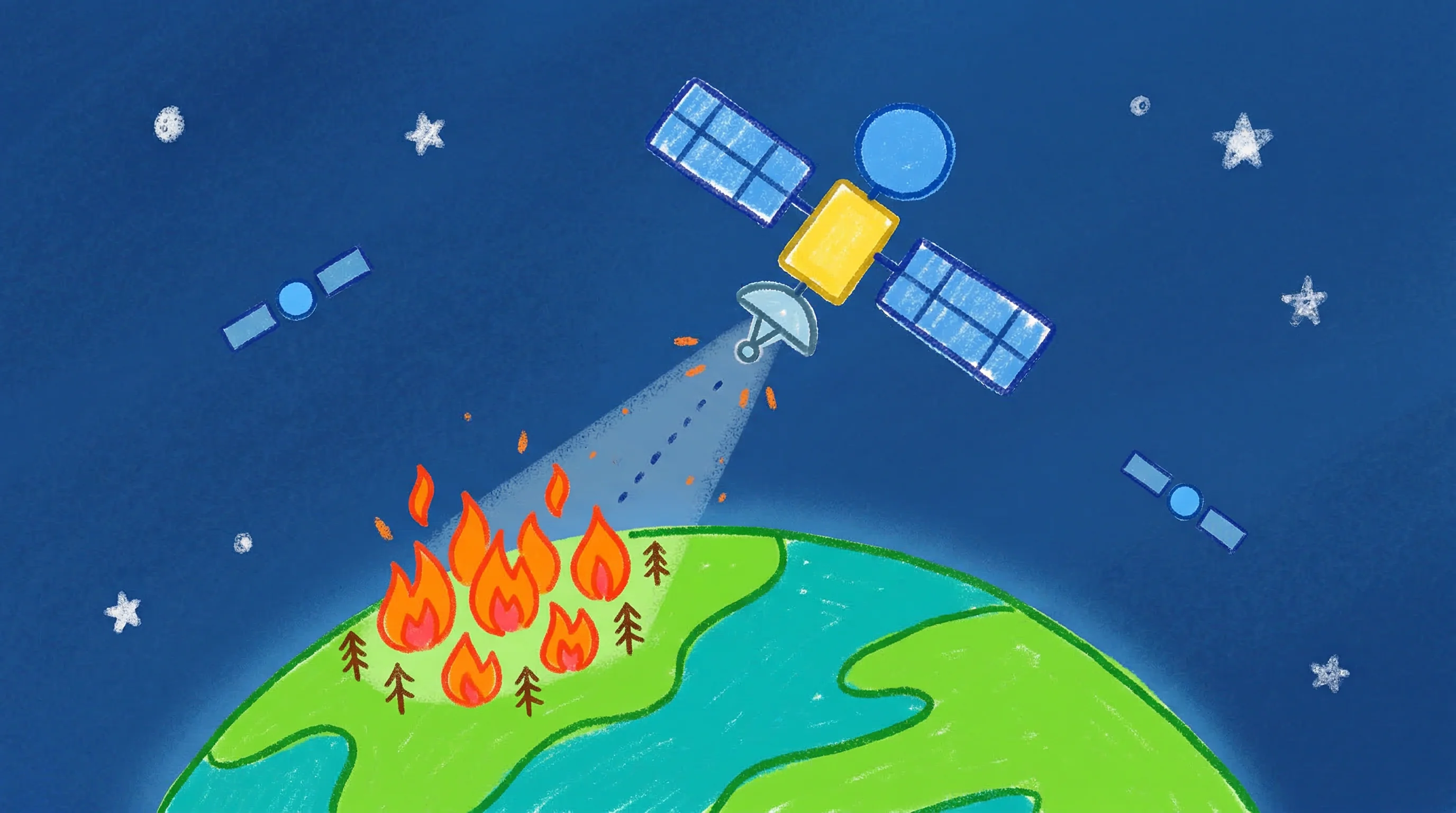
On March 27 last year, OroraTech launched what it called the world's first dedicated wildfire detection satellite constellation—eight satellites delivered into orbit via Rocket Lab. The Munich-based company had raised €25 million in a Series B round the previous October to bankroll the constellation buildout and sharpen its AI models. Colombia's national wildfire program adopted OroraTech's technology last October. The Canadian Space Agency contracted with Spire and OroraTech for a wildfire satellite program, with a precursor satellite slated for 2027 and nine operational satellites expected by 2029.
The U.S. government is moving in parallel, if more slowly. Last July, the USDA, Department of the Interior, and NASA announced an expanded push to leverage satellites for early wildfire detection—a policy framework aimed at tapping both existing and future orbital assets.
Satellites offer something ground systems can't: global coverage and the ability to spot fires in remote terrain where cameras and sensors are impractical or impossible to deploy. The tradeoff is temporal resolution. A satellite revisits the same patch of earth every few hours, not continuously. For ignitions near populated areas or high-risk infrastructure, ground-based networks still win on speed. But for tracking fires in backcountry wilderness? Satellites may be the only game in town.
The Grid Gets Smarter
Utilities, driven by crushing liability exposure and tightening regulations, have become unlikely leaders in wildfire prevention tech. Gridware raised $26.4 million in a Series A last February to deploy sensors on power lines that monitor grid health and detect electrical faults before they spark fires. Last July, during a heat wave, a Gridware alert enabled PG&E crews to intervene before ignition—a small victory that could have prevented a catastrophe.
Overstory pulled in $43 million in a Series B last November to scale satellite-based vegetation monitoring for utilities. The company testified at a FERC wildfire technical conference in October—a sign regulators are treating grid-adjacent intelligence as critical infrastructure, not optional tooling.
Buzz Solutions analyzes grid imagery with AI to flag defects that could ignite fires. Separately, Rhizome Data raised a $6.5 million seed round in mid-2025 and partnered with National Grid in December to deploy its gridFIRM risk platform across Massachusetts, New York, and the UK. The product had launched just last July.
The grid-monitoring layer reflects a hard-won lesson, paid for in lawsuits and scorched acreage: most catastrophic wildfires in the western U.S. don't start from lightning. They start from power infrastructure. Detection matters, yes. But prevention may matter more.
Modeling the Unthinkable
Technosylva deployed what it describes as "the world's largest dedicated wildfire supercomputers" last September, churning through one billion fire simulations daily to support utility planning and real-time operational calls. Its Wildfire Analyst platform is used by U.S. utilities and CAL FIRE for decisions around public safety power shutoffs and resource deployment.
AiDash launched wildfire mitigation planning services last March and announced record quarterly results with its CRIS 2.0 Wildfire product in August. The company integrated with BurnBot in July and Technosylva in August, stitching together vegetation management with fire modeling.
Salo Sciences provides high-resolution fuels data for California, feeding into PG&E's wildfire models. A product sheet from December described 10-meter fuels datasets and 200 million simulations. Jupiter Intelligence's ClimateScore Global includes a wildfire risk module at 90-meter resolution, projecting both current and future risk—data that shows up in utility filings and regulatory submissions.
The modeling layer is less visible than cameras or drones, but it underpins the operational decisions that determine where crews deploy, when utilities cut power, and which neighborhoods get evacuated first. The question isn't whether modeling is useful. It clearly is. The question is whether models can keep pace with climate-driven shifts in fire behavior that are rendering historical data less predictive than it used to be.
Machines That Fight Back
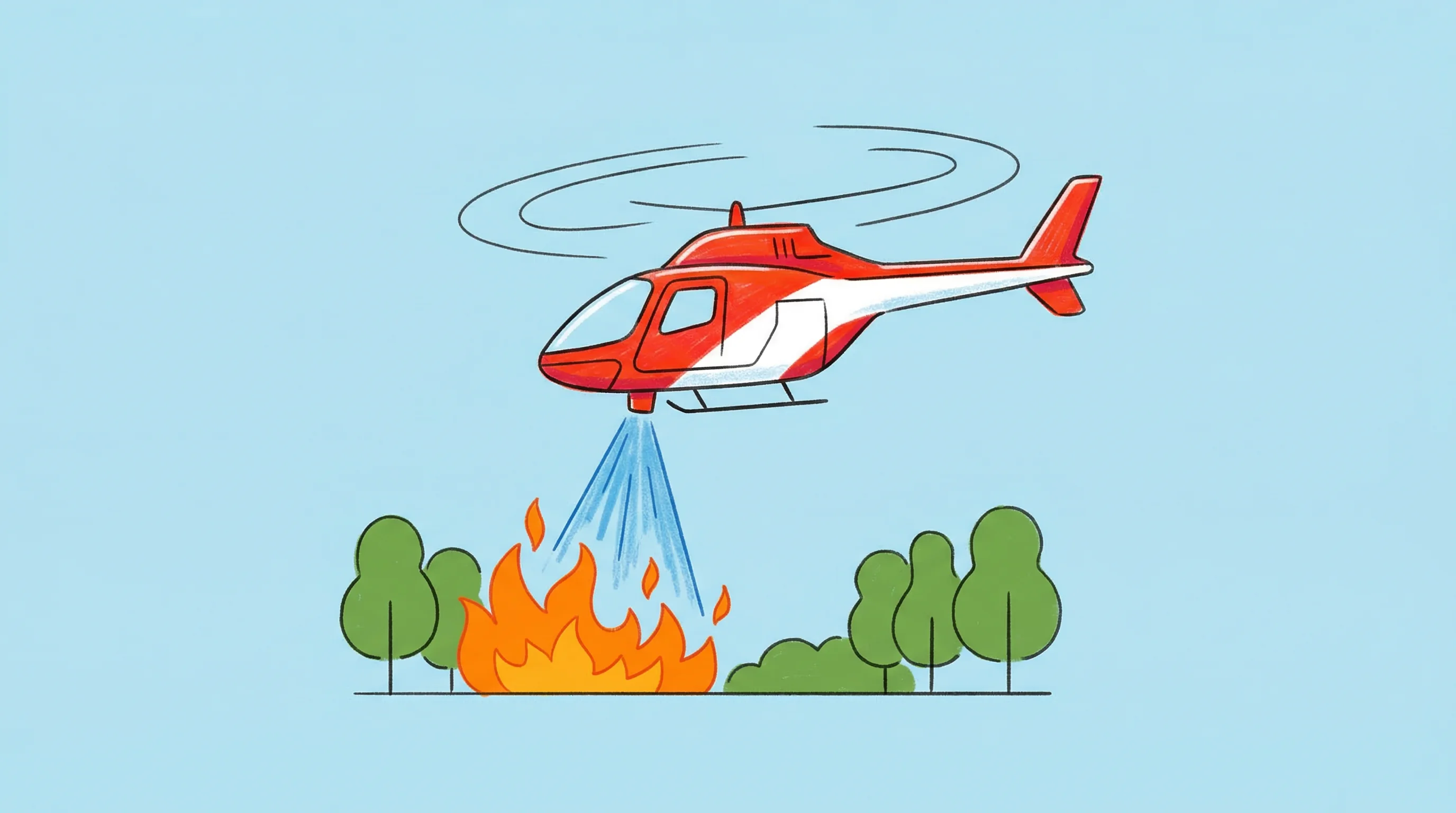
Detection is half the equation. Response determines whether homes burn or don't.
Rain Industries is building autonomous aircraft for rapid initial attack—integration with detection networks and a collaboration with Sikorsky to demonstrate autonomous Black Hawk and Firehawk operations. A California live-fire demonstration and a pilot program funded by EPIC with PG&E both happened in 2025.
Parallel Flight secured an FAA exemption in February for heavy-lift drone operations under federal statute 49 USC §44807. The company's Firefly hybrid UAS is designed for aerial suppression and logistics. The Office of Naval Research awarded Parallel Flight a $3.74 million Phase II SBIR last September.
The $11 million XPRIZE Wildfire competition has emerged as a forcing function for this technology. Finalists in the autonomous response track were announced in February. Team FireSwarm—integrating infrared sensing, swarm drones, and suppression systems—advanced as one of five finalists. Dryad is another, pairing its Silvaguard drone with ground sensors.
Finals testing is set for 2026 in Alaska. The rules are unforgiving: autonomous systems must detect, navigate to, and suppress a fire without human intervention. Whether any team clears that bar could fundamentally reset expectations for what's technically possible in wildfire response. It's also the kind of challenge that tends to produce spectacular failures alongside breakthroughs.
The Supporting Cast
BurnBot raised $20 million in a Series A back in April 2024 for autonomous prescribed burn technology—a different angle on the same core problem: reducing fuel loads before fire season. Kodama Systems is automating forestry equipment to thin forests more efficiently, with pilot operations at the site of the Park Fire.
Frontline Wildfire Defense raised $48 million in a Series A last October for home-scale suppression systems, claiming a 96% survival rate for equipped homes during recent Los Angeles-area fires. FortressFire expanded aerial risk assessments to twelve states in December, providing property-level mitigation guidance for insurers and homeowners.
The insurance industry is adapting in real time. ZestyAI's wildfire risk model became filing-ready in California last February. Kin Insurance adopted the model for its California expansion in June. Kettle, an AI-driven wildfire managing general agent, wrote roughly $20 million in premium in 2024 and launched a non-admitted multi-peril product with RLI in February.
California's regulatory shift—announced in 2024 and refined through subsequent rule changes—allowing broader use of catastrophe models has accelerated adoption of AI-based risk assessment. The insurance layer is shifting from reactive to predictive, deploying the same technologies utilities use for prevention.
What Happens Next
The wildfire technology stack is no longer theoretical. It's operational, funded, and scaling. Camera networks are detecting fires in minutes. Sensors detect them earlier. Satellites provide global eyes. Utilities are preventing ignitions before they happen. Simulations guide deployment decisions. Autonomous systems are entering field trials.
The coordination problem remains unsolved. Detection systems don't always communicate with each other or with the firefighters who need the information. Autonomous aircraft face a thicket of regulatory barriers. Modeling accuracy degrades under climate conditions that have no historical precedent. But the trajectory is unmistakable: the time between ignition and intervention is compressing, and the technologies driving that compression are proliferating.
Perhaps the clearest signal is where the money is landing. Giant Ventures led Pano's Series B. Sequoia led Gridware's Series A. Blume Equity led Overstory's Series B. Convective Capital, a wildfire-focused venture firm, has backed Pano, BurnBot, Rain, and others across the ecosystem. This isn't patient, experimental capital betting on distant breakthroughs. It's growth capital wagering on near-term deployment and revenue.
The fires aren't slowing. The question is whether the technology racing to meet them can accelerate faster.


