

Five years. That's how long it now takes, on average, to connect a new data center to the electric grid—a timeline that Lawrence Berkeley National Laboratory has documented in its ongoing analysis of interconnection queues, with data running through 2024-2025 for projects that came online in 2023. For companies racing to build AI infrastructure, it's become something close to an impossible constraint.
Voxel Energy thinks it has found a workaround, though perhaps a radical one: don't bother with the grid at all.
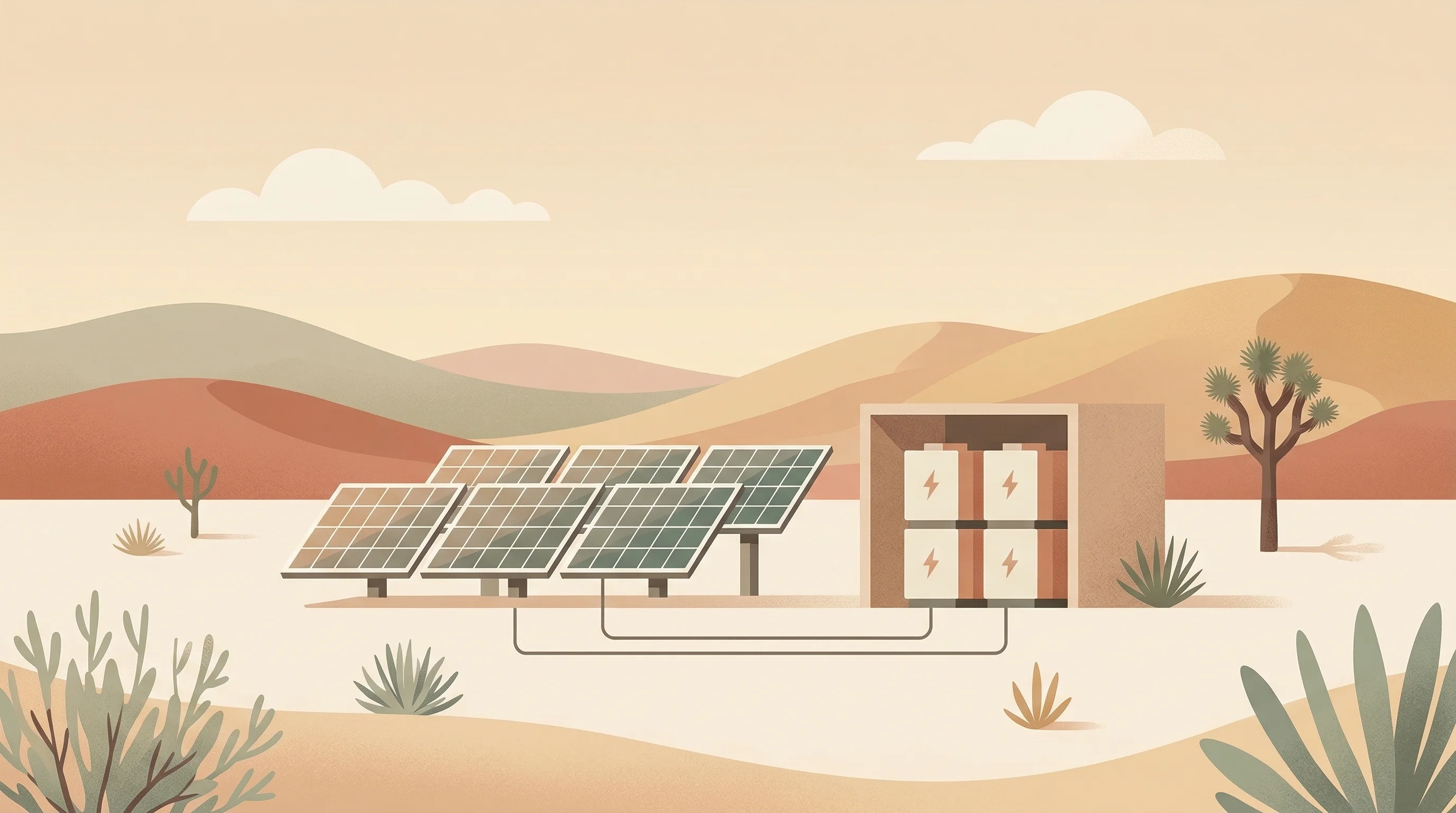
The startup, fresh from Y Combinator's Winter 2026 cohort, is constructing data centers powered exclusively by on-site solar arrays and repurposed electric vehicle batteries. No utility interconnection. No five-year queue. The company promises delivery in months rather than years, using prefabricated modules that sidestep the entire regulatory gauntlet. A working prototype is already running compute workloads, off-grid and operational.
Whether this approach can scale to meet the voracious energy appetite of enterprise AI remains an open question. But Voxel's pitch—"The best grid connection is no grid connection"—captures a moment when the infrastructure itself has become the bottleneck, and startups are designing around it rather than waiting for solutions that may not arrive in time.
Rethinking Power From the Ground Up
Walk through a conventional data center and you'll find electricity converting formats over and over before it ever reaches a server chip. Grid alternating current becomes direct current, then back to AC, then DC again—a cascading series of transformations that Voxel argues is both wasteful and unnecessary.
The company's architecture treats the entire site as what it calls a "DC-native" system, running direct current from solar panels straight through to GPU racks. In a technical white paper released in mid-January, Voxel claimed traditional setups can rack up conversion losses approaching 30% when you tally every stage. Their design? Roughly 4% total loss across just two conversion points.
Sift, a battery monitoring partner that signed on in early February, echoed similar projections—about 26% energy savings versus legacy designs. Those are eye-catching numbers, though they come from the company itself and haven't yet been independently validated at commercial scale.
The system leans heavily on solar generation sized for "hundreds of megawatts" to power GPU workloads, according to Voxel's Y Combinator profile. After sunset, second-life EV battery packs provide the bulk of nighttime power. Backup generators—fuel source unspecified—add another layer of redundancy for round-the-clock operations.
A Founder Who Made His Name Repurposing Batteries

Max Pfeiffer, Voxel's co-founder and CTO, isn't new to the world of recycled battery packs. He previously launched Maxwell Vehicles, an electric vehicle manufacturer built around reusing EV components—work that landed him recognition on Forbes' 30 Under 30 list in 2025. Now he's betting that same expertise translates to data centers, where power storage needs are immense but don't require the performance profile of a vehicle battery.
Voxel sources its storage from the expanding stream of retired EV packs—batteries that have lost enough capacity for automotive use but retain plenty of life for stationary applications. The company contends these modules can handle the sharp power spikes common in AI training, citing one example of a 175 amp-hour pack delivering 184 kilowatts during transient surges versus around 3.4 kilowatts under steady load. That's roughly 5,400% headroom, per their January white paper, though real-world performance under sustained data center conditions hasn't been publicly demonstrated yet.
Sift's telemetry platform monitors individual battery modules, which Voxel says enables predictive maintenance across storage capacity that could eventually scale "into the hundreds of megawatt-hours and beyond." Big ambitions—but then again, so are most promises in the infrastructure space.
Three Founders, One Moonshot
The team is small: just three people listed in Y Combinator's directory. CEO Casey Spencer comes from Tesla's Autopilot program, where he managed projects before founding three hardware companies. Pfeiffer, also a Tesla alum, brings the battery expertise. COO Evan Schmidt rounds out the trio with more than a decade in architecture and commercial construction, including multimillion-dollar data center work.
They took home the audience choice award at Y Combinator's Winter 2026 Product Showcase in late January—a nice validation, though hardly a guarantee of market traction. The company is now accepting reservations for sites it describes as totaling "hundreds (update: thousands) of acres under contract." No customer names. No specific locations disclosed.
It's the kind of vague land bank claim that venture-backed startups often make, and one that's difficult to verify without more transparency.
Plenty of Company in the Off-Grid Race
Voxel is hardly alone in trying to sidestep traditional grid infrastructure. Crusoe and Redwood Materials deployed what was billed as North America's largest second-life EV battery installation around mid-2025—a 12-megawatt solar microgrid with 63 megawatt-hours of storage in Nevada. TerraPower announced a one-gigawatt hydrogen-powered "AI Factory" campus in Texas back in September 2024. Exowatt, working on thermal energy storage, raised $70 million in a Series A round in early 2025.
Energy Vault signed deals with Crusoe in early 2026 for modular units totaling up to 25 megawatts and partnered separately with Peak Energy on sodium-ion storage. Verrus demonstrated grid-interactive data center technology with the National Renewable Energy Laboratory in 2025, showcasing buildings paired with utility-scale batteries capable of supporting 70 megawatts for four hours.
The Washington Post noted in a February report that dozens of off-grid data center projects are planned or under construction across multiple states—part of what the article described as a "shadow power grid" taking shape around AI infrastructure demand.
In other words, Voxel is entering a crowded and fast-moving field. The question isn't whether off-grid data centers are feasible. It's which approach will prove scalable, reliable, and economically viable over the long haul.
From Prototype to Production
Funding details remain murky. Voxel hasn't disclosed how much capital it has raised beyond its participation in Y Combinator's latest batch. The company was founded sometime in 2025 and lists San Francisco as its headquarters on LinkedIn, though an older F6S profile points to Los Angeles.
The startup has a working prototype. It has land under contract—or so it says. What it doesn't have yet is proof that the modular, solar-plus-battery model can reliably power enterprise-grade AI workloads at the scale hyperscalers demand. Data centers are unforgiving environments where uptime is sacred and power interruptions can cost millions.
Still, there's something compelling about Voxel's bet. The five-year interconnection queue isn't getting shorter. Utilities are stretched. AI companies need compute capacity yesterday, not half a decade from now. If the choice is between waiting for the grid to catch up or building around it entirely, a growing number of startups—Voxel among them—are choosing the latter.
Whether that gamble pays off will depend less on elegant engineering diagrams and more on whether these systems can deliver when the lights go off and the backup batteries kick in. That's the moment when theory meets reality, and when we'll learn if off-grid data centers are a genuine alternative or just another infrastructure fantasy that couldn't scale.


