

On a warm July day in 2026, Whispp announced it had raised €5 million—about $5.72 million—to pursue what might seem like an unlikely pivot for an accessibility tech company. The Leiden-based startup, which began life as a calling app for people with voice disabilities, is now betting its future on licensing deals with phone and PC manufacturers.
It's a gamble that places Whispp squarely in the path of a larger industry trend: the race to embed AI processing directly into hardware, rather than shuttling data to the cloud and back. Whether that bet pays off depends on a question the company's roughly 20-person team can't answer yet—will device makers see voice reconstruction as a feature worth building in?
The Money and the Pivot
The July 7 funding round, led by impact investor LUMO Labs alongside undisclosed strategic angels, follows a €750,000 seed that LUMO led in January 2024. Add in a €2.5 million grant from the European Innovation Council's EIC Accelerator program—announced in February 2026 and structured to include both non-dilutive funding and an equity stake in a subsequent round—and Whispp has pulled together roughly €8.25 million in capital and commitments over two and a half years.
The company didn't call this a Series A, perhaps because the funding landscape these days resists tidy labels. What matters more is the strategic shift it funds: away from selling subscriptions to consumers who whisper into a smartphone app, toward licensing the underlying technology to "global leading device manufacturers and semiconductor companies," as CEO Joris Castermans put it in the announcement.
"With this funding round, we make a giant leap towards global implementation of our technology with mobile and PC OEMs," Castermans said, adding a tantalizing coda: "more good news is on the way."
Castermans hinted at forthcoming partnerships, though none were named. But the hire of Mahesh Sundaram as Chief Revenue Officer in February 2026 telegraphed where things were headed. Sundaram spent years at Dolby Laboratories as VP for Asia Pacific, followed by stints at Immersion, Intel, and Authentic Vision—exactly the resume you'd want if you're planning to negotiate chipset-level licensing deals in Shenzhen and Silicon Valley.
What the Technology Actually Does
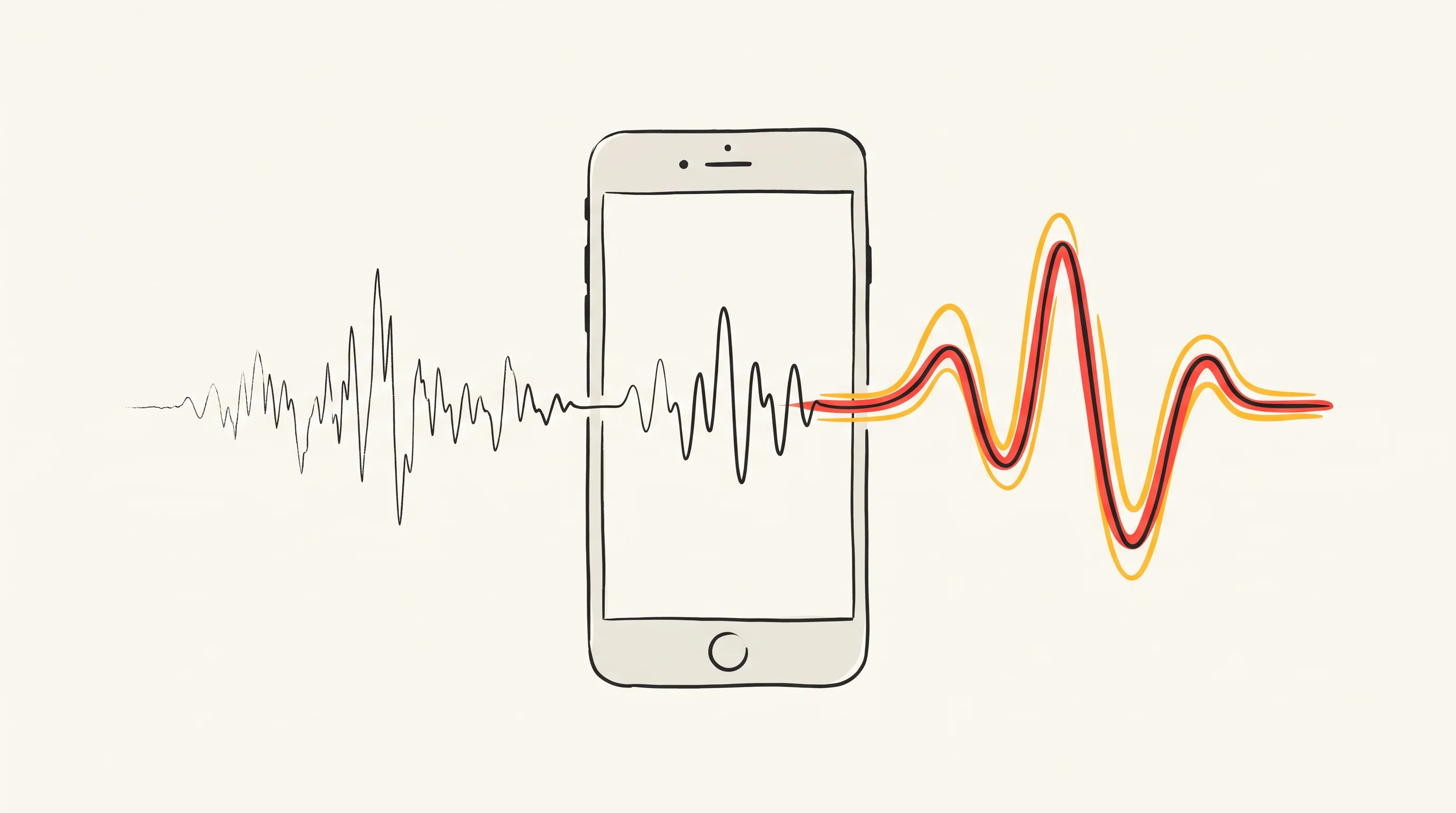
Strip away the business model for a moment. Whispp's core offering is an audio-to-audio AI model that reconstructs speech in real time, entirely on the device. Whisper into your phone, and the system rebuilds the pitch, tone, and intonation of a natural voice in under half a second. It's language-agnostic, or so the company claims.
The primary users? People who stutter. People living with ALS. People who've had their larynx removed due to throat cancer and rely on an electrolarynx—a handheld device that produces a robotic-sounding voice. For them, Whispp offers something closer to normalcy during phone calls or video meetings.
But the company also pitches a second use case that's decidedly less medical: "discreet calling" for anyone who wants to conduct a conversation by whispering in a library, on a train, or in an open-plan office. That dual positioning—assistive technology meets lifestyle feature—might be what makes the pitch to Samsung or Qualcomm more palatable. Accessibility is a mandate in some markets; privacy is a selling point in all of them.
A TIME profile published in October 2024 highlighted the speed and responsiveness of the system. The company's own FAQ notes that it can produce natural-sounding output even when paired with electrolarynx devices, which is no small technical feat.
Why On-Device Matters Now
Whispp's timing, if not perfect, is at least fortuitous. The smartphone and PC industries spent much of 2026 talking about on-device AI as if it were a new religion.
Apple announced an updated "Apple Intelligence" architecture in June 2026, doubling down on local foundation models and minimizing reliance on cloud processing. Qualcomm has spent the year positioning its Snapdragon chipsets as edge AI workhorses for phones, PCs, and wearables. The GSMA's Mobile Economy 2026 report, released in February, called hybrid on-device/cloud AI a defining trend, enabled by neural processing units embedded directly in silicon.
For Whispp, though, on-device processing isn't a trend to ride—it's a technical necessity. Voice reconstruction for live phone calls can't tolerate the latency of a cloud round-trip. Half a second is already pushing the limits of what feels natural in conversation. Add network lag and you're back to the bad old days of satellite phone delays.
There's a privacy angle, too. Whispp's January 2024 privacy policy notes that the company is not a U.S. HIPAA-covered entity, which might complicate adoption in healthcare settings. But if the voice data never leaves the device in the first place, some of those concerns evaporate.
Credibility and Competition
Whispp has collected the kind of accolades that help in OEM pitch meetings. CES named it an Innovation Awards Honoree in 2024. TIME included the technology in its Best Inventions list later that year. The company announced its inclusion on Forbes' 2025 Accessibility 100 list in June 2025.
Still, the company isn't alone in this space. Voiceitt, which focuses on accessibility-focused speech recognition, has raised around $28 million and already integrated with platforms like Zoom and Webex. Voice cloning startups such as Respeecher tackle adjacent use cases in media production. Academic research continues to advance whisper-to-speech models—WESPER and work presented at the ICASSP 2024 Speech Signal Improvement Challenge suggest the field is far from static.
At Mobile World Congress 2026 in Barcelona, Whispp demonstrated its technology to OEMs, telecom platforms, and semiconductor companies. What came of those demos remains unclear. Castermans hinted at forthcoming deals, but announcements and signed contracts are different things.
The Bet

Whispp's plan for the new capital is straightforward enough: more IP development, better AI models, new products, expanded partnerships. The company's LinkedIn profile showed roughly 20 employees in early July—a lean team for a licensing play that requires navigating the procurement processes of global hardware manufacturers.
Whether phone and PC makers will actually license the technology at scale is, at this point, an open question. The assistive market is real but niche. The "discreet calling" market is speculative at best—people have been making phone calls in public for decades without much apparent desire to whisper them.
But here's the pitch Whispp is making: as manufacturers scramble to differentiate their devices with AI features that justify premium pricing, voice reconstruction that runs locally, works in any language, and serves both accessibility mandates and privacy-conscious consumers might be exactly the kind of feature a product manager at a Tier 1 OEM would green-light.
The company is betting that when that product manager sits down to review feature proposals, voice reconstruction makes the cut. Everything else—the funding, the hires, the demos in Barcelona—is preamble to that moment.


