

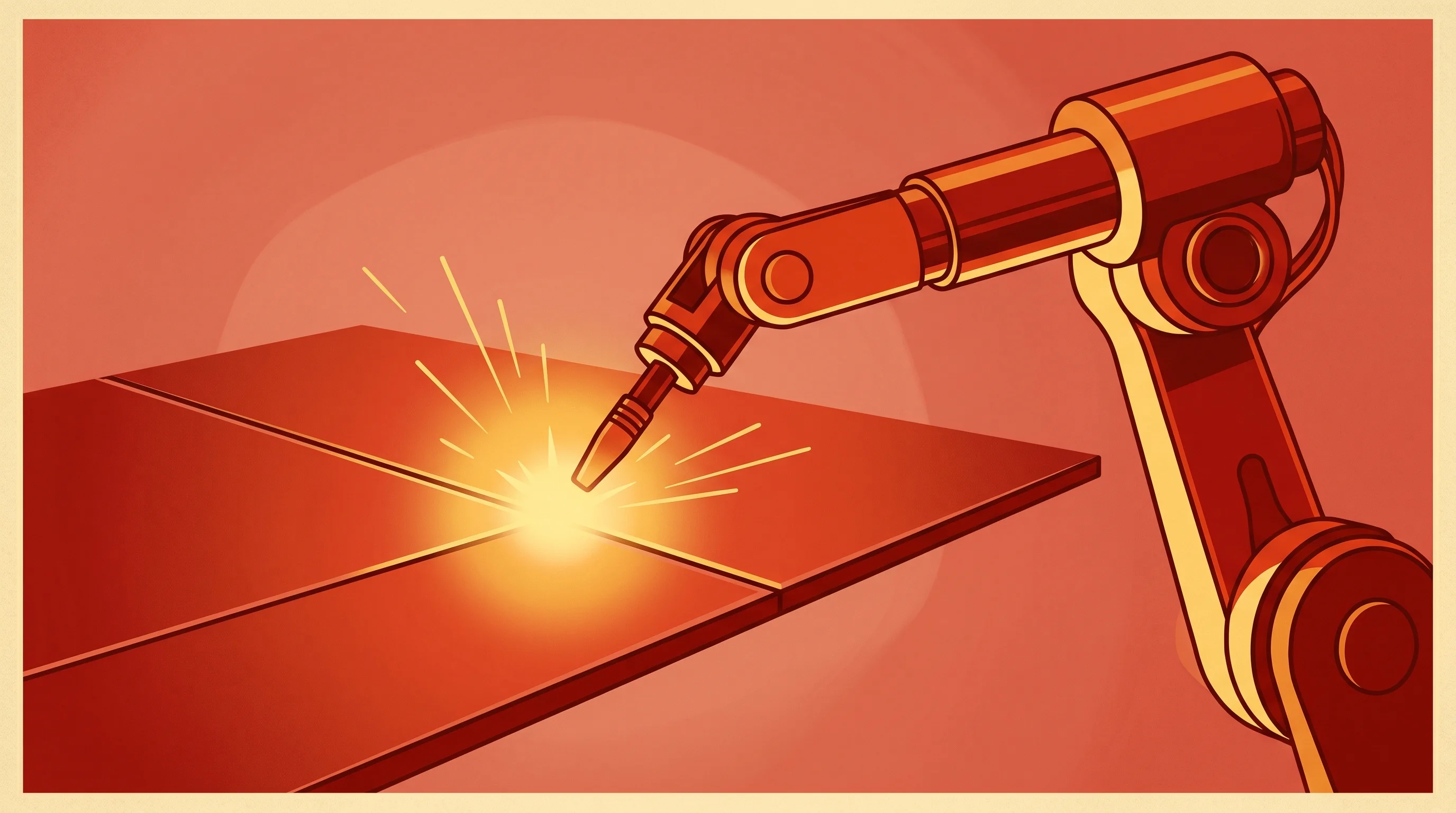
There's a problem brewing in American manufacturing that automation alone can't fix. Or maybe it can, if you teach the robots not just to weld, but to get better at it.
That's the pitch from Advanced Metal Research, a three-person Los Angeles startup that emerged from Y Combinator's Spring 2026 batch with a straightforward premise: robotic welding cells that watch themselves work, inspect what they've made, and adjust. Every bead matters. Every pass becomes training data.
The opportunity—call it desperation, depending on where you sit—is quantifiable. The American Welding Society projects the U.S. will need 320,500 new welding professionals by 2029. That's approximately 80,000 openings annually from 2025 to 2029, accounting for retirements and new positions, set against a current workforce of 771,000, with over 157,000 nearing retirement. Manufacturers can't hire fast enough. They can't train fast enough either.
AMR's founders argue this isn't just a headcount crisis. It's a knowledge-scaling problem, the kind that conventional automation was never designed to solve.
Adaptive, Not Just Automated
Manufacturing has leaned on robotic welding for decades—automotive assembly lines, heavy fabrication shops, anywhere the parts are predictable and the motion can be programmed once and repeated endlessly. What AMR and a handful of competitors are chasing is something different: systems capable of handling variation. Joints that aren't identical. Materials that shift. Real-world messiness.
The technical approach centers on closed-loop learning. AMR's platform, still largely under wraps, combines real-time seam tracking with post-weld inspection. The robot observes as it works, corrects mid-pass, then evaluates the finished weld and feeds that back into the next cycle. Computer vision meets machine learning, creating a feedback architecture that's only recently become economically viable as sensors have gotten cheaper and AI models faster.
Beyond that framework, specifics thin out. The company's website confirms it's building "Robotic Welding Systems." Which welding processes? What sensors? Speed, tolerances, benchmark results? None of that's public yet. No demo videos. No published case studies. For a product launch, it's a deliberately quiet entrance.
The Team Behind It
The founding trio brings an unusual mix. Angus Muffatti, the CEO, has an aerospace pedigree—three published papers on machine learning and AI optimization, hands-on experience designing liquid bi-propellant rocket engines and test facilities. Julian Fried worked as a welding foreman in eastern Pennsylvania, the kind of shop-floor expertise that presumably informs how the product actually behaves under production pressure. Stephen Lin's background includes stints at NASA on spacewalk systems and planetary exploration, building mission control tools that monitored 19 spacewalks in real time.
It's the sort of team composition—technical depth plus manufacturing grit—that makes intuitive sense for hardware automation. Whether it's enough to commercialize a robotic welding system in an increasingly crowded market is a different matter.
A Crowded Starting Line
AMR enters a field already moving fast. Path Robotics, perhaps the most visible name in AI-powered welding, unveiled "Obsidian," a foundational AI model for welding, last September. By April, Path launched Rove, a mobile welding robot pairing Obsidian with a quadruped platform. In February 2026, the company signed a memorandum of understanding with shipbuilder HII to explore integration into shipbuilding operations.
Vancouver-based Novarc Technologies rolled out its NovEye Autonomy system in mid-2024, using real-time vision to automate pipe welding. Abagy offers software layers for adaptive welding robots. CLOOS continues expanding its QIROX and QINEO ecosystems with sensor integration and collaborative robot compatibility. The broader trend—vision-based tracking, AI-driven inspection, adaptive control—has become well-documented in trade publications and welding research through last year.
What sets AMR apart? From publicly available information, that's unclear. The company emphasizes its closed-loop learning and American manufacturing credentials, but performance advantages, cost structures, or deployment timelines remain opaque.
What Comes Next
No announced customers. No disclosed funding beyond Y Combinator's standard check. No published benchmarks. AMR is at the starting line of commercialization, perhaps more uncertain of footing than its founders expected.
The welder shortage it targets is real—documented, worsening, and forcing manufacturers to rethink assumptions. Whether a three-person startup can build, deploy, and scale robotic systems fast enough to capture meaningful market share against established automation players and better-capitalized competitors? That's the open question.
For now, AMR's public footprint consists of a Y Combinator directory listing and a skeletal website. Pilot customers will need to materialize. Working systems will need to prove out in real fabrication environments. The closed-loop learning architecture will need to deliver measurable value—cycle time improvements, defect reductions, something quantifiable.
The workforce math creates a clear opening. Execution is what separates startups from case studies. AMR has the latter part still to write.


