

Arash Barati has seen enough blown budgets to last a lifetime. Across 12 years in real estate development and lending, working on projects worth north of $7 billion, he watched the same ritual play out: teams would spend two weeks—sometimes longer—grinding through blueprints to figure out what a building might actually cost. And even then, the number was more educated guess than gospel.
So when he and his co-founders launched PLAN0 AI, the pitch was blunt: what if we could do that in 30 minutes?
The small team, fresh out of Y Combinator, claims their platform can ingest architectural drawings and spit out detailed cost estimates, 3D models, quantity takeoffs, and even 24-month cost forecasts across individual construction trades. It's an audacious promise in an industry where overruns are practically baked into the business model. Perhaps more audacious: the company reports $20 billion worth of projects running through the system—a figure that remains unverified by independent sources.
That last figure deserves a raised eyebrow. For a startup that just completed the accelerator program and received YC's standard early-stage investment (Dealroom pegs it at $125,000, though conflicting funding reports exist), $20 billion is a staggering number to claim—even if you squint and assume it reflects aggregated pipeline value from pilots or proof-of-concept work. PLAN0 hasn't disclosed customer names. There are no independent sources corroborating the $20 billion claim. And third-party databases show conflicting funding figures ($4 million here, $500,000 there) with nothing to back them up.
Still, construction deals move in enormous increments. A single mixed-use tower can represent hundreds of millions. A portfolio review by a major developer could cross into billions fast. If PLAN0 landed a couple enterprise accounts running multiple projects through early trials, the math isn't completely implausible. It's just unverified.
An Unusual Pedigree
What makes the venture interesting—beyond the bold claims—is the team composition. Barati, the CEO, isn't just another ex-consultant with a deck full of market-sizing slides. He was a VP at Drake Real Estate Partners through April 2022, and before that taught Excel-heavy structuring courses as an adjunct at Columbia's architecture school. He knows how developers think, how deals get penciled, and where the pain lives.
His co-founder and CTO, Shervin Barati, comes from an entirely different universe. Eight years at Apple, managing engineering for hearing health features in AirPods—the same tech that eventually earned FDA clearance as hearing aids. He studied Engineering Science with a robotics focus at Toronto. The third co-founder, identified as Dimitris Pagonakis on LinkedIn, brings experience from Citadel and MIT, according to the company's launch materials.
It's the kind of founding DNA that vertical AI startups are supposed to have: deep domain expertise, serious engineering muscle, and quantitative chops. Whether that translates into product-market fit is another question entirely.
Speed, Forecasts, and a Bloomberg Fantasy
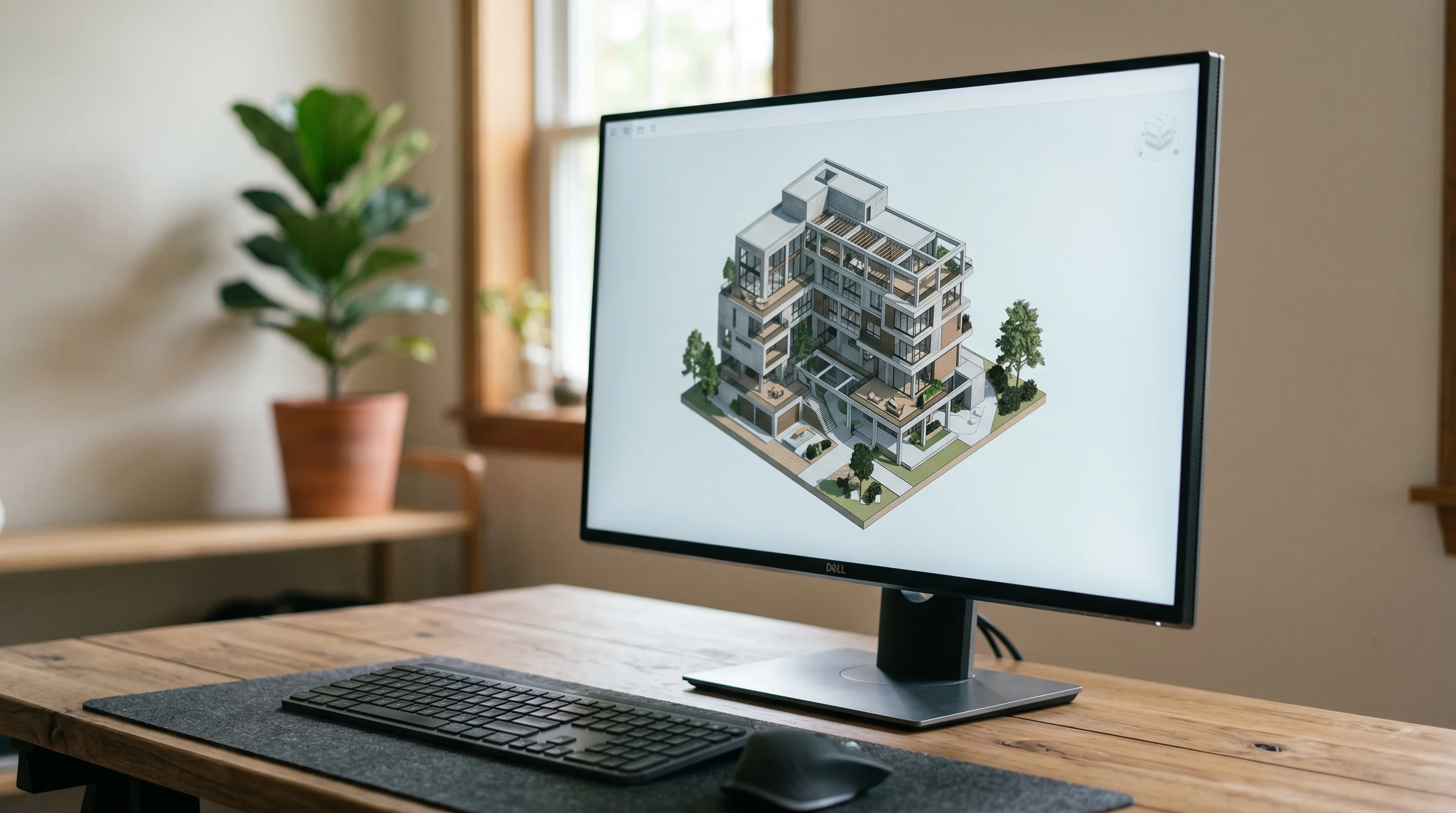
PLAN0's core workflow is straightforward enough. Upload plans. The platform generates takeoffs, builds a 3D model, itemizes costs, and then—here's where it gets more ambitious—runs scenario analysis. Concrete versus steel? The software claims it can model the budget impact.
The more intriguing layer, at least in theory, is the forecasting engine. Using what the company describes as machine learning techniques borrowed from quantitative finance, PLAN0 says it can predict trade-level costs—electrical, plumbing, HVAC, and so on—up to two years out, accounting for localized market shifts.
That requires data. A lot of it. The company says it's building a database of historical and real-time project costs through industry partnerships, though no partner names have surfaced publicly. This is where the "Bloomberg of construction" positioning comes in: the idea isn't just to be a calculator, but to become the intelligence platform tracking cost movements across geographies and trades.
The pitch lands differently depending on who's listening. Developers want faster underwriting and the ability to test design variations without waiting weeks. General contractors need sharper business development estimates and better input cost forecasting. Investors and lenders want independent validation of pro formas and benchmarks against historical overrun patterns.
Whether all those use cases converge into a coherent product remains to be seen.
A Crowded Moment
PLAN0's timing is both opportune and competitive. The construction tech landscape has gotten noisy in recent months. Gordian launched Flash AI Estimating in March, built on RSMeans data. Planera introduced "Manny," an AI scheduling assistant, in April. BuildOps released an AI-native system for specialty contractors on May 7. Even incumbents like Autodesk and Procore have been threading AI into their estimating workflows.
A BuiltWorlds report from March identified standardization, accuracy, and speed as the primary drivers for estimating tool adoption. Autodesk has reported that some customers see 30 to 50 percent time savings on takeoff work. An Associated General Contractors survey from April notes that AI usage among contractors remains emerging—adoption is growing, but it's deliberate and ROI-driven, not hype-fueled.
The established players—Autodesk Takeoff, Procore Estimating, STACK—have already digitized much of the workflow and offer extensive integrations with project management and accounting systems. PLAN0 is betting that raw speed (the 30-minute claim) and forward-looking intelligence (the 24-month forecasting) create enough differentiation to matter.
That's a tough bet in a market historically allergic to change, even if momentum is clearly building.
The Execution Test

PLAN0 was founded in 2024, verified by YC's directory. The product is live, with a demo video circulating on YouTube. No pricing details have been disclosed publicly, though the value proposition comes through clearly enough: faster, smarter, data-backed estimates.
For an industry where cost overruns remain practically endemic—where blown budgets are the punchline to a very expensive joke—the promise is compelling. Fast, accurate, forward-looking estimates would be transformative if they actually work at scale.
That's the catch, though. Can a small team, however well-credentialed, build the data moat it envisions? Can they convert early traction—whatever form that takes—into sustained growth in a category that's getting more competitive by the month? Can they defend the $20 billion claim with actual customer logos and verifiable metrics?
The founders clearly have the domain knowledge. They've got the technical chops. And if the launch materials are even half right, they've got some early momentum. Now comes the part where promises meet reality, where speed claims get tested in production, and where a catchy tagline either becomes a business or fades into the long list of ambitious pivots.
Construction, after all, is an industry that's seen plenty of technology promises before. What it hasn't seen—yet—is one that actually delivered.


