

The welding torch is a tool older than television, older than antibiotics. For more than a century, it's been wielded by human hands. Those hands are vanishing.
By 2029—just a few years from now—the American welding industry will need 320,500 new welding professionals, according to projections from the American Welding Society. Meanwhile, 157,000 current welders are nearing retirement. The arithmetic is brutal. Traditional recruiting strategies, apprenticeships, and trade school pipelines aren't anywhere close to closing this chasm.
So the industry is trying something else: teaching machines to weld. Or more precisely, teaching machines to amplify what the remaining welders can do.
From Y Combinator–backed startups in Los Angeles to century-old industrial giants retooling entire product lines, a wave of AI-enabled welding robots, collaborative automation systems, and cloud-connected power sources is sweeping across fabrication shops. Each arc strike becomes training data. Each seam becomes a lesson the machine remembers. The bet is that a smaller workforce can somehow meet surging demand from infrastructure megaprojects, defense shipbuilding, and the great reshoring of American manufacturing—if the technology can learn fast enough.
A 320,000-Worker Hole in the Ground
The Bureau of Labor Statistics counted 457,300 welding jobs in 2024 and projects a modest uptick to 467,200 by 2034—just 2% growth. But that serene-looking figure masks something more urgent. The agency anticipates approximately 45,600 job openings per year, most driven by retirements and workers simply leaving the field. Median pay sits at $51,000, respectable but hardly the kind of number that floods technical schools with applicants. And geography matters: roughly 60% of the U.S. welding workforce clusters in the South, Southeast, and Great Lakes regions, according to an October 2025 analysis in AWS Welding Digest.
Pull back further and the picture gets darker. The Manufacturing Institute and Deloitte have estimated that manufacturers may need up to 3.8 million new employees by 2033, with 1.9 million positions at risk of going unfilled altogether. Welding—a bottleneck skill in everything from bridge fabrication to naval vessels—sits squarely at the center of this crisis.
When Huntington Ingalls Industries hired 8,000 employees last year, the shipbuilder's annual report and trade press coverage highlighted persistent workforce retention struggles and the need for expanded apprenticeships. CHIPS Act megaprojects stretch deep into the 2030s. Micron's fabrication plants in New York and Idaho alone represent a decade-long buildout, ensuring structural steel and pipe welding demand won't ease anytime soon.
Census Bureau data from April 2026 showed total construction spending at $2.172 trillion on a seasonally adjusted annual basis, with manufacturing construction holding at $188.9 billion in March. The Infrastructure Investment and Jobs Act's Bridge Investment Program and Buy America mandates keep domestic steel fabrication humming. Pipeline standards under federal regulations—PHMSA Parts 192 and 195, incorporating API 1104 and ASME Section IX qualifications—mean critical energy infrastructure can't cut corners on certified welders.
Defense backlogs and federal infrastructure dollars guarantee the work. Finding people to do it? That's the problem.
When Machine Learning Meets the Arc
Collaborative robots, or cobots, accounted for 18.1% of the 9,055 industrial robot units ordered in North America during the first quarter of 2026, according to the Association for Advancing Automation. That's $543 million in orders, and the cobot share has hovered near 19–20% since the association began tracking the category. Overall robot orders grew 6.6% year-over-year in 2025, with gains concentrated outside the automotive sector—a signal that general manufacturing and metal fabrication shops are testing automation, perhaps tentatively.
What's genuinely new is the intelligence layered atop the hardware.
Lincoln Electric's CheckPoint cloud platform, now standard on Power Wave and PIPEFAB welding systems, logs parameters from every weld. Miller Electric's Insight suite—Centerpoint, Core, ArcAgent hardware—does the same for its machines, which generated roughly $1.89 billion in welding segment revenue for parent Illinois Tool Works last year. ESAB's WeldCloud and Kemppi's WeldEye, with native connectivity rolled into the X5 FastMig and Master M 358 as of October 2025, round out a cohort of cloud-connected power sources that treat weld data as a product in itself.
Sensor technology has matured in parallel. SERVO-ROBOT's laser vision systems, ABICOR BINZEL's TH6D laser seam sensors, and Xiris's HDR weld cameras enable real-time seam tracking and arc monitoring—features that once required expert human judgment, the kind that took years to develop. Academic research published over the past year or two demonstrates deep learning models for weld defect detection, multi-modal fusion (audio plus vision) for penetration monitoring, and even vision-to-code automation for seam tracking. A March 2026 review in a peer-reviewed journal called real-time AI-based welding defect diagnosis "a critical frontier," citing progress in convolutional neural networks for radiographic inspection and hybrid architectures combining CNNs with Vision Transformers.
Offline programming tools—RobotStudio, Octopuz, RoboDK—and digital twins from Siemens Tecnomatix and NVIDIA Omniverse cut robot programming time dramatically. Sandvik reported a greater than 50% reduction in programming time using Visual Components' offline programming software in a case study published last year. NVIDIA announced in 2026 that partners FANUC, ABB, Yaskawa, and KUKA are integrating Omniverse and Isaac platforms for virtual commissioning, suggesting simulation-first workflows are migrating from research labs to actual production floors.
Startups and Giants Both Bet on Augmentation
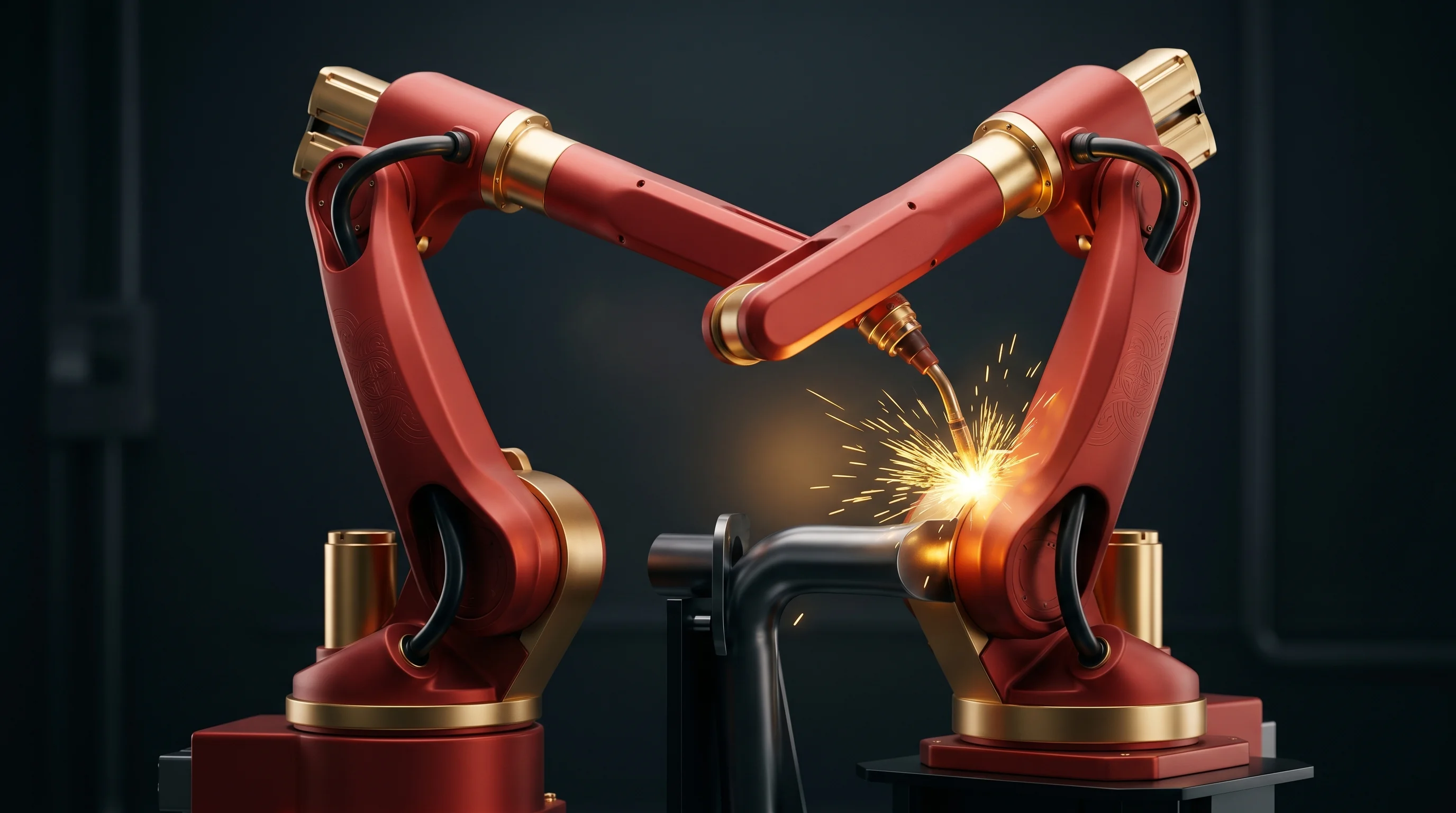
Advanced Metal Research, a three-person startup founded in Los Angeles and part of Y Combinator's Summer 2026 batch, exemplifies the new entrant. CEO Angus Muffatti, former welding foreman Julian Fried, and ex-NASA systems engineer Stephen Lin are building American-made robotic welding cells with computer vision for real-time seam tracking and post-weld inspection. The YC directory describes their thesis as "welding knowledge that can scale"—a closed-loop manufacturing system that learns from every weld.
It's early days, of course. But the framing is telling: not replacing welders, but encoding their expertise in software that can run around the clock.
Hirebotics, which pairs Universal Robots cobots with Miller power sources, has published case studies claiming dramatic results. Athena Manufacturing reported welds "70% faster" and unified monitoring through Hirebotics' Beacon OS. Advanta Southeast claimed a "400% production boost." Vectis Automation, another cobot integrator using Universal Robots platforms, helped Centerline Brackets achieve return on investment in less than three months, according to AWS Welding Digest coverage from November 2025.
These are vendor-reported figures, not independent audits, so a grain of salt is warranted. But they sketch the ROI pitch to small and mid-sized fabricators wrestling with high-mix, low-volume runs—the kind of chaotic job shops where flexibility matters as much as speed.
Path Robotics, which secured a $100 million Series D round in October 2024, positions itself as an AI-native player in autonomous welding cells. Weldobot markets "fully autonomous welding technology." Universal Robots previewed welding-focused robots and partner solutions—Hirebotics multipass capabilities, TTA seam tracking, AI-driven weld recommendations—at FABTECH 2025 in Chicago last fall.
The major industrial robot manufacturers aren't sitting still. Yaskawa's Motoman ArcWorld, FANUC's Arc Mate series with ArcTool and Touch Sensing technology, and ABB's WeldGuide IV through-arc seam tracking all received updates or new deployments over the past year or so.
Lincoln Electric, with consolidated sales around $4.2 billion last year, saw its Americas Welding segment grow 4% (driven by pricing and acquisitions), though the automation portfolio softened during the year, according to the company's February 2026 earnings call. ESAB Corporation posted roughly $2.84 billion in revenue for 2025. Both incumbents frame automation as a secular growth driver in investor materials, citing the welder shortage, reshoring trends, and infrastructure spending.
But Lincoln's 2025 automation softness suggests the adoption curve isn't a straight line. Capital expenditure cycles and integrator bandwidth still matter. The technology might be ready, but getting it onto factory floors is another story entirely.
The Training and Standards Race

If robots are to augment welders rather than replace them, someone still has to program, monitor, and troubleshoot the machines. Miller's AugmentedArc augmented reality training system and Lincoln's VRTEX VR welding simulators reflect an industry belief that immersive technology can shorten time-to-competency. A March 2026 preprint introduced WeldAR, an AR system for live welding instruction.
The goal? Produce robot operators and weld technicians faster than traditional apprenticeships, which can span years—time the industry simply doesn't have.
Standards are evolving in parallel. The American Welding Society released the 25th edition of D1.1/D1.1M:2025, the Structural Welding Code for steel, on April 17, 2025. ISO 10218-1:2025 and ANSI/A3 R15.06-2025—the updated industrial robot and collaborative robot safety standards—arrived in late 2024 and 2025, tightening expectations for risk assessments and system design. OSHA's 29 CFR 1910 Subpart Q remains the baseline for welding safety, with no recent substantive changes but ongoing information collection notices.
PHMSA updated pipeline welding standards last year, incorporating ASTM A381/A381M-18, and proposed a 2026 rule tweak to allow NDT-based qualifications for compressor station welding. That's a signal, however faint, that regulators see digital documentation and AI-assisted inspection as credible alternatives to traditional methods.
Perhaps the clearest articulation of the industry's stance comes from AWS Welding Digest's March 2026 editorial, "Sparks of the Future," which reiterated the 320,500-by-2029 shortfall and framed automation as augmenting workers, not replacing them. The Association for Advancing Automation's February 2026 press release announcing the prior year's 6.6% robot order growth noted that broadening adoption across general industries underscores a "long-term competitiveness strategy."
Lincoln Electric's CEO, in earnings transcripts, has consistently cited the welder shortage alongside reshoring and electrification as secular tailwinds for automation. It's the kind of message investors want to hear—and, more importantly, the kind manufacturers wrestling with unfilled orders need to believe.
What Comes Next
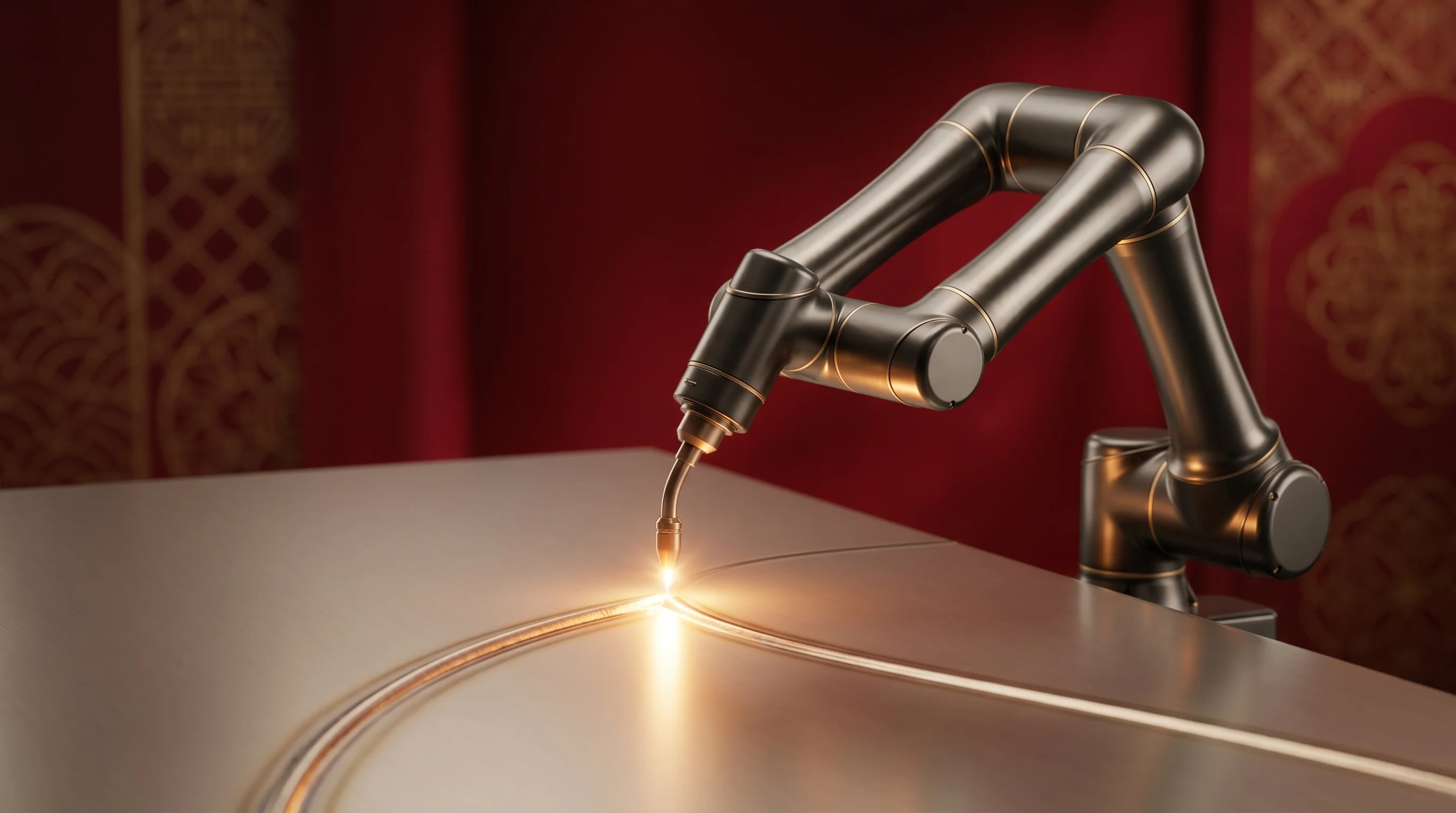
The math remains unforgiving. If 320,500 welding professionals are needed by 2029 and traditional pipelines deliver a fraction of that, the gap widens unless productivity per worker increases. Collaborative robots, AI-driven seam tracking, cloud-connected power sources, and digital quality assurance offer a potential multiplier. One skilled welder overseeing multiple cells. A novice getting real-time guidance from a vision system that's analyzed millions of welds.
The catch is deployment speed.
Association data from the first quarter of 2026 shows steady but not explosive robot orders. Many fabricators still balk at upfront costs or lack in-house expertise to integrate cobots. Job shops with chaotic part mixes struggle to justify the programming overhead, even with offline programming tools that promise faster turnaround. Workforce development remains a bottleneck of its own: who trains the trainers on AR simulators? Who validates that a machine-learning model's weld classification meets AWS D1.1 or API 1104 standards?
Industry events signal momentum, at least. AWS's Welding Automation Exposition & Conference convened in Minneapolis in June 2026, focusing on robotics, sensors, and Industry 4.0. FABTECH 2026 is set for Las Vegas in October, where FANUC, ABB, and the cobot vendors will debut their latest offerings. The American Welding Society's editorial drumbeat—automation as augmentation, not replacement—appears to be landing with manufacturers who see no other way to fulfill order books.
The policy environment helps. Buy America rules and CHIPS Act commitments lock in demand for domestic welding. Defense shipbuilding backlogs stretch years into the future. Data center and energy infrastructure projects require specialized pipe and structural welding that won't vanish overnight.
The question is whether the technology can scale welding expertise faster than the workforce shrinks.
If Advanced Metal Research's "closed-loop learning" or Hirebotics' Beacon OS can capture and distribute decades of welding knowledge in software, the 320,000-worker shortfall might become manageable. If not, the gap between demand and supply will widen, and American manufacturing competitiveness will suffer accordingly. The reshoring dream, the infrastructure push, the defense industrial base—all of it depends on steel being joined together properly, at scale.
The welding torch remains in human hands. But those hands are increasingly guiding machines that remember every arc, every seam, every imperfection. The goal isn't to eliminate the welder. It's to make one welder as productive as ten—or at least productive enough to bridge the gap before it swallows the industry whole.


