

Airbound, a Bengaluru-based drone manufacturer, announced Monday it has closed a $37 million Series A round led by Greenoaks, with participation from DoorDash, venture investor Lachy Groom, Lightspeed India and Humba Ventures. The funding brings the startup's total capital raised to nearly $50 million as it pursues what its 20-year-old founder calls a "mass-ratio thesis" for aerial logistics.
The investment represents DoorDash's first disclosed venture into the Indian market and signals the food-delivery giant's broader push into autonomous aerial delivery networks. The company received FAA Part 135 air carrier certification for DoorDash Air earlier this year, positioning it to operate commercial drone delivery services in the United States.
Airbound manufactures what are known as tail-sitter drones—aircraft that launch vertically like a rocket, then rotate mid-flight to cruise horizontally in the manner of a conventional plane. The design is hardly new in aerospace circles, but Airbound's gamble rests on economics rather than engineering novelty.
CEO Naman Pushp has built the company around a counterintuitive constraint: according to Pushp, the company follows a "mass-ratio thesis" where drones are designed to weigh less than the matter they move. "We want to build towards a world where everything has cost parity with trucking," Pushp told TechCrunch. The startup's current TRT model weighs approximately 1.5 kilograms and carries roughly one kilogram of payload, cruising at 60 kilometers per hour over a 40-kilometer range. A next-generation variant now in development will weigh about three kilograms while ferrying up to five kilograms. The longer-term roadmap, according to reports in Moneycontrol, envisions 100-kilogram cargo capacity and eventually passenger transport—though the timeline for such ambitions remains unspecified.
Neil Shah, a partner at Greenoaks, framed the investment thesis in stark terms. When a single autonomous aircraft can move one package with the cost efficiency of a fully loaded 20-ton truck, he said in a statement, "fast delivery and cheap delivery are no longer in tension, and roads stop being the default."
Whether that vision holds up against the realities of regulation, weather and urban airspace management is another matter.
From hospital corridors to state-scale networks
Airbound has logged more than 13,000 autonomous flights, concentrated in Bengaluru and the Andhra Pradesh city of Guntur. The most substantive proof of concept came through a partnership with Narayana Health, where Airbound drones moved medical samples along a four-kilometer corridor from Chandapura Clinic to Narayana Health City. Each trip took roughly ten minutes. The route went operational in January and completed more than 1,000 flights, ferrying up to 40 samples per flight with no failed deliveries, according to a March report in the Indian Express.
The company now plans to extend that network to a Banashankari hospital facility being designed without an on-site laboratory, relying instead on drone connectivity for diagnostic samples—a test case for decentralized healthcare logistics.
In June, Airbound signed a memorandum of understanding with the Andhra Pradesh Drone Corporation targeting a network that would connect the cities of Amaravati, Vijayawada and Guntur. The stated goal is 10,000 flights per day. Geetanjali Sharma, managing director of the state entity, told YourStory that Airbound "is not just launching a new mode of delivery, it is laying the foundations of a new logistics architecture for Andhra Pradesh."
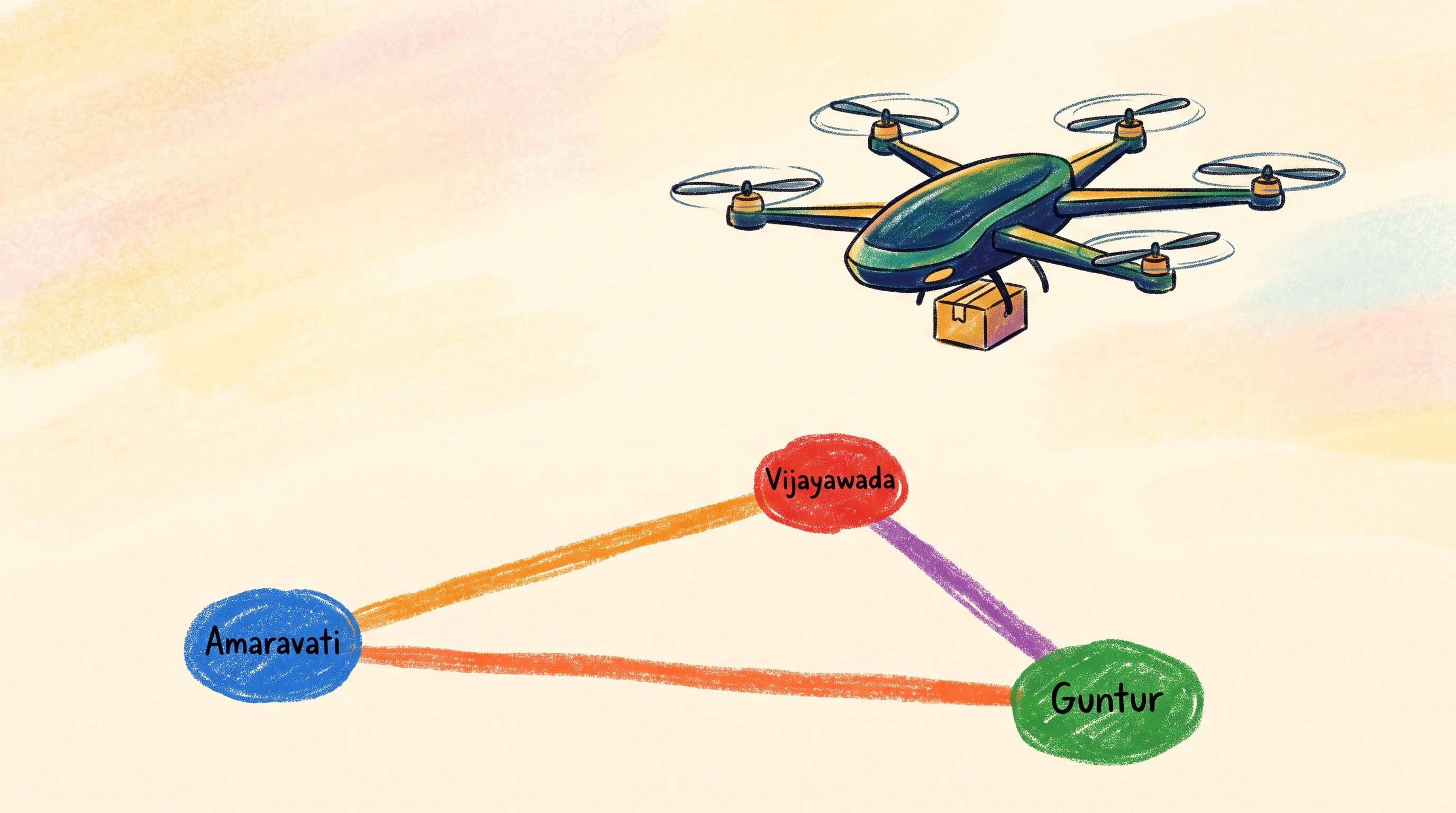
Pushp was careful to clarify that the startup has no government contract or subsidy. The state entity supports the regulatory framework; Airbound will sell services to private customers.
Pre-revenue, but unapologetic
The company is broadly pre-revenue. Pushp attributes the delay to regulatory bottlenecks, particularly the slow pace of beyond-visual-line-of-sight (BVLOS) approvals that would permit drones to fly autonomously over longer distances without human observers stationed along the route. "The goal is to be a giant in a few decades, not to make revenue as soon as we can," he said.
That patient capital approach aligns with the investor roster. Lachy Groom, co-founder of Physical Intelligence and a former Stripe executive, led Airbound's $8.65 million seed round in October of last year. That round drew backing from Humba Ventures, Lightspeed and senior leaders at Tesla, SpaceX and Anduril, according to TechCrunch. An earlier seed tranche of roughly $1.7 million closed in November 2024, led by Lightspeed India.
Harrison Shih, head of product for DoorDash Labs, said the delivery giant was drawn to Airbound's willingness "to go back to first principles and take on the physics and cost constraints that are keeping aerial delivery from being ubiquitous."
Airbound now employs more than 150 people and operates from a 43,000-square-foot facility in Bengaluru, where it designs and assembles aircraft. The Series A capital will fund accelerated engineering, scaled manufacturing and expanded go-to-market efforts, the company said.
A crowded sky
Airbound enters a competitive landscape. In India, Skye Air Mobility raised a $9 million Series B in March led by IAN Alpha Fund for hyperlocal delivery expansion. TSAW Drones and Garuda Aerospace are also exploring commercial delivery use cases.
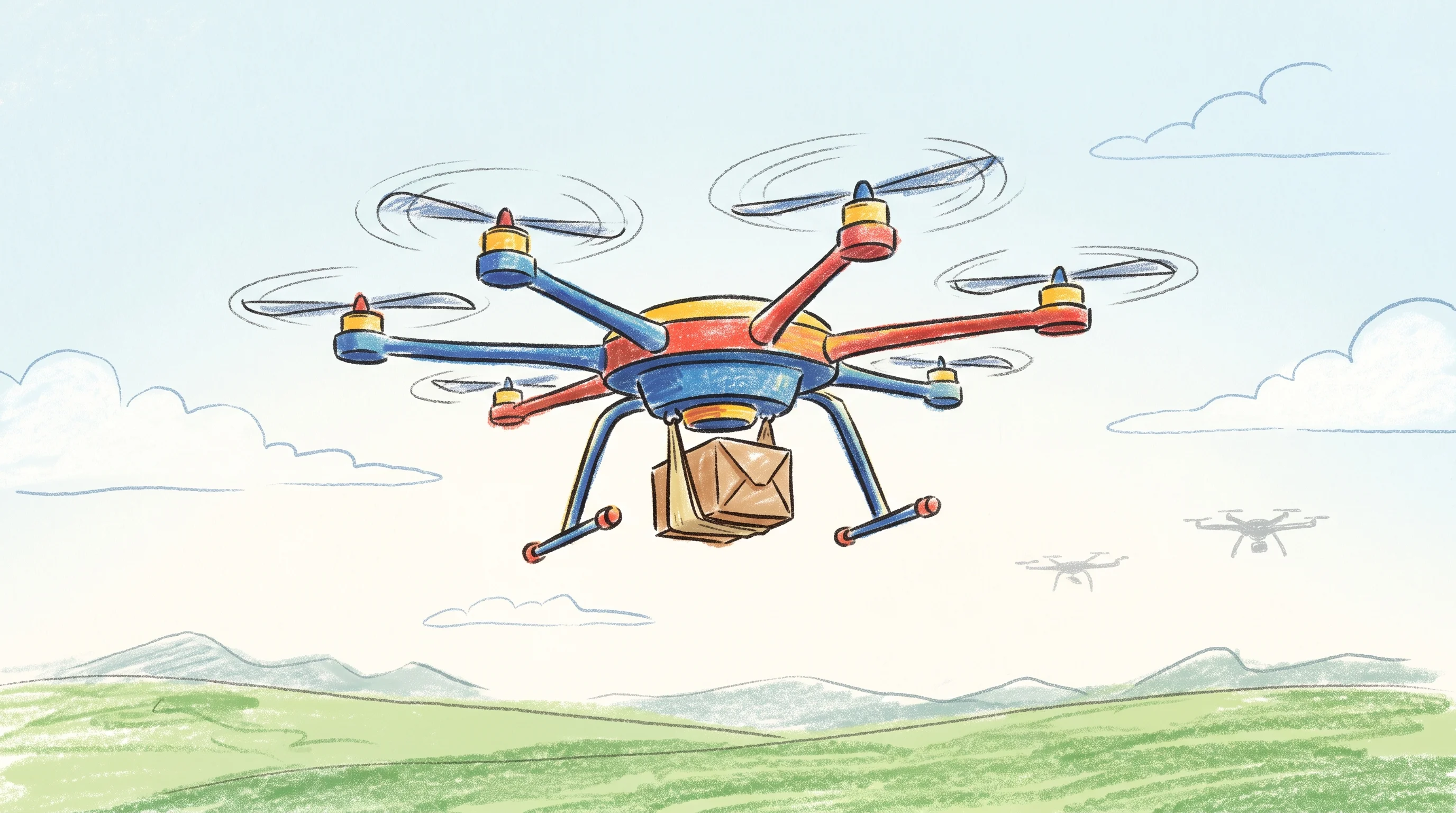
Globally, Zipline remains the category leader. The California-based drone-delivery company raised more than $600 million in January and added $200 million in March at a valuation near $7.6 billion, after surpassing two million deliveries. Zipline is now expanding operations to Houston and Phoenix.
Pushp's stated ambition is less about becoming the UPS of the sky and more about positioning Airbound as the underlying infrastructure. "The Boeing role," he told TechCrunch. "The aircraft airlines everywhere rely on, not the airline itself." He added to the Times of India that at the manufacturing scale Airbound is targeting, producing 100 aircraft a day "will start to feel very small."
That scale remains theoretical. For now, the company is navigating the unglamorous middle distance between seed-stage demos and commercially viable operations—a stretch where physics meets paperwork, and capital runs up against certification timelines.


