

In the latest sign that investors remain bullish on computational drug discovery—even as questions swirl about when AI-generated molecules will actually reach patients—a three-year-old biotech with dual headquarters in Southern California and Shanghai has closed a $35 million Series A+ round.
Aureka Biotechnologies announced the funding in late April, led by Sequoia China, which now operates under the name HongShan. The Irvine-area company says it marries microfluidic lab hardware with generative AI to design antibodies from scratch, a technically ambitious approach that requires both computational firepower and old-fashioned wet-lab infrastructure. One drug candidate is reportedly nearing clinical trials. The company claims commercial revenue in the tens of millions of US dollars over the past two years, though those figures haven't been independently verified.
For HongShan and its co-investors, the bet hinges on whether Aureka's "closed-loop" system—generate candidates, test them, feed results back into the AI, repeat—can compress the notoriously sluggish timelines of antibody development. Biotech has never moved quickly. Whether machine learning can change that remains an open question.
A Crowded Table
Matrix Partners China and Boyuan Capital came in as new backers in the A+ round, joining earlier investors 5Y Capital, Qiming Venture Partners, and NRL Capital. The round follows a November Series A of $23 million-plus, co-led by 5Y and Qiming. Across its Series A tranches, the company has raised funding nearing $100 million.
That puts Aureka in rarified air for a startup barely out of its infancy. Founded in 2023 by Weian Zhao, a UC Irvine professor whose academic work centers on microfluidics and immunotherapeutics, the company maintains operations in both Laguna Hills, California and Shanghai. The dual-office setup hints at the cross-border manufacturing and regulatory dance that many biotech firms navigate when courting both Western pharma and Chinese capital.
The fresh capital will go toward expanding what Aureka calls its AuraIDE platform—integrating foundation models for protein design with high-throughput experimental rigs. Plans include beefing up the platform's AI agent capabilities and scaling up infrastructure for functional antibody screening. Translation: more robots, more data, more algorithms.
Function First, Questions Later
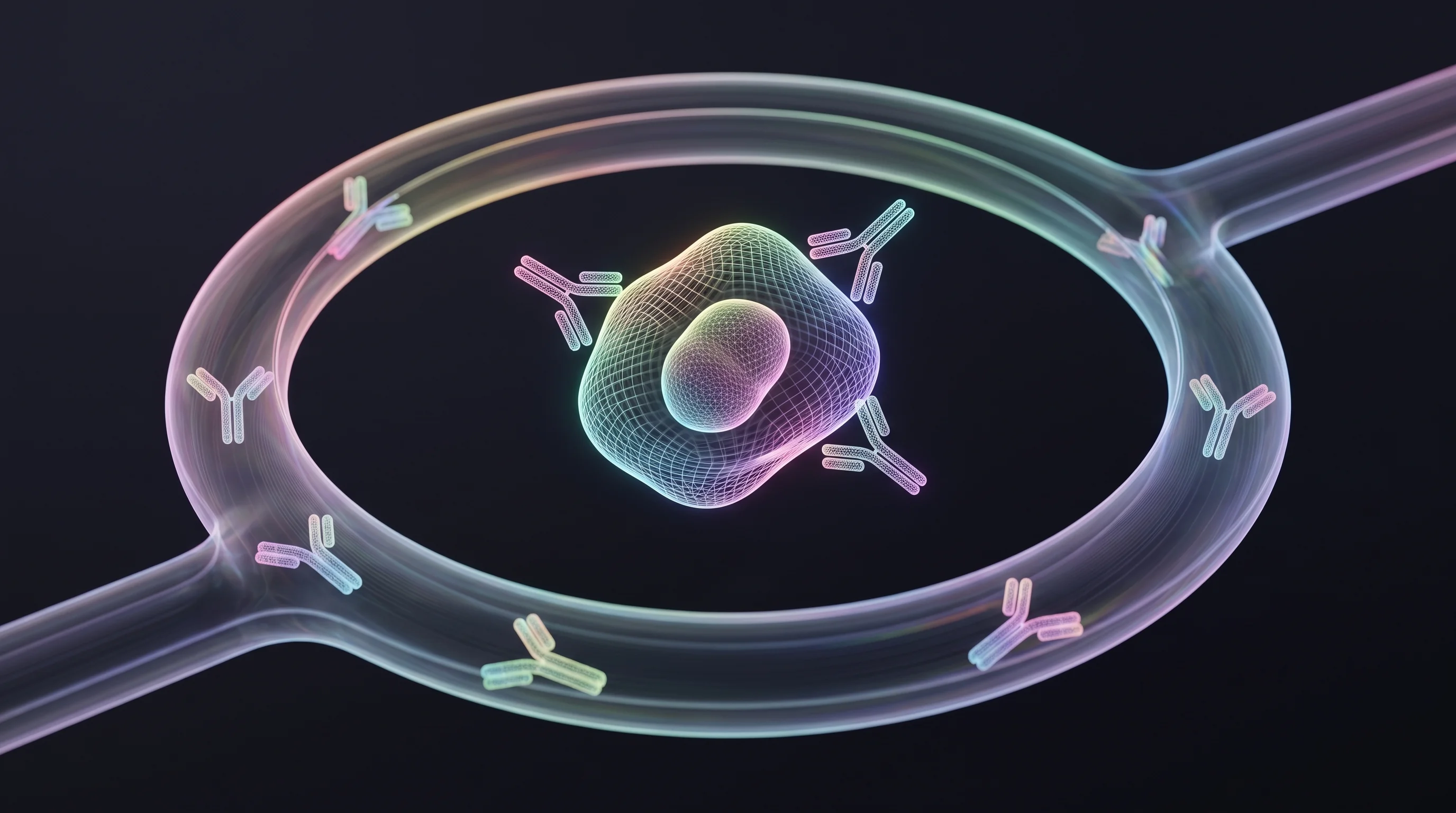
AuraIDE operates on a generate-test-learn-optimize loop. Microfluidic systems screen antibody behavior at the single-cell level, feeding performance data back into generative models that tweak designs for the next iteration. The company targets cardiometabolic and inflammatory diseases, betting that "function-first" design can tackle unmet needs in areas like receptor agonism, pH-dependent antibody recycling, and biparatopic constructs for antibody-drug conjugates.
It's a mouthful of jargon, but the underlying pitch is straightforward: instead of designing antibodies based on structure alone, Aureka says it optimizes for how they actually behave in biological systems. Whether that translates to better drugs is, of course, the multibillion-dollar question.
The company points to business development deals and what it calls "NewCo collaborations" as proof of traction, claiming those partnerships have generated revenue in the tens of millions over two years. One public tie-up, announced in May 2024, pairs Aureka with BD Biosciences to develop research reagent antibodies—useful for lab work, though not quite the same as therapeutic candidates. Other pharmaceutical partnerships in Europe and the United States remain unnamed.
Pipeline in Motion (Maybe)
Aureka says one drug candidate is "about to enter" clinical trials, with two more in investigational new drug development. The company has assigned internal codes to several programs: AURA-083 (a multispecific antibody), AURA-104 and 105 (receptor agonists), AURA-136 (an internalizing antibody), AURA-053 (pH-switch technology), and AURA-010, 012, and 014 (epitope-specific antibodies).
That's a lot of irons in the fire for a company that, according to LinkedIn data, employs somewhere between 11 and 50 people. Perhaps the leanness is intentional—venture-backed biotechs often stay small until a lead asset hits clinical proof-of-concept. Or perhaps it reflects how much of the heavy lifting is being done by algorithms rather than full-time scientists. Either way, Aureka remains compact for an outfit approaching clinical milestones.
CEO Zhao spoke at the Cambridge Healthtech Institute's Antibody Solutions conference in May, a sign the company is working to build visibility in antibody engineering circles. Skeptics might note that conference appearances are easier to come by than FDA approvals.
The AI Drug Discovery Scramble
Aureka's raise arrives amid a broader wave of capital flowing into AI-driven drug discovery. Stipple Bio emerged from stealth with a $100 million Series A in April for its antibody-drug conjugate platform. Converge Bio pulled in $25 million in January for generative AI services. Dozens of other startups are chasing similar promises: faster timelines, better molecules, lower failure rates.
Aureka's twist—proprietary microfluidic hardware alongside AI models rather than software alone—represents a more capital-intensive gamble. Integration of computational and experimental systems, the thinking goes, yields better antibodies faster. But hardware burns cash. Wet labs are expensive. And even the best-designed antibody can flop in the clinic for reasons no algorithm anticipated.
Whether one near-clinical asset and partnership revenue in the tens of millions justifies a valuation inching toward nine figures will become clearer as data trickles out. For now, HongShan and its fellow investors are betting that function-first antibody design, powered by closed-loop AI, can move the needle in an industry where progress is measured in decades, not quarters.
The platform may work. The science may pan out. Or Aureka may join the long list of biotechs that raised big, spoke confidently, and discovered that biology doesn't care how clever your models are. Time, as always in drug development, will tell.


