

The pitch sounds almost absurdly simple. Detection systems—those increasingly elaborate webs of acoustic sensors, radar arrays, and computer vision—have gotten frighteningly good at spotting drones. So what if you built something that doesn't fly like a drone at all?
This is the question keeping a small group of engineers up at night, and it's led them down an unexpected path: robot birds. Not bird-shaped drones with propellers tucked inside. Actual flapping-wing aircraft that glide, soar, and beat their wings in ways that mimic nature closely enough to fool the very systems designed to protect critical infrastructure.
Among those taking the bet is Ornadyne, a Los Angeles startup that participated in Y Combinator's Spring 2026 batch. The company is building what its founders call "reconnaissance ornithopters"—aircraft that look and move like birds because, well, that's the point. In a world where counter-drone technology is projected to grow from $3.18 billion in 2025 to $19.84 billion by 2033, standing out means not standing out at all.
Whether that gamble pays off depends on a technological cat-and-mouse game that's accelerating faster than most defense analysts anticipated just a few years ago.
When Propellers Became a Liability
The modern battlefield has been unkind to conventional drones. Ukraine's grinding conflict has turned into a brutal testing ground for both offensive and defensive drone systems, and the lessons have been stark. Detection networks now layer acoustic localization atop electro-optical tracking and radio frequency monitoring, creating kill chains that are increasingly hard to slip through.
Research published over the past two years paints a picture of rapid sophistication. Tetrahedral microphone arrays paired with deep neural networks can now pinpoint drone positions with startling accuracy. Separate work on acousto-optical fusion systems has demonstrated reliable separation of UAVs from background noise—the birds, the traffic, the ambient chaos that previously offered cover.
The problem, from a reconnaissance perspective, is training data. These systems learn to recognize the acoustic signature of spinning propellers, the steady flight paths of quadcopters, the predictable radar returns of fixed-wing platforms. They're optimized for what drones have historically looked like. Which is, perhaps, an exploitable weakness.
U.S. regulatory changes have tightened the screws further. The FAA's Remote ID mandate, enforced since early 2024, effectively requires most drones to broadcast their position. Defense procurement has meanwhile grown increasingly restrictive about foreign-sourced components under successive National Defense Authorization Act provisions. The operational space for traditional small UAS—both commercially and militarily—is shrinking.
Enter the ornithopter, stage left.
The Physics of Not Being Noticed
Flapping-wing flight offers stealth advantages that aren't immediately obvious. During glides, these aircraft produce acoustic signatures far quieter than any propeller-driven system. The intermittent wing beats create radar returns—what engineers call micro-Doppler signatures—that are vastly more complex than the steady signal from spinning rotors.
Academic papers from recent years have explored this dynamic in detail. The scattering patterns from flapping wings introduce enough variability to complicate radar classification. Some researchers have even investigated deliberate "micro-Doppler camouflage" strategies, essentially exploiting these natural variations to muddy the detection picture.
Then there's visual mimicry, which operates on a different axis entirely. Human operators and computer vision algorithms trained on mechanical profiles struggle when confronted with something that genuinely resembles a seagull or hawk. Guard From Above, a European firm, demonstrated its "Seagull Evo" at an industry show in Brussels in early 2026—a gull-shaped platform weighing about 1.5 kilograms that hand-launches and achieves roughly an hour of endurance while carrying electro-optical and infrared cameras. The resemblance isn't cosmetic. It's tactical.
But here's where things get tricky. Ornithopters have historically suffered from an endurance problem. The Guinness World Record for unmanned flapping-wing flight on a single charge sits at just over two and a half hours—respectable for a lab experiment, modest for operational utility. Chinese state media reported in early 2026 that an "eagle-like" platform achieved more than four hours aloft, though those figures lack independent confirmation and remain unverified.
The performance gap between flapping-wing and conventional fixed-wing endurance remains real, even if it's narrowing.
Engineering the Gap Closed

Recent technical work suggests the field is maturing faster than outside observers might expect. A paper published in January 2026 demonstrated large ornithopters achieving continuous flight through jump-assisted takeoff mechanisms, enabling ground-to-air transitions without sacrificing the acoustic advantages that make these platforms interesting in the first place. Other research from Chalmers University showed pitch-axis super-maneuverability in morphing-wing designs, the kind of agility that starts to look operationally relevant.
The miniaturization frontier is advancing as well. One preprint described a butterfly-inspired 26-gram tailless robot achieving autonomous flight. Another detailed variable transmission mechanisms for insect-scale platforms, pushing lift-to-weight ratios above 2:1—numbers that matter when you're trying to carry sensors in a package small enough to resemble an actual insect.
Control systems have gotten stranger and more sophisticated. Collision perception using flexible piezoelectric films inspired by beetle mechanoreceptors. Artificial microsaccade vision stabilization borrowed from how birds' eyes work. Bell-shaped spanload distributions enabling tailless yaw control. These aren't incremental tweaks; they represent the kind of biomimetic engineering that was mostly theoretical a decade ago.
Whether it all translates to something militaries actually want to buy is another question.
The Ornadyne Bet and the Founder DNA
Geourg Kivijian, Ornadyne's CEO, worked at NASA's Jet Propulsion Laboratory on Mars Sample Return behavior coordination before moving to Astrolab. His Cal Poly master's thesis focused on ornithopter design with variable flapping angles, and he picked up a first-place finish at a 2025 regional aerospace conference for his research. His co-founder and CTO, Armen Arakelyan, has a résumé that runs through SpaceX (Starship components) and USC's Rocket Propulsion Laboratory, which set a student altitude record of 144 kilometers in 2019.
The technical pedigree checks out. The commercial viability is less certain.
The team is targeting "hour-class flight times" with low acoustic signatures, positioning their work explicitly around the counter-UAS detection gap. In their Y Combinator launch materials from mid-2026, they argued the U.S. has fallen behind Europe and China in flapping-wing development—a claim that's probably true, if only because American defense investment in the area has been sparse. They framed their technology as "harder to classify and target" than conventional platforms, which is the core thesis.
Funding details remain murky. Y Combinator backing is confirmed, though specific raise amounts have not been verified through primary documentation. The team size appears to be just the two founders, which suggests very early days.
Market Realities and the Adoption Problem
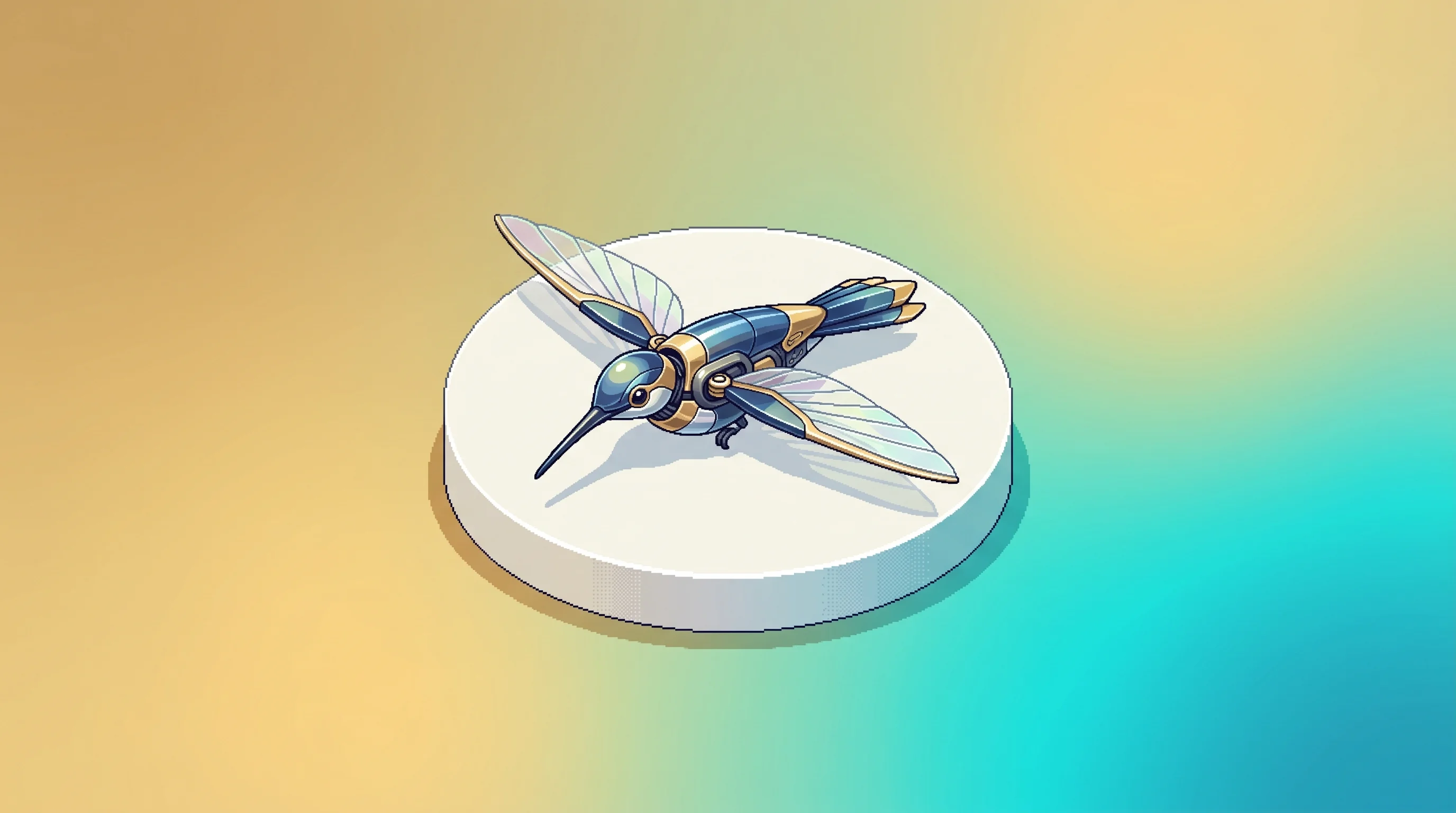
Here's where optimism meets friction. Western defense adoption of flapping-wing ISR remains virtually nonexistent in publicly disclosed procurements. The Seagull Evo entered market-entry phase in early 2026 with no named customers. The most prominent U.S. program was AeroVironment's Nano Hummingbird—a DARPA-funded demonstration from 2011 that weighed 19 grams and flew for about 11 minutes. Impressive as a proof-of-concept. But it never transitioned to production, and there's been no public follow-on.
China's Northwestern Polytechnical University published papers on its "Dove" flapping-wing micro air vehicle between 2010 and 2018, and state media claimed deployments across several provinces. The current status of those programs is opaque, as are most details about Chinese defense R&D. It's possible they're flying operationally. It's also possible they're sitting in storage.
Commercial applications exist outside the ISR world. Clear Flight Solutions' "Robird" has been deployed at Edmonton International Airport since 2017, using peregrine falcon flight patterns to scare away real birds. That's a solved problem with paying customers—but wildlife control is a very different market from reconnaissance.
The regulatory landscape adds complexity on multiple fronts. FAA Remote ID requirements constrain civil testing, though waivers exist for aeronautical research and development. Defense procurement comes with its own labyrinth: restrictions on foreign components, the DIU Blue UAS program's compliance frameworks, export controls under ITAR and EAR that would govern international sales of defense-oriented systems. Navigating that bureaucracy takes time and capital, neither of which early-stage startups have in abundance.
The Detection Side Isn't Sleeping
There's a countervailing force worth considering. Counter-drone systems aren't static. The same research advancing bird-mimicking platforms is pushing detection capabilities forward. A 2025 paper explicitly identified "bird overlaps" as a challenge for multi-modal detectors while simultaneously mapping potential solutions. Machine learning models are being trained to distinguish biological from mechanical flight. Sensor fusion architectures keep adding modalities.
The advantage ornithopters offer—ambiguity, delayed classification—might be temporary. Defenders need reliable positive identification to avoid shooting down actual wildlife (bad optics, illegal in most contexts). Attackers only need enough confusion to delay the detection-to-interception cycle. That's an asymmetric problem, but asymmetries don't last forever.
How long flapping-wing platforms maintain an edge depends partly on adversarial adaptation speed, and partly on how much investment flows into counter-detection training data. If ornithopters become a genuine threat, classification systems will adjust.
What Success Actually Looks Like
For Ornadyne and similar efforts to cross the chasm from interesting to useful, several milestones matter. Multi-hour endurance with mission-relevant payloads—not just flying, but flying with cameras, communications, and processing onboard. Reliable autonomous operation beyond line-of-sight, which is a hard regulatory and technical problem. And survivability in contested environments, where even delayed detection may still enable interception if the platform is slow or predictable.
The broader pattern, though, seems hard to ignore. As counter-drone systems proliferate—driven by a market projected to grow at 25% annually through the end of the decade—signature management becomes central to the offensive side of the equation. Stealth isn't binary; it's about making detection expensive enough, delayed enough, or uncertain enough to shift the operational calculus in your favor.
Flapping-wing platforms might represent a narrow window of tactical advantage that closes once classification systems catch up. Or they might become a persistent class of low-signature ISR assets that exploit fundamental physics detection systems can't fully solve. The answer likely depends less on the technology itself than on procurement pipelines and how quickly defense budgets adapt to unconventional approaches.
A Center for Strategic and International Studies analysis from mid-2025 emphasized that lessons from Ukraine suggest commercial R&D typically needs to reach Technology Readiness Level 6 or 7 before military adoption becomes plausible. That points toward patient capital and incremental validation mattering more than breakthrough moments—not exactly the venture capital investment thesis most startups chase.
The Cycle Turns

Maybe the most revealing aspect of this entire story isn't whether robot birds achieve widespread deployment. It's what their emergence says about the detection-evasion cycle that's defined military technology for centuries. When conventional approaches become predictable, advantage shifts to unconventional alternatives. At least until detection adapts and the cycle repeats.
Ornadyne is betting that cycle just turned, that the relentless optimization of counter-drone systems around propeller-driven platforms has opened a gap big enough to slip through. Whether they're right—or whether they're early, which in venture capital often amounts to the same as being wrong—remains an open question.
But the fact that bird-mimicking drones are being built at all suggests the detection arms race has reached a curious inflection point. When the solution to being spotted is to stop looking like what spotters expect to see, maybe the game has gotten stranger than anyone quite anticipated.


