

The 100-foot vessel plowing through the waters off New England doesn't look like much from shore. No crew visible on deck, no dramatic weaponry bristling from its superstructure. Just a test platform churning through wave after wave, around the clock, accumulating hours.
But those hours matter. By January 2026, Blue Water Autonomy's ungainly testbed had logged more than 1,000 hours of open-ocean operations—more seat time, or rather sea time, than most early-stage hardware startups manage in conference rooms. While peers iterate on software demos and PowerPoint decks, the Boston-based defense tech company has been iterating on ships.
It's an unusual strategy. Perhaps even an improbable one, given the capital intensity of maritime hardware. Yet Blue Water has attracted $64 million in backing since emerging from stealth last April, including a $50 million Series A led by Google Ventures in August. The pitch: design and build autonomous warships from scratch, engineered not as bespoke naval platforms but for mass production at U.S. shipyards.
Now comes the hard part. The company is preparing to launch its first full-scale vessel—a 150-foot autonomous surface ship—in 2026, betting that the U.S. Navy's appetite for unmanned warships will translate into contracts before the venture capital runs out.
When Silicon Valley Meets Naval Architecture
Most autonomous vessel programs start with an existing hull and bolt on automation systems afterward. Retrofit, in industry parlance. Blue Water took what its founders describe as a "clean-sheet" approach, designing the ship and its autonomy software together from day one. The platform is a medium-to-large unmanned surface vessel stretching roughly 100 to 150 feet—"half a football field," as CEO Rylan Hamilton puts it.
It's meant to carry serious Navy payloads: missiles, radar systems, electronic warfare gear, logistics cargo. And it's designed to operate for months at sea without anyone aboard, with enough range to cross the Pacific.
Hamilton knows the Navy intimately. A former Surface Warfare Officer, he left the service and co-founded 6 River Systems, a warehouse robotics company that Shopify acquired for roughly $450 million in 2019. His co-founder Scott Miller cut his teeth as an early engineer at iRobot before founding Dragon Innovation, acquired by Avnet in 2017. The third co-founder, Austin Gray, served as a Navy intelligence officer and has written extensively—and publicly—about software-defined warships and the sclerotic state of American shipbuilding.
Together, they're bringing a Silicon Valley startup mentality to one of the least Silicon Valley industries imaginable. Naval shipbuilding moves slowly, costs enormously, and tolerates failure poorly. Blue Water is trying to move fast and, if not break things, at least build them differently.
The Unglamorous Work of Not Breaking Down
That 1,000-hour milestone announced in January wasn't about flashy autonomy demonstrations. No drone swarms, no AI-powered threat detection. Instead, Blue Water's engineering teams spent months in New Bedford, Massachusetts, testing propulsion, power generation, and fuel systems in 24/7 shifts.
The focus: unglamorous subsystems that determine whether an unmanned vessel can actually survive months at sea. Fuel polishing. Electric power stability. Leak prevention. Automated lube oil changes. The kinds of maintenance tasks that sound tedious until you realize a ship without a crew can't exactly radio for help when something breaks.
"Reliability first" might seem like an odd priority for a venture-backed startup racing to deploy. But Hamilton and his team are betting that the Navy's biggest barrier to adopting unmanned vessels isn't capability—it's confidence that these things won't become expensive drifting hazards.
The 1,000-hour figure also carries symbolic weight. It exceeds the Navy's previous 720-hour land-based testing baseline for propulsion systems, and it represents real operational stress. Waves. Salt spray. Vibration. The unpredictability of open water, which has a way of exposing design flaws that never surface in controlled environments.
Whether 1,000 hours is enough to prove reliability remains an open question. The Navy will want more. Much more.
Activating Dormant Shipyards
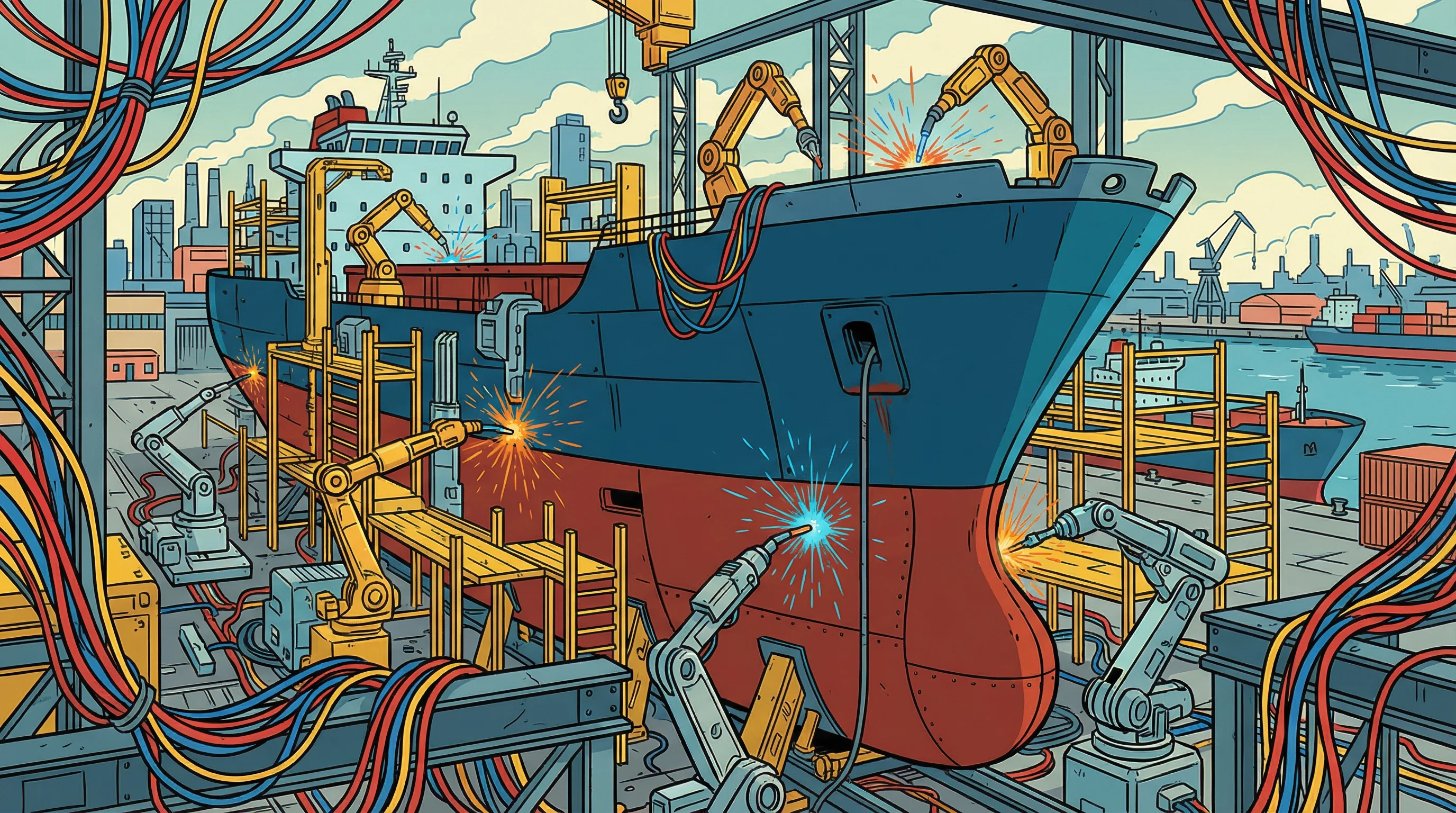
In September, Blue Water announced a production partnership with Conrad Shipyard in Morgan City, Louisiana. The deal calls for Conrad to build the first class of vessels using automated panel lines and welding processes across multiple facilities.
It's part of a broader production philosophy that sets Blue Water apart from defense primes. Rather than compete for space at the handful of major naval shipbuilders—facilities already stretched thin with submarine and destroyer programs—the company is targeting small and mid-tier U.S. shipyards with underutilized capacity. The bet: there's dormant manufacturing capability scattered across the Gulf Coast and beyond, waiting for the right kind of work.
Blue Water has already engaged more than 50 suppliers for long-lead materials and quadrupled its headcount since the seed round. In July, it opened a Washington, D.C., office at the Navy Yard to accelerate integration with potential Navy users and speed up on-water testing. By late 2025, the company had assembled an advisory board of senior defense and tech leaders and brought in Tim Glinatsis, a veteran shipbuilding executive, to oversee production.
The pace feels aggressive. Whether it's sustainable depends on how quickly the Navy's procurement process can match Blue Water's ambitions.
A Market Taking Shape in Real Time
Blue Water is building into a market that didn't quite exist two years ago. The U.S. Navy is in the midst of consolidating its Medium Unmanned Surface Vehicle (MUSV) and Large USV programs into something called the Modular Attack Surface Craft framework—MASC, in Pentagon acronym-speak. Think modular multi-mission autonomous vessels that can swap payloads and roles depending on the mission.
Congress has shown unusual interest in funding unmanned vessels, a shift driven partly by concerns about China's naval expansion and partly by the high cost of crewed warships. The fiscal 2025 budget request highlighted USV enabling technologies, and NAVSEA issued industry engagement calls throughout 2025 seeking feedback on MASC program architecture.
The competitive landscape is crowded and getting more so. L3Harris holds a 2020 contract for MUSV prototypes—195-foot platforms designed for ISR and electronic warfare missions. DARPA's NOMARS program produced the 180-foot USX-1 Defiant, engineered for up to 12 months of unmanned operations. Leidos demonstrated the Sea Hunter trimaran on an autonomous round trip between San Diego and Pearl Harbor, though the program has since struggled to gain traction.
Among the venture-backed cohort, Saronic acquired a Louisiana shipyard in 2025 and is building a 150-foot autonomous vessel called Marauder with a 40-ton payload capacity. Anduril, the defense tech unicorn founded by Palmer Luckey, is pursuing MASC in partnership with HD Hyundai. BlackSea Technologies unveiled a 66-foot catamaran USV family in September with ambitious six-month prototype delivery timelines.
Blue Water's pitch to investors hinges on its full-stack approach. GV's investment thesis, articulated when the firm led the Series A, centers on the team's ability to design both the autonomy software and the ship hardware together from the start—rather than treating them as separate systems that need to be integrated later. Dave Munichiello of GV, who joined Blue Water's board, pointed to the founders' pedigree from the Navy, Amazon Robotics, iRobot, and DARPA as differentiators in a suddenly crowded field.
Whether that's enough to win Navy contracts remains unclear. The MASC program is still taking shape, requirements are still being defined, and the Navy has a long history of favoring established defense primes over startups, no matter how promising.
Borrowing From Consumer Tech
In a series of op-eds published in War on the Rocks, co-founder Austin Gray has argued for what he calls "software-defined warships." The concept borrows heavily from commercial technology: build hardware platforms designed to accommodate rapid software iteration, enabling capability upgrades without hauling the vessel back to the shipyard for months of costly retrofitting.
It's an appealing vision. A single hull design could serve ISR missions one month, electronic warfare the next, logistics resupply after that—just by swapping payloads and software configurations. Modularity could reduce development costs and accelerate production timelines, assuming the underlying platform is reliable enough to support multiple mission profiles.
Blue Water positions itself as both a tech company and a shipbuilder, a hybrid identity that allows it to move quickly from R&D to yard production while publicly sharing technical milestones. That transparency is atypical for traditional naval programs, which tend to operate behind classification barriers. Whether it's a competitive advantage or simply good marketing is hard to say.
Beyond the Pentagon
While Blue Water's immediate customer is the U.S. Navy, the technology carries potential spillovers into commercial shipping. Independent sea trials of AI-enabled autonomous navigation have demonstrated fuel reductions of up to 15 percent and CO2 emissions cuts of around 10 percent, according to recent industry reports.
If military autonomy advances migrate to commercial vessels—and there's no guarantee they will, given the regulatory and liability complexities—the implications for decarbonization could be substantial. Global shipping accounts for roughly 3 percent of global greenhouse gas emissions.
Unmanned, months-long missions also enable capabilities that matter beyond defense: distributed maritime logistics, persistent environmental monitoring, offshore energy operations, scientific research in remote waters. Whether those markets materialize quickly enough to matter for Blue Water's business model is another question.
The 2026 Test
Blue Water's timeline puts it on an aggressive path. The company has funding, a shipyard partner, a test vessel logging real ocean hours, and a founding team with proven exits. It's designing for a Navy program still taking shape, which means risk—but also an opportunity to influence requirements rather than chase them after the fact.
The real test comes in 2026, when the first full-scale vessel hits the water. A thousand hours at sea is a meaningful start, but it's still just a start. The next thousand hours will be on a larger platform, carrying real payloads, operating in conditions that matter to the Navy. That's when the engineering meets the mission, and when the venture capital meets the reality of defense procurement.
Whether Blue Water can deliver on its promise of producible, reliable autonomous warships at scale remains an open question. The Navy has a graveyard full of ambitious programs that looked promising on paper.
But Hamilton and his co-founders have built and sold hardware companies before. They know the difference between a demo and a product. And they've spent a thousand hours in cold New England waters learning what it takes to keep a ship running when no one's aboard to fix it.
That might be enough. Or it might just be the beginning of a much longer, more expensive education.


