

Quantum computers, for all their mind-bending promise, keep running into the same mundane constraint: they don't play well with others.
That's the problem CavilinQ is trying to solve. The Cambridge, Massachusetts startup—spun out of research labs at Harvard and the University of Chicago—announced an $8.8 million seed round on April 2, 2026, betting that the future of quantum computing won't be built on ever-larger processors, but on getting smaller ones to talk to each other.
The financing was led by QVT, with checks from Safar Partners, MFV Partners, Serendipity Capital, and Harper Court Ventures. It's the kind of technical wager that makes sense only if you believe quantum computing will eventually need the equivalent of fiber-optic cables—which is precisely what CavilinQ's founders think.
Founded in 2025 by Shankar Menon and Brandon Grinkemeyer, the company emerged from the kind of academic pedigree that venture investors circle on pitch decks: Hannes Bernien's lab at UChicago and Mikhail Lukin's at Harvard, both of whom now serve as scientific advisors. Menon, who finished his PhD at Chicago last year, is CEO. Grinkemeyer, the technical co-founder, is CTO.
Their pitch hinges on a stubborn reality. Individual quantum processors hit walls—thermal, physical, error-prone walls. You can only cram so many qubits onto a chip before the whole thing becomes unmanageable. The industry knows this. The response has been modular thinking: link multiple processors into a networked system.
Easier said than done.
Mirrors, Light, and Fragile Quantum States
Connecting quantum systems without obliterating their quantum states is, to put it mildly, hard. Classical computers move bits around with wires and electrical signals. Quantum systems require something more delicate.
CavilinQ's answer involves ultra-high-finesse optical microcavities—precision mirrors that trap light with near-perfect efficiency. Think of them as translators: they convert quantum information from processors into photons, which can travel across optical links, then convert it back on the other end. The trick is maintaining coherence, the fragile quantum property that makes any of this worthwhile.
The technology is platform-agnostic, at least in theory, designed to work with different qubit types. But its origins lie in neutral-atom systems, where Menon and Grinkemeyer spent years developing cavity-mediated entanglement techniques. Recent work from the founding team—published research on error-detected quantum operations with neutral atoms mediated by an optical cavity—demonstrated finesse levels approaching one million at 780 nanometers. That's the kind of technical milestone that gets meetings with investors.
Whether it translates into a commercial product is another question entirely.
Infrastructure Play, Not Full-Stack Ambition
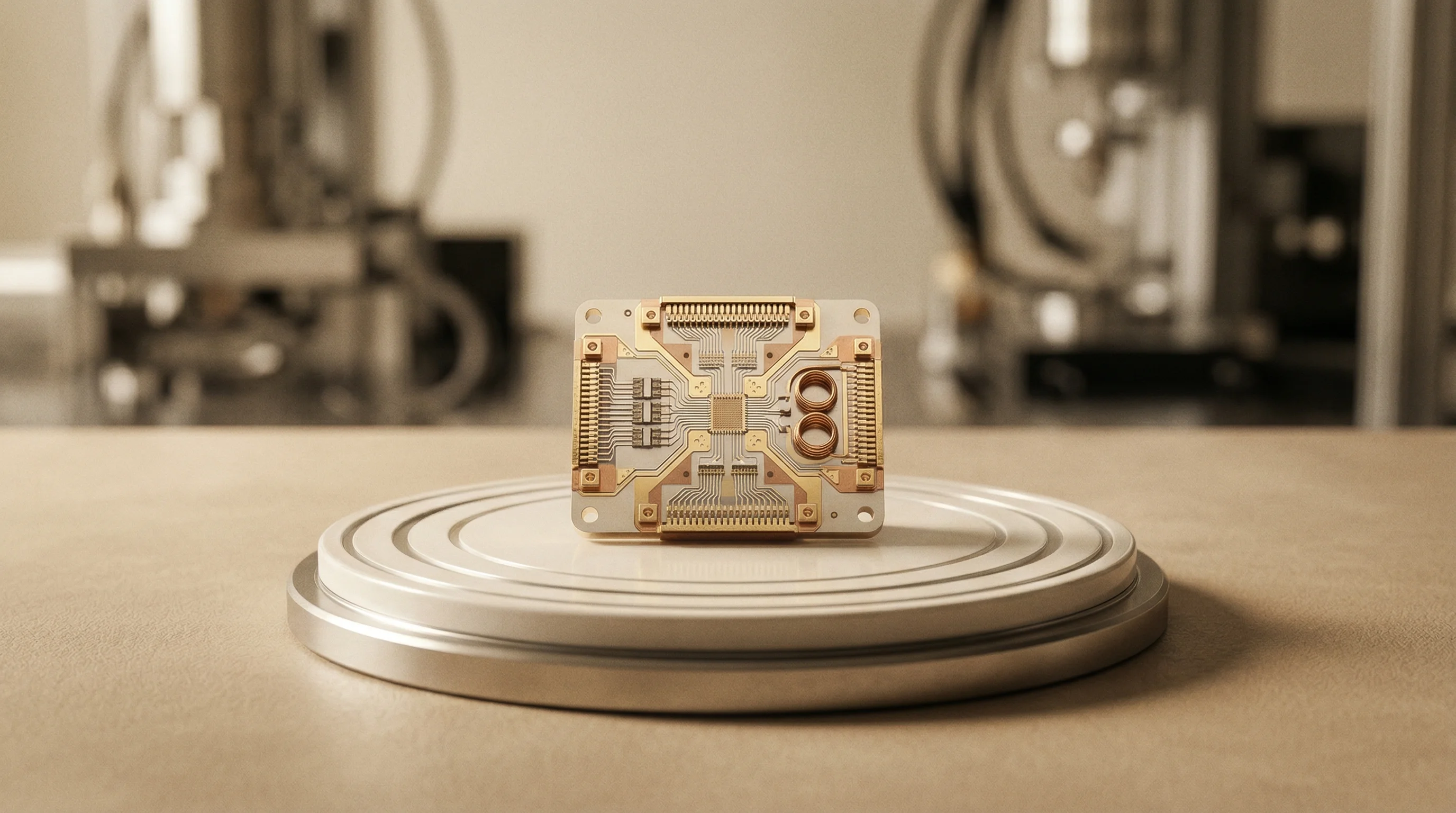
The seed funding will go toward the usual priorities: hiring, demonstrating that the interconnect technology actually works beyond lab conditions, and courting early partnerships with quantum hardware companies and research institutions. CavilinQ wants to build repeatable manufacturing processes—a leap from one-off academic prototypes to something that could be produced at scale.
The company's stated five-year ambition, per an announcement from the University of Chicago's Polsky Center, is to become the "default interconnect layer" for modular quantum systems. That framing is deliberate. CavilinQ isn't trying to build quantum computers. It's building the pipes.
That positioning could be smart—or limiting, depending on how the market shakes out. Multiple customers across the quantum hardware landscape sounds appealing. But it also means CavilinQ's success depends on other companies' timelines, technical roadmaps, and willingness to adopt someone else's infrastructure.
Before this round, the company picked up $150,000 from the George Shultz Innovation Fund in June 2025 and secured a spot in Harvard Innovation Labs' Grid Accelerator Fellowship the following month. Menon, for his part, went through the Polsky Center's I-Corps program and held a Polsky Commercialization Fellowship while getting the company off the ground—the kind of stepping-stone grants that help academic ideas inch toward commercial viability.
A Chicago Quantum Moment?
The investor group tells its own story. Harper Court Ventures, a $25 million fund that launched on May 29, 2025 and targets UChicago spinouts in quantum, energy, and AI, was an obvious fit. It's managed by MFV Partners, which already has PsiQuantum in its portfolio—a sign that the firm is comfortable with quantum's famously long timelines.
Safar Partners, a university-focused investor managing over $1 billion, and Serendipity Capital, which backs critical technologies including quantum, filled out the syndicate. QVT, a family office with a track record in private tech investments, took the lead.
The timing is worth noting. CavilinQ's seed came just two days after memQ, another UChicago quantum spinout focused on networking and memory, closed a $10 million Series A on March 31. Two quantum infrastructure deals in the same week, from the same university ecosystem.
Coincidence, perhaps. Or evidence that investors are warming to picks-and-shovels plays in quantum—companies solving connectivity and scaling bottlenecks rather than swinging for the full-stack quantum computer prize.
The Hard Part

CavilinQ has capital now. It has scientific credibility and a focused technical thesis. What it doesn't have—what no quantum startup has—is certainty.
The technology is early. The timelines are stubbornly long. The market is still figuring out what it wants. Optical interconnects might become standard infrastructure for modular quantum systems, or they might end up as one approach among many, adopted by some players and bypassed by others.
For now, CavilinQ's job is narrower: prove the hardware works outside controlled lab environments, convince quantum computing companies that buying interconnects makes more sense than building their own, and survive long enough to see if the industry's modular dreams materialize.
The hard part, as always, comes next.


