

The December chill in Shenzhen did little to dampen spirits. Some 800 people—engineers, investors, hospital administrators—converged on the city from December 28-30, 2025, for what organizers billed as the Brain-Computer Interface Industrial Application Conference. A few days earlier, authorities had unveiled two funds totaling RMB 1.16 billion earmarked for BCI development across the Greater Bay Area.
Similar tableaux unfolded that month in Beijing, Shanghai, and Hangzhou: municipal officials unveiling action plans, clinical teams presenting patient data, startups announcing financing rounds that would have seemed fantastical not so long ago. The choreography pointed to something larger. China's brain-computer interface industry had crossed a threshold—from niche academic pursuit to asset class, from research curiosity to industrial policy priority.
The market figures tell part of the story. CCID Consulting pegged China's BCI sector at RMB 3.2 billion (roughly USD 446 million) in 2024, with expectations climbing to RMB 3.8 billion this year and RMB 5.58 billion by 2027—a compound annual growth rate nearing 20 percent. Some analysts float RMB 120 billion by 2040, though projections that distant are less forecast than aspiration.
More revealing, perhaps, is the sheer breadth of activity: invasive systems achieving real-time speech decoding, semi-invasive platforms entering multi-center trials, and non-invasive wearables filing for Hong Kong IPOs. Capital is flowing. Talent is relocating. Hospitals are budgeting for procedures that didn't have billing codes two years ago.
Three Tiers, Different Speeds
The technology itself splits into three camps, each advancing at its own pace.
Invasive systems—requiring neurosurgery to position electrodes on or within brain tissue—have delivered the most cinematic demonstrations. In December 2024, NeuroXess, working alongside Shanghai's Huashan Hospital, decoded Mandarin speech in real time from a tetraplegic patient who "spoke" the phrase "Happy New Year, 2025" through robotic synthesis. StairMed, another invasive player, raised RMB 350 million in February 2025 to scale medical-grade MEMS manufacturing for its platform.
Then there's the middle tier. Beijing's Xinzhida NeuroTech, collaborating with the Chinese Institute for Brain Research, developed "North Brain No.1"—a wireless, 100-plus-channel device implanted via hard-dura or epidural routes, avoiding penetration of the cortex itself. By June 2025, five patients had received implants. Two more followed by early 2026, and the program transitioned to Good Clinical Practice multi-center trials. NeuCyber NeuroTech, also Beijing-based, reported in March 2025 that an aphasic patient had recovered the ability to communicate more than 60 common Chinese words and phrases through a full-cortical implant after training.
Non-invasive platforms—EEG-based wearables, primarily—target consumer rehabilitation and assistive markets. BrainCo, split between Hangzhou and Boston, announced around RMB 2 billion in financing in early January 2026, making it the second-largest BCI round globally after Neuralink's USD 650 million Series E from mid-2025. Reports in August 2025 and January 2026 indicated the company had filed confidentially for a Hong Kong IPO, though neither BrainCo nor the exchange confirmed details.
Policy as Accelerant
On August 7, 2025, seven Chinese ministries—among them Industry and Information Technology, National Development and Reform, and the Health Commission—issued joint implementation opinions on BCI innovation. The document set concrete benchmarks: key technical breakthroughs and initial standards systems by 2027; by 2030, a secure, globally competitive ecosystem anchored by two or three internationally influential companies.
That blueprint cascaded downward. Shanghai's January 2025 action plan targeted five-plus invasive BCI products in clinical trials by 2027 and full clinical deployment of invasive systems by 2030. Beijing's roadmap called for cultivating three to five global BCI champions by decade's end. Shenzhen deployed the RMB 1.16 billion in December 2025 via a Brain Science & Brain-like Intelligence Industry PE Fund and a Blue Ocean Seed Fund aimed at full-cycle projects.
But perhaps the most consequential move came from the National Healthcare Security Administration. In March 2025, the agency established upfront pricing items for BCI clinical services: invasive implantation fees, removal fees, non-invasive fitting fees. Shanghai piloted local implementation that September, following the national framework. The pricing framework doesn't guarantee insurance reimbursement—a critical distinction—but it allows hospitals to budget for clinical delivery post-approval, removing long-standing ambiguity that had chilled medical-device investment cycles.
Capital responded accordingly. BrainCo's RMB 2 billion round in January 2026 drew participation from investors at a pre-IPO valuation that reportedly exceeded USD 1.3 billion the previous August. Zhiranyiliao, a Beijing invasive-BCI developer, closed a RMB 300 million A-plus round on February 11, 2026, backed by Chinese deep-tech funds. The Ministry of Industry and Information Technology's blueprint explicitly encouraged national funds—including the Manufacturing Transformation & Upgrade Fund and the SME Development Fund—to participate, fostering what policy documents termed "tech-industry-finance integration." Whether those public-private partnerships optimize for returns or strategic objectives remains an open question.
Portraits from the Field
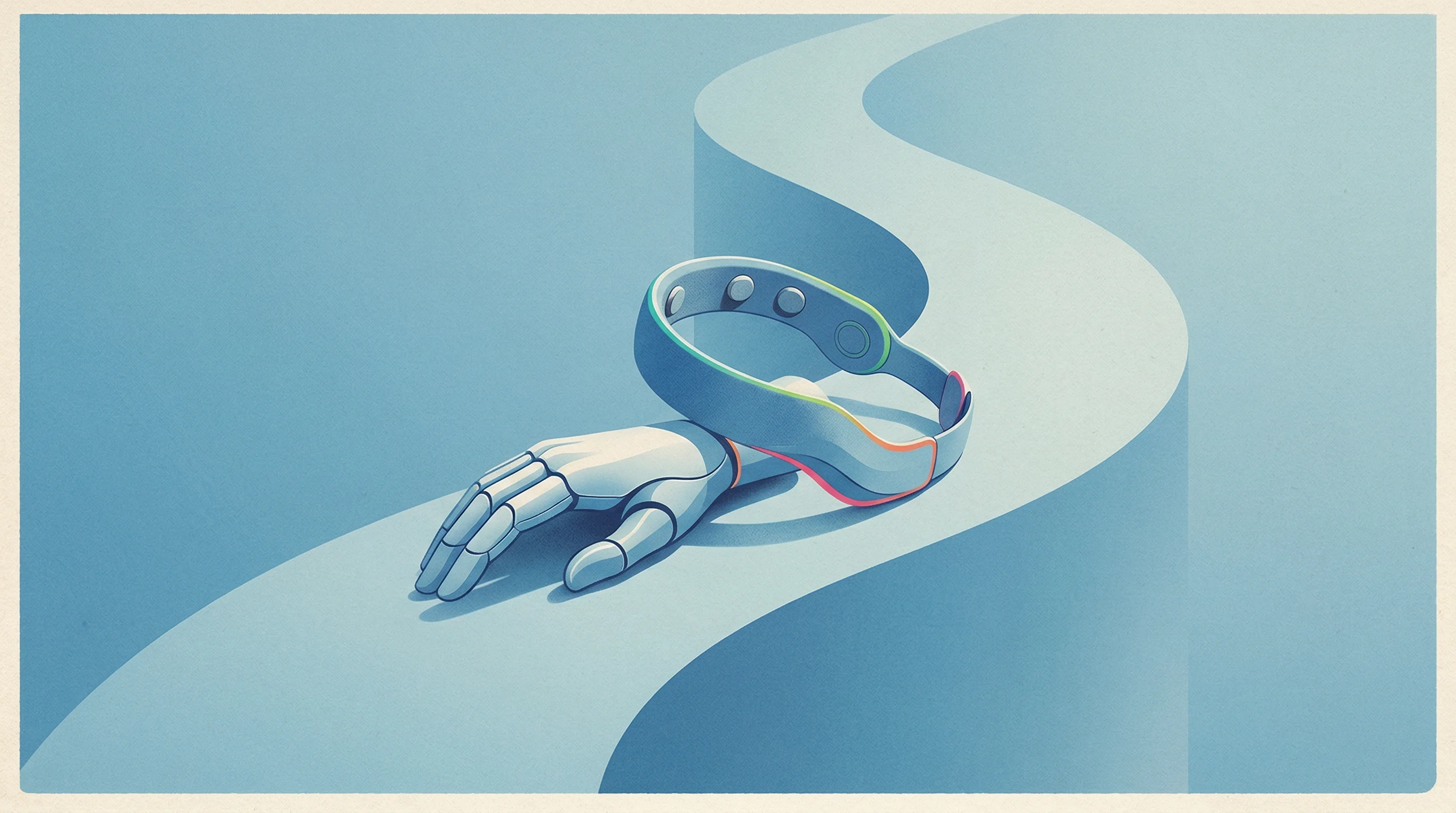
BrainCo's arc offers a window into the non-invasive segment's commercial potential. Founder Han Bicheng has spoken publicly about expanding into Hong Kong and positioning for broader Asia-Pacific markets. The company's neuroprosthetics and EEG-based rehabilitation tools have navigated regulatory pathways in multiple jurisdictions, though its 2019 deployment of attention-monitoring headbands in Chinese classrooms sparked privacy controversies that still color current data-governance debates.
NeuroXess embodies the invasive frontier. By late 2025, the Shanghai firm claimed involvement in more than 50 patient trials, though independent registry verification typically lags press-conference announcements. CEO Peng Lei, in an April 2025 interview, conceded that China's invasive-BCI surgical throughput still trails Neuralink's pace but argued that flexible ECoG arrays offer advantages in signal fidelity and long-term biocompatibility.
Then, in January 2026, Peng left NeuroXess to co-found Gestala—a Chengdu-Shanghai ultrasound BCI startup backed by investor Chen Tianqiao's Tianqiao and Chrissy Chen Institute—positioning for "full-brain read/write" via non-invasive focused ultrasound. The move underscores how quickly technical modalities and founder alignments are shifting. One quarter you're implanting electrodes; the next you're betting on soundwaves.
Xinzhida's "North Brain No.1" program illustrates the semi-invasive route's appeal: wireless telemetry, 100-plus channels, surgical implantation that avoids penetrating the brain's surface. Multi-center GCP trials launched in late 2025 across Peking University First Hospital, Xuanwu Hospital, and Beijing Tiantan Hospital. Municipal and government investors, including Zhongguancun Development Group, have backed development. Beijing officials framed early 2026 milestones as steps toward commercial deployment, though regulatory timelines remain fluid—as they do in most jurisdictions.
StairMed's February 2025 Series B—RMB 350 million led by Qiming Venture Partners, OrbiMed, and Lilly Asia Ventures—funded invasive hardware manufacturing, including medical-grade MEMS production and next-generation clinical systems. At the time, the round was characterized as a record for China's invasive-BCI segment, though that claim now sits alongside BrainCo's larger, if non-invasive-focused, raise.
Milestones and Unknowns

The 2027 targets are close enough to test execution. Shanghai's goal of five invasive products in clinical trials within two years will reveal whether regulatory pathways can keep pace with technical ambition. Beijing's 2030 aspiration for three to five global champions presumes sustained capital availability, talent retention, and resolution of equipment dependencies—domestic roadmaps reference electrode fabrication, application-specific integrated circuits, surgical robotics, and other components that currently lean on imports.
Peer-reviewed clinical outcomes, while emerging, remain less abundant than press-conference demonstrations. Implant counts are climbing, yes, but trial registries often lag announcements by months, and standardized endpoints are still maturing. Legal scholars have called for clearer categorization of "brain data" under China's Personal Information Protection Law and Data Security Law; specific neuro-rights frameworks trail behind policy enthusiasm.
The ultrasound modality gestating in 2026—Gestala's founding is emblematic—aligns China with a global wave of non-invasive-alternative funding. Whether focused ultrasound achieves the resolution and write capabilities its proponents claim will determine if it complements or displaces electrode-based approaches. Academic work on EEG foundation models, imagined-speech decoding, and cross-subject adaptation hints at AI-BCI convergence, but commercial translation remains uncertain.
Investors parsing the sector face familiar deep-tech dilemmas: long clinical timelines, binary regulatory outcomes, difficulty benchmarking progress when trial data are often pre-released via state media. The NHSA pricing items provide a reimbursement scaffolding, but actual coverage decisions will unfold province by province. Policy-driven capital can accelerate infrastructure build-out—MEMS fabs, surgical robots, clinical-trial capacity—but it also raises questions about returns when municipal governments are co-investors chasing strategic goals rather than pure financial outcomes.
The 2030 Question

By 2030, if the national blueprint's ambitions materialize, China could field multiple BCI platforms with regulatory clearance, hospital adoption, and international sales. That timeline assumes clinical evidence accumulates, talent pipelines hold, data-governance frameworks stabilize, and city competition remains constructive rather than duplicative.
The alternative? A fragmented landscape of overfunded local champions chasing the same patient populations with overlapping technologies—a risk inherent in decentralized industrial policy. For now, the momentum is undeniable, the capital committed, the clinical milestones arriving with enough regularity to sustain investor attention.
Whether that translates to durable competitive advantage or a plateau once low-hanging fruit is harvested will become clearer as 2027 approaches. The Shenzhen conference crowd in December seemed optimistic. But optimism, as any seasoned business reporter knows, is the easy part.


