

The physics problem is maddeningly simple. A drone lifts off to inspect a transmission line, flies for maybe 40 minutes if the weather cooperates, then limps back to its charging pad. Repeat. The nation's electric utilities, which are about to spend something north of $1 trillion modernizing the grid over the next few years, have been looking for a way around this battery bottleneck. What if the drone could just... stay up there? What if it recharged from the very power lines it was supposed to be inspecting?
It sounds like the kind of idea you sketch on a whiteboard during a late-night engineering session and then quietly abandon when reality intrudes. Except a handful of startups aren't abandoning it. Voltair, a five-person team that passed through Y Combinator, is one of them. Founded in San Francisco by Ronan Nopp, Avi Gotskind, Hayden Gosch, and Warren Weissbluth, the company is positioning itself around autonomous aircraft that could theoretically stay aloft indefinitely by siphoning energy from transmission infrastructure.
Whether that's a genuine product roadmap or an aspirational research project—well, that distinction matters quite a lot. And lately, Voltair's messaging has gotten a bit harder to pin down.
Money, Miles, and Mandates
The numbers driving all this are substantial. The Edison Electric Institute projects utilities will plow over $1.1 trillion into transmission and distribution upgrades between 2025 and 2029. In 2025 alone, investor-owned utilities are spending roughly $208 billion on grid improvements, according to EEI figures from October. That money is replacing aging poles, hardening lines against storms, and meeting new federal requirements. When the Department of Energy closed a $1.6 billion loan guarantee to American Electric Power last October—funding to rebuild and optimize some 5,000 miles of transmission lines across five states—it was one more signal that utilities and regulators now treat grid resilience as existential.
Inspection requirements have tightened in parallel, perhaps more than the utilities expected. NERC's FAC-003 vegetation management standards impose strict clearance zones to prevent tree-related outages. California's wildfire mitigation programs push PG&E and San Diego Gas & Electric into near-continuous monitoring of high-fire-threat districts. Traditional methods are straining under the load. Truck rolls can top $5,500 per dispatch. Helicopter surveys burn fuel and require specialized pilots. Ground crews navigate terrain that doesn't always cooperate.
Drones became the obvious answer—Southern Company deployed Skydio Docks for beyond-visual-line-of-sight flights as of January 2025. Duke Energy folded drones into post-hurricane damage assessments. New York utilities NYSEG and RG&E announced drone inspections of thousands of transmission miles in November 2024. Market forecasts vary, as they always do, but generally agree the sector is expanding quickly. One projection has the broader utility drone market growing from $1.2 billion in 2024 to $4.5 billion by 2033—roughly 16.5 percent annual growth.
Still, the battery ceiling holds.
The Endurance Problem
Most commercial inspection drones manage 30 to 45 minutes aloft before needing to land and recharge. That constrains range, limits corridor coverage, and forces a return to base. The prevailing workaround is "drone-in-a-box" systems: weatherized docking stations that automate takeoff, flight, and charging. Skydio's Dock for X10 supports shielded BVLOS operations and can be networked along transmission routes. DJI's Dock 2, launched globally in March 2024, pairs with the Matrice 3D and 3TD platforms. Percepto secured an FAA Type Certificate in September 2024 and now operates remote fleet management—one pilot overseeing multiple sites.
These dock networks extend range by leapfrogging coverage areas, but they demand physical infrastructure: ground pads, power connections, cellular or satellite backhaul. Each installation carries permitting, construction, and maintenance overhead. For utilities managing thousands of miles of lines through remote or mountainous terrain, scaling a dock network becomes capital-intensive fast. The economics improve considerably if a drone can refuel without ground infrastructure—either wirelessly or by tapping the lines themselves.
Which brings us back to Voltair's core proposition. Or propositions, plural.
Charging from the Line Itself

The concept of drones harvesting energy from transmission lines isn't speculative. It's been demonstrated, if not yet commercialized at scale. In March 2024, researchers at the University of Southern Denmark published work showing autonomous perching on overhead power lines and inductive energy harvesting. Their system pulled roughly 50 watts from a conductor carrying around 300 amps—enough to sustain a small rotorcraft between inspection runs. The researchers detailed a perception and landing stack that let the aircraft approach, grip, and stabilize on a live line without shorting the conductor or damaging equipment.
Hydro-Québec and Drone Volt took a different approach. Their LineDrone physically lands on and rolls along energized conductors up to 315 kilovolts. It's built for contact inspection—measuring sag, checking hardware—rather than energy extraction, but it proves drones can safely interface with high-voltage infrastructure under utility protocols. The system reflects decades of Hydro-Québec's live-line robotics work, stretching back to the LineRanger program in the late 2000s.
Wireless power beaming offers yet another path. DARPA's POWER program has demonstrated optical beaming over distances exceeding five miles. PowerLight Technologies has announced that its laser system could deliver kilowatt-class power to drones at ranges approaching two kilometers. These methods sidestep physical contact with transmission lines, though they introduce complexity around beam alignment, atmospheric interference, and safety certification. Reach, a startup profiled by Unmanned Systems Technology in May 2024, demoed a wireless power mesh beaming 256 watts to a quadcopter in flight at NASA Ames.
The technology, in other words, exists. What doesn't exist—yet—is a large-scale commercial deployment by a utility announcing its drones are living on the grid, never touching down.
What Voltair Is Actually Selling
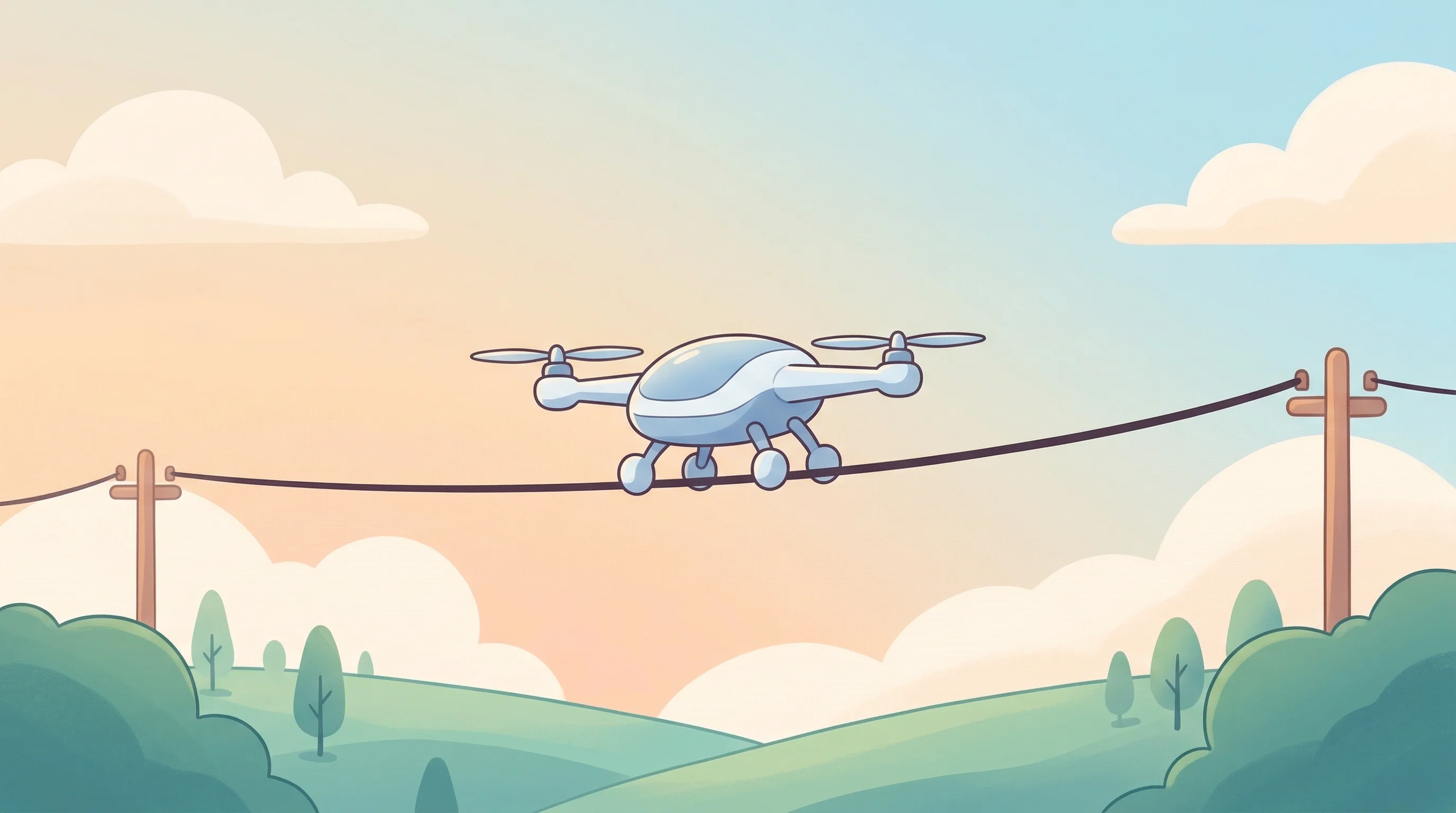
Here's where Voltair's story gets interesting, and slightly more complicated. The company's Y Combinator launch post declared that Voltair "builds drones that charge directly on transmission lines," enabling indefinite deployment for storm response, wildfire monitoring, and routine inspections. That framing—drones that never land, that live on the infrastructure they're inspecting—is undeniably compelling to utilities desperate to eliminate truck rolls and accelerate damage assessments.
But by March 2026, Voltair's website had shifted emphasis. The current version describes hybrid fixed-wing VTOL aircraft with a 70-mile range, autonomous mission planning, and "solid state inductive charging pads" for remote operations. The utility-focused pages tout storm response, vegetation management, and asset inspection services delivered through a fleet networked to ground charging stations. An older iteration of the site referenced "patent-pending recharging IP enabling recharge off an AC powerline of any voltage using inductive charging." That language now redirects or has been softened. The current site reads more like a drone-as-a-service platform built on proven dock technology, with line-charging somewhere on the horizon.
That discrepancy doesn't necessarily mean Voltair oversold its vision. It may just mean the company is pursuing a pragmatic near-term go-to-market while keeping longer-term R&D cooking in the background. Deploying pad-based networks lets Voltair compete today against Skydio, DJI, and Percepto. Perfecting autonomous line-charging would be transformative—potentially category-defining—but it likely requires extensive field trials, utility safety approvals, and regulatory coordination under frameworks like OSHA's 1910.269 standard, which governs work near energized conductors.
Still, the gap between the YC pitch and the current product positioning is worth noting.
Regulatory Friction
Routine beyond-visual-line-of-sight operations remain constrained by federal regulation, which matters enormously for anyone trying to scale an autonomous inspection fleet. The FAA published its BVLOS Notice of Proposed Rulemaking on August 7, 2025, proposing a performance-based framework to replace the current waiver-by-waiver process. The comment period was reopened in late January 2026, and legal observers expect a final rule sometime this year. Until then, scaling requires either shielded BVLOS—operations over private property or restricted corridors—or individual waivers. Dominion Energy, NYPA, and Percepto have secured such approvals, but the process is slow and bespoke.
Any system that physically contacts or harvests power from transmission lines faces additional scrutiny. Utilities operate under NERC reliability standards and must coordinate any equipment interacting with energized infrastructure. Minimum approach distances, electromagnetic interference tolerance, fail-safe mechanisms—all would need validation. Hydro-Québec's LineDrone underwent years of testing before commercial deployment. OSHA's 1910.269 rules impose strict safety protocols for live-line work, and while those target human workers, regulators would likely apply similar rigor to autonomous systems.
State-level critical infrastructure restrictions add another layer. Several states have considered or enacted drone standoff rules around substations and generation sites. The American Security Drone Act, embedded in the FY2024 National Defense Authorization Act, restricts federal procurement of drones manufactured by covered foreign entities. DJI, the dominant hardware vendor, is caught in that net, pushing utilities with federal funding toward U.S.-made alternatives like Skydio and newer entrants. Voltair's YC pedigree and San Francisco base position it on the favorable side of those restrictions, though the company hasn't publicly disclosed its hardware sourcing or manufacturing strategy.
Market Timing
The confluence of grid investment, tightening inspection mandates, and maturing drone autonomy suggests the market is ready—or nearly ready—for more persistent aerial platforms. McKinsey's March 2026 analysis of electrification equipment trends projects sustained transmission and distribution capital expenditure through 2040, driven by decarbonization, electrification, and resilience imperatives. Inspection requirements will scale with that buildout.
Whether line-charging drones capture a meaningful share depends on variables beyond pure engineering. Technical feasibility is established—academic research and DARPA programs prove the physics work. Commercial readiness is murkier. No utility has publicly announced large-scale deployment of self-charging inspection drones harvesting power from transmission lines. The systems demonstrated to date are either prototypes (Southern Denmark's research platform), military-focused (DARPA and PowerLight beaming), or contact-inspection tools not designed for energy extraction (LineDrone).
Voltair's current product—as described on its website—appears to be a hybrid VTOL platform with LiDAR, thermal, and RGB sensors, supported by ground-based inductive charging pads. That's credible, aligned with what Skydio, Percepto, and others are deploying. The line-charging capability, if and when it materializes in the field, would differentiate Voltair significantly and potentially unlock indefinite-endurance missions.
Until then, the company is competing in a crowded market on the strength of its autonomy software, sensor suite, and execution.
What Comes Next
The BVLOS final rule will be the regulatory inflection point. If the FAA adopts a performance-based standard allowing routine operations over linear infrastructure—transmission corridors, pipelines, rail lines—drone inspection providers face fewer bureaucratic hurdles and faster scaling. Utilities will shift from ad hoc pilots to systematic deployment, potentially ordering fleets in the dozens or hundreds rather than ones and twos.
On the technology side, expect incremental progress on in-flight charging and power beaming over the next two to three years, driven by defense applications and academic research. Commercial adoption will lag military use cases; utilities are conservative buyers with long procurement cycles and rigorous safety standards. A company that demonstrates safe, repeatable line-charging in the field—validated by a major utility partner and blessed by regulators—could capture outsized market share and licensing revenue.
Perhaps more importantly, it could redefine what utilities expect from aerial inspection platforms.
Voltair's founders came out of a University of Washington student competition, according to coverage from April 2025, and made it through Y Combinator's gauntlet. That trajectory suggests credibility and early traction. The five-person team has room to iterate quickly. But scaling a hardware-intensive, safety-critical product in a regulated market requires capital, partnerships, and patience—often more patience than venture-backed startups can afford.
Whether Voltair's "charge on power lines" thesis proves out in commercial deployments, or remains an aspirational long-term bet, will determine whether the company becomes a case study in infrastructure innovation or a cautionary tale about overpromising on emerging technology. The grid inspection market is expanding. The technology is advancing. A window is opening for startups that solve the endurance problem.
Voltair is one of several racing toward it. The next 18 months should clarify who gets there first—and whether getting there first actually matters if the regulatory and commercial pieces don't fall into place.


