

The pitch sounds almost quaint in an era of remote work and Zoom fatigue: build a physical space, fill it with founders, and watch the connections spark. Yet on Wednesday, April 22, 2026, more than 300 people crowded into a gleaming 4,000-square-meter facility in northern Riyadh's Al-Narjis district, suggesting that reports of the office's death may have been exaggerated.
This wasn't just another coworking space opening. COLABS, a Pakistan-born workspace platform, was making a calculated wager—that it could forge what its co-founder Omar Shah calls a "Saudi-Pakistan innovation corridor" by creating places where entrepreneurs from both countries could collide, collaborate, and close deals that might never happen over a video call.
The opening drew a roster that reads like a who's-who of regional venture capital: speakers from BECO Capital, Shorooq Partners, 500 Global, even Sotheby's and local real estate heavyweight Aqar. Panel discussions carried titles like "Conviction and Capital: Saudi and Beyond" and "Culture as Connection," framing the expansion as something more ambitious than a landlord chasing rent checks.
COLABS has raised more than $8 million to date, backed by Shorooq, Waseel Partners, Zayn VC, Indus Valley Capital, and Fatima Gobi Ventures. The company now claims operations across more than 500,000 square feet in over ten locations, serving north of 5,000 members and 300 companies—figures that represent significant growth from earlier public disclosures, though the company has been opaque about granular occupancy metrics.
Building More Than Just Square Footage
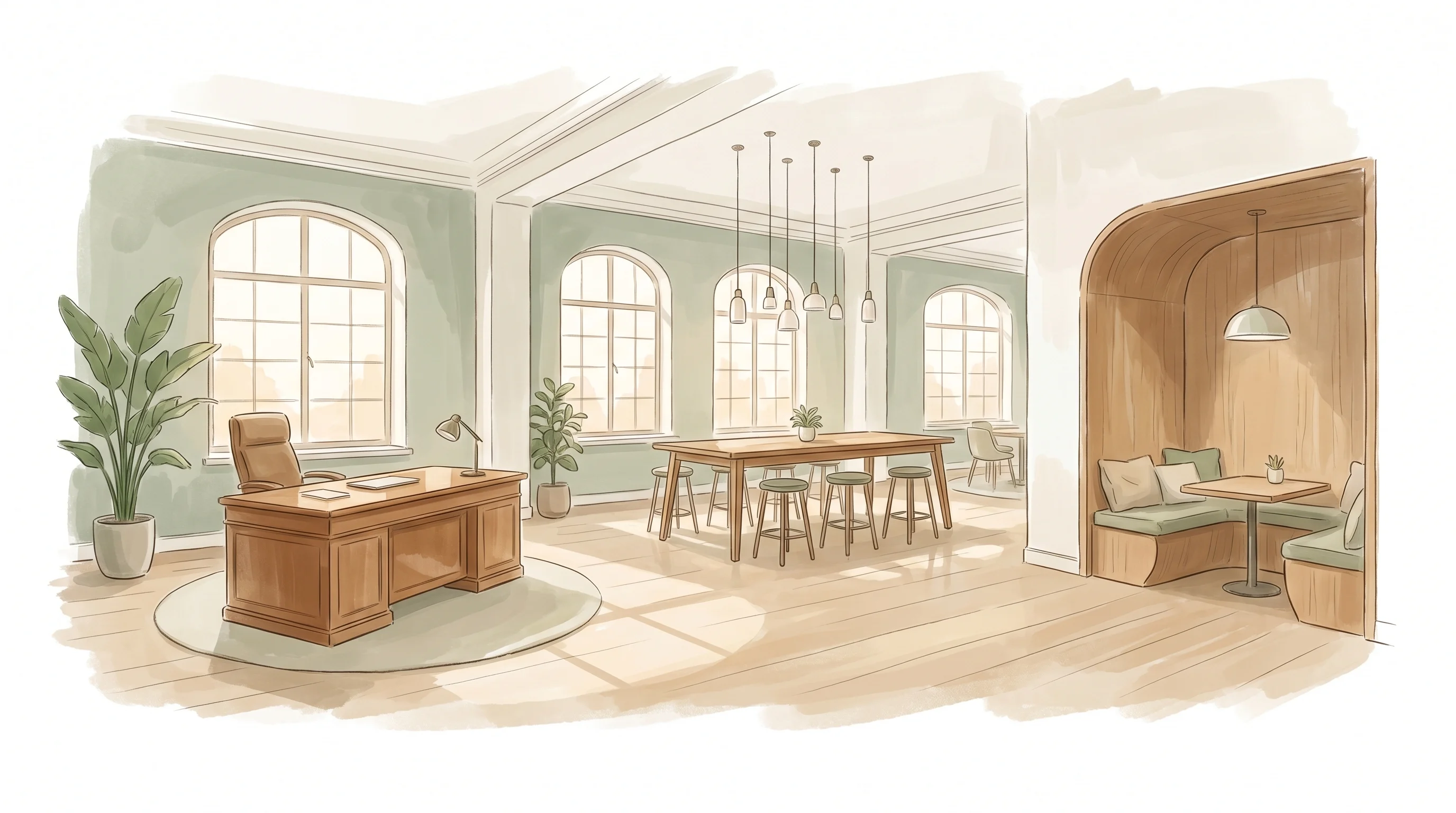
Walk through the Riyadh campus and the amenities blur together in a way that feels both familiar and formulaic: an event hall for 200-plus attendees, a rooftop terrace, podcast studio, more than ten meeting rooms, on-site daycare, a café. Third-party real estate listings have advertised indicative rates for serviced offices at approximately SAR 2,924 per person monthly, though COLABS hasn't confirmed official pricing publicly.
What differentiates the space, at least in theory, is the network it plugs into. Co-founder and CEO Omar Shah, who cut his teeth at the now-defunct Abraaj private equity firm, positions COLABS not as a coworking operator but as infrastructure for cross-border commerce. The company, which launched in Lahore back in 2019, now describes itself as "Riyadh-headquartered" in corporate materials—a rhetorical shift that signals where its center of gravity has moved.
The strategy required local navigators. COLABS partnered with Waseel Partners Investments, a Riyadh-based firm that helped decode regulatory frameworks and commercial norms in a market still finding its footing as a startup hub. Shorooq Partners, a key investor in the company's growth to more than $8 million in total funding, framed this Riyadh campus as its third investment in the company and positioned the facility as a node in a broader regional lattice.
Timing matters here. Saudi Arabia's coworking market has grown crowded as Vision 2030 diversification goals pump capital into entrepreneurship and the Kingdom captures an outsized share of MENA venture funding. Operators like AstroLabs, Servcorp, and Regus already compete for tenants in commercial districts like Olaya and King Abdullah Financial District. COLABS enters with a differentiator it hopes will resonate: a built-in binational network and a narrative that frames workspace as connective tissue for cross-border deal flow.
Culture as Commercial Strategy

In February, weeks before the Riyadh launch, COLABS announced a partnership with the Abdulmonem Al-Rashed Humanitarian Foundation to develop cross-regional arts and culture programming under its COLABS Creative Collective initiative. The move signaled an intention to blur boundaries between workspace and cultural infrastructure, appealing to creative professionals and knowledge workers beyond the traditional tech startup crowd.
The company has also cultivated corporate partnerships with global brands—EY, DigitalOcean, Canva, Coca-Cola, Spotify, Endeavor—offering members discounts, programming, and network effects that stretch beyond physical square footage. Business support services like recruitment, payroll, and compliance round out the offering, a model imported from Pakistan and now transplanted to Saudi soil.
Social media engagement around the launch ran into the hundreds on LinkedIn, with posts detailing speaker lineups and event RSVPs generating dozens of comments and shares. COLABS hasn't disclosed pre-leased capacity or occupancy rates, but the 300-person turnout for opening night suggested at least early curiosity among Riyadh's entrepreneurial set.
The Occupancy Question
Whether curiosity converts to sustained revenue is the real test. Riyadh's coworking landscape is fragmented—AstroLabs emphasizes market-entry support for international companies, Servcorp and Regus cater to corporate clients seeking premium serviced offices, smaller players like The Space and Scale target niche segments. COLABS is betting that Pakistani founders eyeing Saudi expansion and Saudi entrepreneurs curious about Pakistan's talent pool and cost arbitrage will pay for proximity and serendipity.
Perhaps the most revealing aspect of the launch wasn't the panel discussions or the amenities checklist. It was the implicit acknowledgment, in an age of frictionless digital connectivity, that geography still exerts a gravitational pull. That the right physical space, in the right city, might accelerate relationships and transactions that Slack channels and Zoom rooms can't quite replicate.
For now, the Riyadh campus represents an experiment—can a workspace operator build a commercial bridge between two ecosystems that rarely share deal memos, cap tables, or conference agendas? The 4,000 square meters in Al-Narjis may offer an answer, assuming the founders, investors, and ecosystem builders who showed up on that Wednesday evening decide to stick around long enough to find out.
---
Note: Some figures cited reflect company disclosures from early 2026 and may have shifted since then. The coworking market remains fluid, with operators adjusting footprints and pricing in response to occupancy trends and macroeconomic conditions.


