

The foreman at a sprawling solar site in California's Central Valley had a problem most people wouldn't consider: his best workers were getting hurt lifting the same object, hundreds of times a day, in triple-digit heat. The object? An 85-pound photovoltaic panel. The solution his company eventually tried? A robot.
It's a scene playing out with increasing frequency across the American Southwest and beyond, as the renewable energy industry confronts an arithmetic problem it can't hire its way out of. The EIA projected 86 gigawatts of new utility-scale capacity additions in 2026, with solar representing just over half that figure—a breakneck pace that would require the construction sector to attract 349,000 net new workers in 2026 alone, per estimates from Associated Builders and Contractors released in January.
Those workers aren't coming. Or at least, not fast enough.
Instead, a clutch of startups is betting that autonomous systems—industrial robot arms mounted on off-road chassis, guided by computer vision and GPS precision—can shoulder the most punishing aspects of solar farm construction. Among them is Cosmic Robotics, an eight-person team out of Y Combinator's latest cohort, founded in 2024 and based in San Francisco. By February of this year, the company's Cosmic-1 system had moved from pilot to certified field deployment with Sunstall's SunRobi division, which announced it had become the first qualified operator of the technology.
What's striking isn't just the emergence of these robots. It's the convergence of forces making them suddenly indispensable: crushing labor shortages, an explosion in data center electricity demand driven by artificial intelligence, and the simple ergonomic reality that humans weren't designed to hoist 90-pound objects in desert sun from dawn to dusk.
The timing, in other words, may finally be right.
When Supply Chains Meet Physics
Globally, the solar industry installed around 698 gigawatts of new photovoltaic capacity in 2025, nudging cumulative installations toward three terawatts by year-end, according to the International Energy Agency's PVPS Snapshot published in May. The U.S. accounted for a record 86 GW of planned utility-scale capacity additions in 2026, with solar representing just over half that figure, per EIA projections from February and March.
Solar and storage together accounted for more than 90 percent of new U.S. power additions in the first quarter alone, and utility-scale solar contracts climbed 15 percent year-over-year, according to the Solar Energy Industries Association and Wood Mackenzie's market report released in June.
The pace is relentless. The work itself? Tedious, backbreaking, often conducted in locations where cell service is a luxury and shade is nonexistent. A typical utility-scale PV module weighs somewhere between 80 and 100 pounds—well above the 51-pound "load constant" that NIOSH established decades ago as the upper limit for safe two-handed lifts. Crews repeat this motion hundreds of times each day, hoisting panels several feet off the ground onto tracker arrays that follow the sun's arc across the sky.
It is, as James Emerick, Cosmic's co-founder and CEO, put it in an April 2025 TechCrunch interview, "terrible work in remote places." Emerick would know. Before launching Cosmic, he worked at Built Robotics, another Bay Area company tackling construction automation. That experience informed his pitch when Cosmic announced a $4 million pre-seed round led by Giant Ventures: solar installation is ripe for disruption because the bottleneck is no longer module cost or even permitting—it's the physical capacity to build fast enough.
Panel placement is one stage in a sprawling multi-phase process: site prep, pile driving, racking assembly, electrical wiring, testing. Each has attracted its own automation experiments. Built Robotics focused on autonomous pile driving with its RPD35 system, which can handle piles up to 19 feet and has been trialed at sites like Fortescue's Cloudbreak Solar Farm in Australia, results published by the Australian Renewable Energy Agency in April. Civ Robotics offers autonomous layout-marking robots that have worked with Bechtel and other large engineering firms. Terabase Energy is advancing Terafab, a field-factory approach that combines AI and robotics, targeting hundreds of megawatts of installs this year.
Then there's AES's Maximo, perhaps the furthest along in proving the concept at scale. By March, Maximo's four-robot fleet had installed 100 megawatts of panels at AES's one-gigawatt Bellefield project in Kern County, California, exceeding one module per minute with its latest v3.0 units. Chris Shelton of AES noted that the milestone "demonstrates that field robotics can move beyond experimentation and deliver consistent results at utility scale."
Which is another way of saying: this is no longer just a prototype game.
The Forces Driving Adoption
Three dynamics are colliding to make automation not just appealing but necessary.
First, the labor picture is bleak and getting bleaker. The Bureau of Labor Statistics projects employment for solar PV installers will grow 42.1 percent from 2024 to 2034, with wind turbine technicians expanding by nearly 50 percent, according to a July update. That growth rate far outstrips the ability to train and retain workers, especially in a construction sector already wrestling with demographic headwinds—aging tradespeople, competition from other infrastructure megaprojects, and a persistent skills gap.
Helge Biernath, CEO of Sunstall, told pv magazine in an April interview that integrating robots helps "reduce strain" and "improve consistency and throughput on large-scale sites," freeing experienced crews to focus on tasks requiring judgment and finesse rather than brute repetition. It's a diplomatic way of acknowledging what site managers already know: you can't hire your way out of this.
Second, data centers are rewriting electricity demand forecasts in real time. Gartner reported in June that data center consumption would grow 26 percent in 2026, with AI-optimized servers accounting for roughly 31 percent of data center power draw. The EIA noted in January that the U.S. is experiencing its strongest four-year electricity demand growth since 2000, with solar expected to supply much of the new generation. By mid-year, the Federal Energy Regulatory Commission had issued show-cause orders to regional transmission organizations, demanding faster processes for large load interconnections—a signal of just how urgent the pressure has become.
The Department of Energy projects data center electricity consumption could reach 11.8 percent of total U.S. demand by 2030, according to updated forecasts from June. That's roughly double the current share. Someone has to build the generation to feed that appetite.
Third, there's the stubborn reality of human ergonomics. Lifting a 90-pound panel repeatedly, in scorching heat or bitter cold, is precisely what OSHA and NIOSH guidelines warn against. Robots don't fatigue. They don't suffer lower-back injuries. They don't need hydration breaks when the thermometer hits triple digits. And crucially, they don't quit after three months because the work destroyed their knees.
Policy adds a wrinkle. The Inflation Reduction Act's prevailing wage and apprenticeship requirements, finalized by Treasury and the IRS in mid-2024, impose penalties on projects that fail to meet labor standards. Automation doesn't exempt developers from these rules, but it can ease the physical burden on workers and potentially allow smaller, higher-skilled crews to meet productivity targets while staying compliant. Whether that calculus pencils out at scale remains to be seen.
Cosmic and the Emerging Playbook
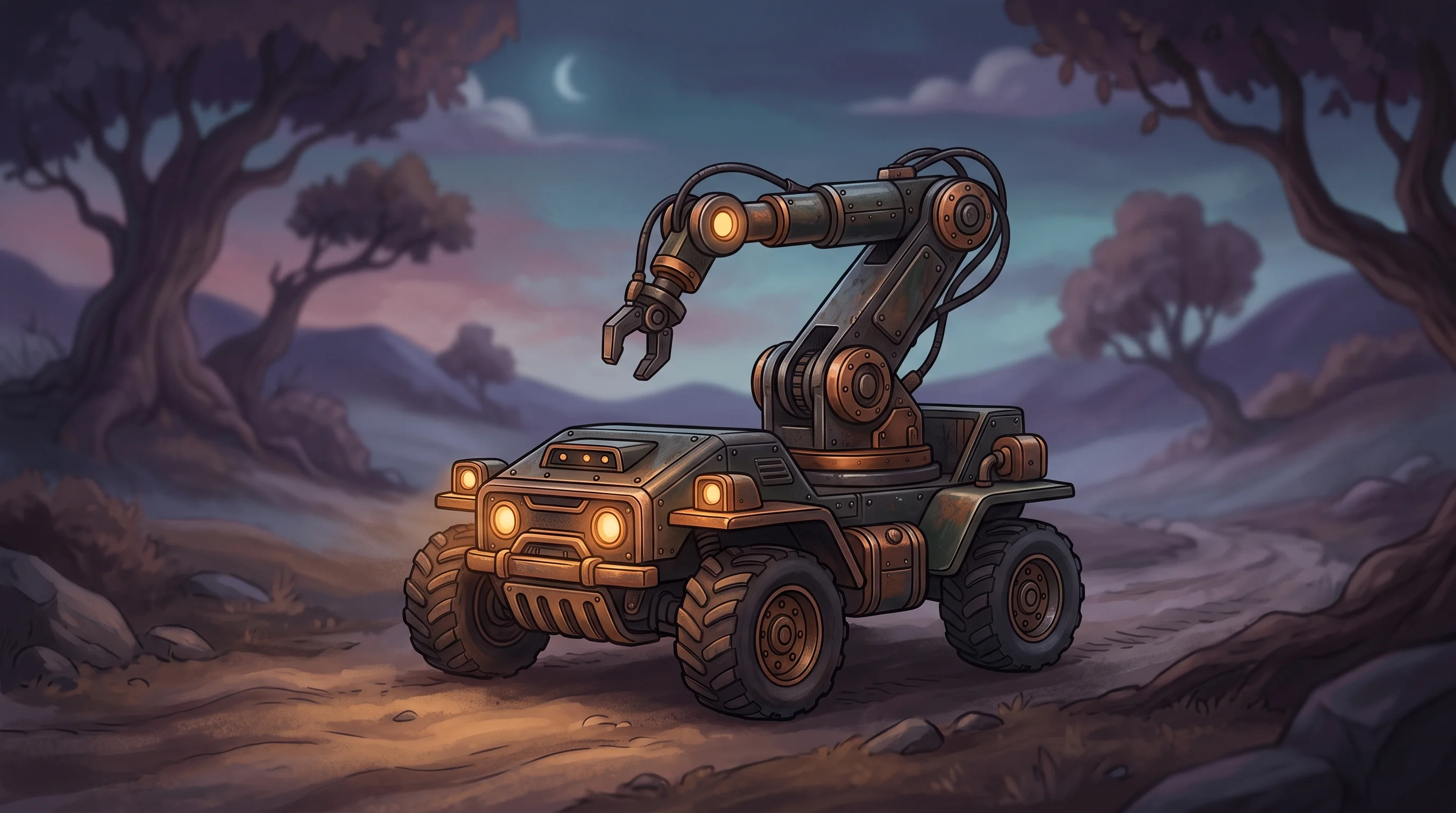
Cosmic Robotics exemplifies the current approach. Co-founded by Emerick and Lewis C Jones, the startup uses industrial-grade hardware—specifically a KUKA KR IONTEC robotic arm designed for harsh factory environments—mounted on an autonomous off-road vehicle. Computer vision and RTK GNSS (real-time kinematic global navigation satellite systems, for the uninitiated) enable the system to navigate rough terrain and align panels to within a millimeter. The Cosmic-1A system uses suction end-effectors to grip modules and reportedly can place one panel every 30 to 40 seconds, roughly matching the pace of the fastest human installers, though that figure comes from the company's April 2025 TechCrunch coverage and is now more than a year old.
By February, Sunstall's SunRobi division announced it had become the first certified operator of Cosmic's autonomous installation systems, following what it described as "repeated deployments on U.S. utility-scale projects," according to press releases from early in the year. In May, Jones shared a LinkedIn post celebrating a "fully autonomous solar panel installation" milestone—the kind of update that suggests the technology has moved beyond controlled demos into actual jobsite conditions.
On July 8, Cosmic participated in FTC Solar's inaugural "Robo Day" at the tracker manufacturer's ASTAAR training facility in Seguin, Texas. The event brought together Cosmic and half a dozen other robotics vendors—Aonics, BotCrew, Civ Robotics, Libra Robotics, Ozzies, and RoboForce—each focused on different slices of the construction process: module mounting, cable handling, material movement, layout marking. FTC's intent was clear: position itself as automation-ready and demonstrate that the future involves multiple robots working in concert, not a single silver-bullet solution.
According to the company's Y Combinator profile, Cosmic is deploying "on some of the largest solar farms in the U.S." and has "more than doubled labor productivity across tens of thousands of panel installs," though independent third-party validation of those claims hasn't surfaced in mainstream press coverage as of mid-year. The company lists a team of eight and mentions involvement in a NASA lunar construction effort, though details on the latter remain sparse—perhaps a hedge for future revenue streams beyond terrestrial solar.
AES's Maximo, by contrast, offers harder numbers and a longer track record. The AES-incubated robotics unit scaled from one to four robots at Bellefield, installed 100 MW by March, and publicly cited throughput exceeding one module per minute. The system uses NVIDIA's Isaac Sim and Omniverse for validation, alongside on-site AI orchestration to coordinate fleet operations, according to Solar Power World coverage from late March. That level of disclosed performance provides a benchmark against which newer entrants like Cosmic will inevitably be measured—and it's a high bar.
Elsewhere in the ecosystem, the pace of experimentation is quickening. Charge Robotics has piloted a portable factory approach with SOLV Energy, aiming to assemble modules on-site. Relu Robotics in China reportedly deployed a nine-ton tracked robot in Algeria for PV construction in harsh desert conditions, per July coverage in pv magazine España. Goldbeck Solar in Europe won The smarter E Award in June for its HeliomatiX system, which the company claims reduces man-hours by up to 85 percent—a figure that, if accurate, would be game-changing. Terabase Energy's Terafab is targeting hundreds of megawatts in deployments this year.
Most systems today operate in what insiders call "assisted autonomy" mode. The robot handles the lift and precise placement; human workers fasten the panels, check quality, and troubleshoot when things go sideways. The trajectory, though, is toward full automation of fastening, as suggested by technical discussions at FTC's Robo Day and in pv magazine coverage from April. Whether the industry gets there in two years or five depends on how quickly the hardware matures and how willing EPCs and developers are to cede control to machines.
What Comes Next
The near-term outlook hinges on three questions, none of them trivial.
First: Can these systems prove consistent economic value at scale? AES has demonstrated 100 MW of robotic installs. Sunstall has operationalized Cosmic's system with certified crews. FTC Solar's Robo Day suggests tracker manufacturers are preparing for a multi-vendor robotics ecosystem. But the next milestone will be third-party, project-level cost and schedule data showing robots deliver measurable internal rate of return uplift, not just productivity gains in a vacuum. Developers need to see proof that the CAPEX hit of buying or leasing robots pays back in faster schedules, fewer injuries, and lower labor costs. That data is still emerging.
Second: Will tracker OEMs and EPCs standardize on automation-friendly designs? Today's robots are purpose-built for specific tracker geometries, clamp systems, and module dimensions. As the industry shifts toward larger bifacial modules and single-axis trackers with tighter tolerances, equipment that can adapt to multiple configurations without extensive reengineering will hold a decisive advantage. FTC's emphasis on an "ecosystem of autonomous solutions working in concert," from its July 8 press release, points toward a future where interoperability becomes a competitive differentiator. But getting rival manufacturers to agree on common standards? That's a political and commercial challenge, not just a technical one.
Third: How will the interplay of IRA labor standards, trade actions, and interconnection bottlenecks shape adoption? The Commerce Department and U.S. International Trade Commission continue to issue preliminary determinations in anti-dumping and countervailing duty investigations—India, Indonesia, and Laos were subjects of recent preliminaries—affecting module sourcing timelines and costs. FERC's actions to streamline generator interconnection and accommodate large loads reflect systemic pressure to build faster, and automation directly supports schedule certainty when modules are actually available. IRA domestic content bonus credits and prevailing wage requirements remain in force. Robots reduce heavy labor, but they don't remove the need for compliance or suddenly make tariffed modules cheaper.
Workforce implications deserve more than a passing glance. The construction labor gap is real, and robots likely augment crews rather than replace them in the medium term, given the dexterity and problem-solving still required for fastening, wiring, commissioning, and troubleshooting. The Bureau of Labor Statistics still projects massive growth in solar installer jobs through 2034. The question isn't whether humans will work on solar farms a decade from now—they will. It's whether robots can shoulder the repetitive, injury-prone tasks so that people can focus on higher-value work in safer conditions. And whether the industry can train workers fast enough to keep up with either scenario.
For climate tech investors and renewable energy executives, the takeaway is relatively straightforward, if unsettling. Solar installation automation is no longer speculative. Multiple vendors have moved from pilots to certified operations. EPCs are integrating robotics into project plans. Tracker OEMs are designing for automation compatibility. Cosmic Robotics, with its Y Combinator pedigree and $4 million in pre-seed capital, represents one early-stage bet in a rapidly maturing space. But it's the broader convergence—record solar deployments, acute labor shortages, data-center-driven urgency, and maturing autonomy technologies—that makes the sector worth watching closely over the next twelve to eighteen months.
The IEA's latest snapshot notes that the global PV market is shifting from a module-cost-driven phase into an integration-and-storage-constrained phase. Labor and execution speed are now the bottlenecks, not silicon wafer prices or inverter lead times. Robotics offers a path through that bottleneck, provided the economics hold and the ecosystem coalesces around something resembling common standards.
The next wave of utility-scale solar projects will almost certainly be built by human-robot teams. The only question—and it's not a small one—is which teams prove most effective, and how quickly the industry can scale them before the data centers run out of patience.


