

When a grid infrastructure fire knocked out power to a California factory last year, the clock started ticking. Production halted. Revenue evaporated. The traditional remedy—waiting for utility crews, engineering studies, interconnection applications—promised months of downtime, maybe longer.
Instead, the facility was running at full capacity within six hours. Off-grid. 1.5 megawatts. The machinery humming again thanks to a patchwork of diesel generators and something newer: a standardized microgrid system from Critical Loop, a Long Beach startup that just closed a $12 million funding round.
The late-January infusion, tracked by CB Insights and PitchBook, brings the three-year-old company's total capital raised to $12.39 million. Known backers include Alchemist Accelerator, Better Ventures, and Adapt Nation Capital, though Critical Loop hasn't yet announced who led the round—a telling silence in an industry where naming marquee investors typically happens before the ink dries.
The Four-Year Wait Nobody Can Afford
Here's the brutal arithmetic facing anyone trying to plug into America's electrical grid right now: Lawrence Berkeley National Laboratory's interconnection queue data shows more than 2,600 gigawatts of generation and storage projects stuck in bureaucratic purgatory. Median wait times? Four to five years, and climbing.
In Texas alone, ERCOT—the state's grid operator—fielded 230 gigawatts worth of large-load connection requests in 2025. That's a fourfold spike from the prior year, driven almost entirely by data centers scrambling for power as artificial intelligence workloads explode across the industry. Silicon Valley Power has erected 48-megawatt facilities that sit dark, fully built but unconnected, waiting for someone to flip the switch.
The disconnect between digital ambitions and physical reality is becoming untenable. S&P Global estimates U.S. data centers will demand 22 percent more grid power by year-end 2025, then nearly triple that appetite by decade's end. Multi-year interconnection timelines don't merely frustrate CFOs—they threaten entire business models.
Enter the microgrid merchants, companies like Critical Loop betting that speed trumps everything.
Combiners, Controllers, and C-17s
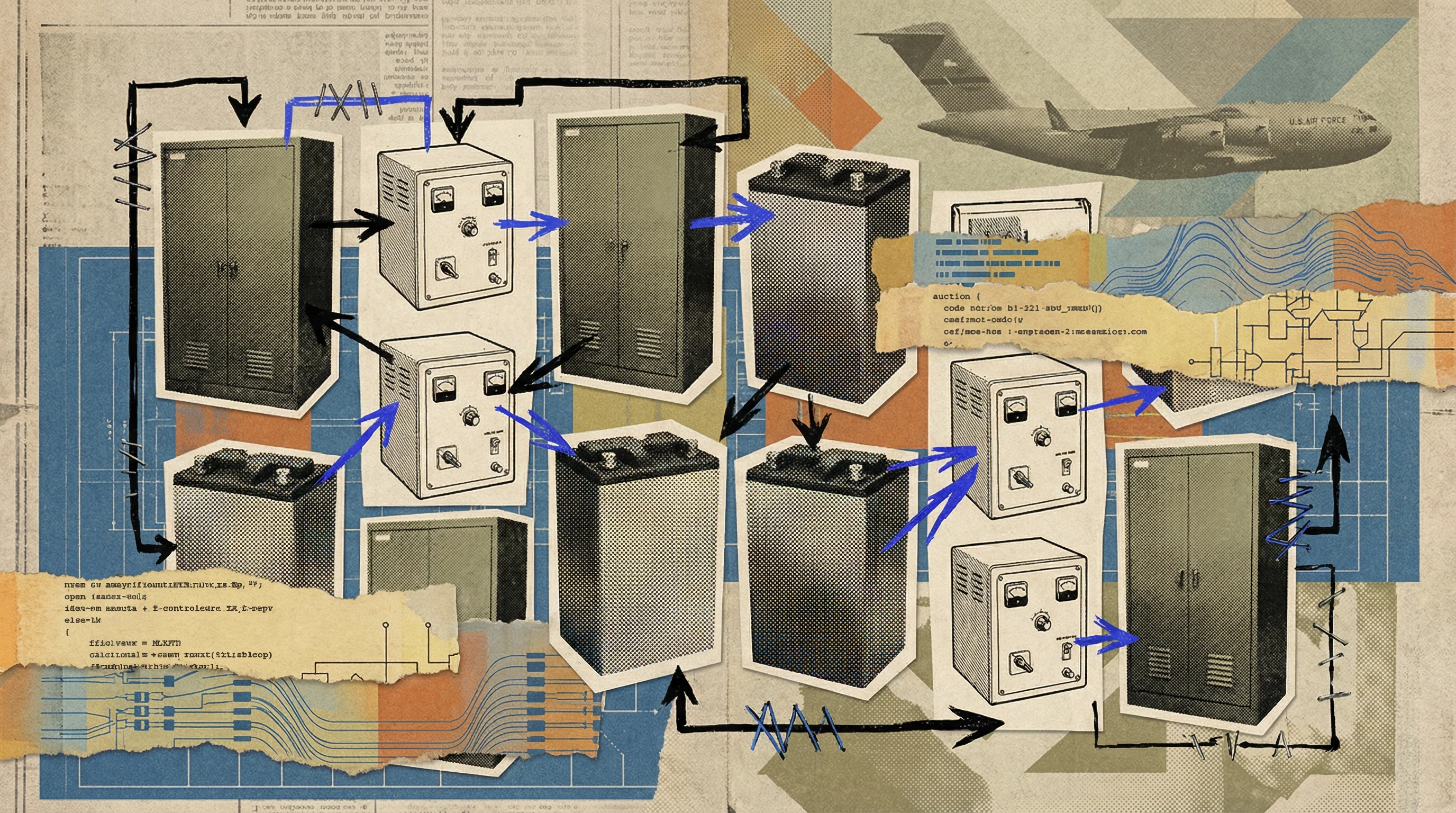
Critical Loop's proposition sounds deceptively simple: what if power infrastructure could be deployed like software? The company's platform stitches together standardized cabinets (which they call "Combiners"), UL 3141-certified site controllers, and megawatt-scale batteries that can be moved where needed. Software layers on top, predicting demand spikes and orchestrating energy flows in real time.
Deployments happen in hours, not months. That factory restoration wasn't a fluke.
The technology is already humming in environments where downtime carries consequences. San Diego International Airport installed Critical Loop's predictive energy platform last November to juggle battery storage and solar generation, shaving peak demand when the grid groans under Southern California's afternoon heat. A defense contractor's rocket engine test facility in California now runs on a nearly one-megawatt Critical Loop microgrid.
Perhaps most ambitious: National Defense Magazine reported in December that the startup is pitching mobile systems capable of scaling to 100 megawatts for remote military installations. Systems designed to fit inside C-17 cargo planes and stand up rapidly wherever troops deploy—or wherever disaster strikes and civilian infrastructure collapses.
Credentials and Context
The founding team's résumés read like a Silicon Valley defense-industrial crossover episode. CEO Balachandar Ramamurthy spent years at SpaceX working on flight safety and crew reliability—the kind of engineering where mistakes cascade catastrophically. CTO Lydia Maher, a Forbes 30 Under 30 Europe honoree, came from Palantir's data analytics trenches.
Their advisory bench carries weight. Arno Harris sits on PG&E's board and previously led Recurrent Energy. Ravi Chaudhary served as assistant secretary of the Air Force. These aren't merely decorative names; they signal access to procurement channels and regulatory corridors where microgrid contracts get written.
Meanwhile, government money is starting to flow toward the problem. Texas authorized $1.8 billion for critical-facility microgrids serving hospitals, water treatment plants, and emergency operations centers—the kind of infrastructure that can't afford multi-day blackouts when hurricanes hit or heatwaves strain the grid past its design limits.
Hardware in Motion

In early January, supplier Coulomb Solutions announced delivery of a 2.33-megawatt-hour mobile battery system to Critical Loop's fleet, a tangible sign the startup is building out physical inventory rather than just pitching vapor.
That matters because microgrids have traditionally been bespoke affairs—what Critical Loop dismisses as "snowflake" projects requiring months of custom engineering for each site. The company's wager is that standardization unlocks something utilities and traditional contractors can't match: the ability to relocate capacity as demand shifts, rather than betting billions on fixed infrastructure that may or may not align with where AI data centers decide to sprout next year.
Whether that bet pays off depends partly on factors beyond Critical Loop's control. Interconnection reform is inching through regulatory bodies. Utilities are experimenting with new queue management schemes. But political will moves slower than technology, and data centers can't wait for Congress to fix the grid.
The Unspoken Calculation
What Critical Loop hasn't detailed publicly—and what will determine whether this $12 million round fuels genuine scale or merely buys runway—is unit economics. Portable megawatt infrastructure isn't cheap to manufacture, deploy, or maintain. The company's revenue model, customer acquisition costs, and margin structure remain opaque.
Still, the market signal is hard to ignore. When a factory operator chooses six hours of microgrid deployment over six months (or longer) of interconnection queue purgatory, they're making a statement about the value of certainty. When airports and defense contractors make similar calculations, the statement gets louder.
Critical Loop is betting that in an era where grid capacity can't keep pace with digital demand, speed isn't just an advantage. It's the whole game.
And they're betting investors agree.


