

The scenario is familiar to anyone who's flown search-and-rescue missions: your drone hovers above miles of forest or coastline, and the camera's field of view becomes a cruel negotiation. Zoom out for coverage, and you'll miss the backpack that signals a lost hiker. Zoom in for detail, and you might fly right past them.
Copenhagen startup Sapient Perception believes it has an answer. The company's newly introduced ECHO system—what it bills as "the world's first dedicated 10K sensor purpose-built for UAVs"—promises to collapse that tradeoff entirely. On paper, at least, it's an audacious claim: up to 100 times greater area coverage at the same resolution, all captured in a single frame.
Announced on May 6, ECHO represents Sapient's entry into the crowded, high-stakes world of defense and emergency response sensing. Whether it delivers on that promise remains an open question. But the architecture alone suggests the founders have thought carefully about what happens when bandwidth is scarce, altitudes are extreme, and missing a target isn't an option.
Three Parts, One Bet
ECHO isn't just a camera. It's a three-piece system designed to process intelligence before it ever reaches a ground station.
The front end—the ECHO sensor itself—captures what the company describes as 10K resolution imagery, though exact pixel dimensions haven't been disclosed. The FORGE module, an NVIDIA-based processor weighing less than 500 grams, handles compute in flight. And IGNITE, the AI framework that ties it all together, runs operator-supplied detection models on the aircraft, georeferencing hits and sending only verified alerts earthward.
That last part matters more than it might seem. Streaming raw 10K video from a stratospheric platform—or from a contested zone where bandwidth is a battlefield resource—simply isn't feasible. By processing imagery onboard and transmitting only detections, Sapient sidesteps a problem that has bedeviled high-resolution UAV sensing for years.
The company points to ongoing deployments for high-altitude intelligence and surveillance work, including partnerships with Spaceline, a stratospheric platform developer. According to Spaceline, ECHO addresses both detail and bandwidth constraints at altitudes where conventional systems struggle.
Integration flexibility appears baked into the design. IGNITE is model-agnostic—operators can feed it their own training data and custom algorithms. The system connects via MAVLink, CAN, and Ethernet, slotting into existing drone architectures without requiring wholesale redesigns. For U.S. and NATO customers, Sapient emphasizes NDAA compliance and an ITAR-free, allied supply chain. Important checkboxes, if not exactly differentiators in a market where everyone's trying to tick the same boxes.
Pedigree and Pivot
The founders didn't arrive from nowhere. Anthony Garetto, Lau Nørgaard, and Michael Messerschmidt—Sapient's CEO, CTO, and chief business officer, respectively—spent years at Phase One, the Danish imaging powerhouse known for medium-format aerial cameras used in mapping and inspection. Sapient itself spun out in April 2025, initially under the name Apex Imaging before rebranding in March.
That lineage shows in the product. Phase One built its reputation on precision optics and high-resolution systems for civilian applications. The founders are now translating that expertise into missions where the stakes are considerably higher: convoy protection, minefield clearance, border surveillance.
In mid-April, Sapient announced a €2 million pre-seed round co-led by Danish venture firms Balnord and FORWARD.one. The funding will go toward hiring, expanding IGNITE's software capabilities, and supporting early deployments across defense, security, and emergency response customers. Exact headcount is hard to pin down—business registries list somewhere between seven and nine employees—but the team is small and the timeline ambitious. Which is either a sign of lean execution or a signal that scaling will be the real test.
Ukraine as Proving Ground
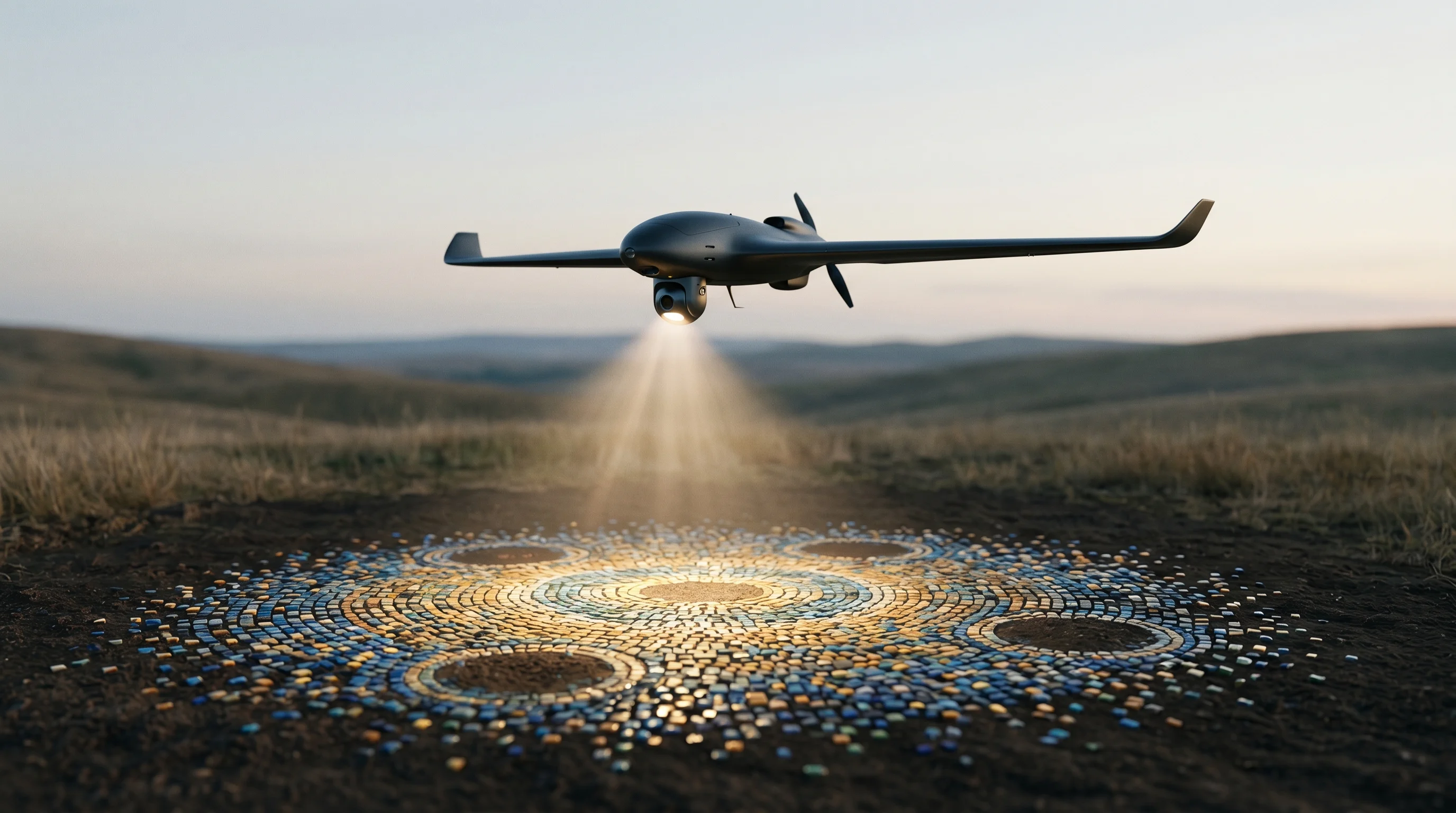
Perhaps the clearest evidence of traction comes from the front lines. Trade publications indicate Sapient is integrating its wide-area sensors into UAVs that feed into Dropla Tech's Blue Eyes edge platform, which Ukraine's Ministry of Defence reportedly uses to detect ambush drones and landmines along supply routes.
Dropla, a Danish-Ukrainian dual-use startup that raised €2.4 million in August 2025 to scale its explosive-threat detection AI, represents a broader pattern in the Eastern European defense tech ecosystem: startups cross-pollinating and fielding solutions faster than legacy contractors can turn around PowerPoint decks. Whether that speed translates to durability under operational stress is another question, but it's hard to ignore when real-world missions are involved.
Beyond Ukraine, Sapient targets search-and-rescue operators, border agencies, and conventional ISR missions. The use cases are intuitive—scanning coastlines for missing vessels, monitoring borders, clearing mines—but they also hinge on a technical premise that hasn't been independently verified. Finding a person in a vast search area, as one industry outlet put it, can come down to spotting "few pixels" in a haystack of imagery. If ECHO genuinely delivers that capability without sacrificing coverage, it's a meaningful leap. If not, it's an expensive curiosity.
The company plans to showcase the system at XPONENTIAL 2026 in Detroit and the Resilience Conference in Copenhagen, both scheduled for mid-May. Those venues matter: defense customers tend to buy on proof, not press releases. Hands-on demos will tell more than spec sheets.
What's Missing
For all the detail Sapient has shared, critical gaps remain. Exact pixel counts for the 10K sensor? Not public. Frame rates? Field-of-view options? Dynamic range? All absent. Pricing and lead times—arguably the most relevant data points for potential buyers—are similarly undisclosed.
The company's claim of 100× coverage improvement is, for now, just that: a company claim. Independent benchmarks don't exist yet, and in a market where Teledyne FLIR, NextVision, Trillium, and even Raytheon are pushing advanced perception systems, proving a technical edge requires more than announcements.
Teledyne's Hadron 640 series, for instance, dominates the dual thermal/visible module space for small drones. NextVision and Trillium offer stabilized gimbals with onboard AI. Raytheon recently flight-tested its RAIVEN sensing suite, a reminder that major primes aren't sitting idle. Sapient's advantage, if it holds, lies in purpose-built 10K resolution at drone-compatible weight. But holding that advantage in contested procurements takes data, not marketing.
Pixels and Promises

So where does that leave Sapient? With a sensor, a modest funding round, and a handful of early customers willing to test the hypothesis that 10K imaging changes the equation for UAV missions.
The team has the imaging pedigree to execute. Phase One didn't build its reputation by accident. But defense markets reward performance, not potential. And in missions where success is measured in lives saved—or threats neutralized—"up to 100 times" better doesn't mean much until it's proven in conditions where failure isn't academic.
For now, ECHO is a compelling pitch. Whether it becomes a standard tool in UAV sensing, or a footnote in the long history of promising prototypes that didn't scale, will depend less on announcements and more on what happens when the cameras roll in anger. The founders know that. So do the customers who'll decide whether to write the checks.


