

Six months ago, most American software engineers couldn't have told you what DeepSeek was. Today, the upstart Chinese AI lab—an offshoot of a quantitative hedge fund, no less—has OpenAI and Anthropic scrambling to defend their business models.
The catalyst? DeepSeek managed to build language models that perform nearly as well as the West's most expensive offerings, but at a fraction of the cost—about 99% less at the task level. Industry observers are calling it an "efficiency shock," and that phrase undersells it.
Consider the stark arithmetic: According to pricing data compiled by Axios, DeepSeek's V4 Flash model delivers comparable performance to Anthropic's Claude Opus 4.8 on complex coding and autonomous agent tasks. The kicker is what it costs to run them. The same workload that rings up $25 on Claude costs about $0.28 on DeepSeek—a 99% discount at the task level. Even adjusting for token-by-token pricing differences, DeepSeek holds an 89-fold advantage.
Within days of V4 Flash's debut, the competitive response was swift and unambiguous. OpenAI cut GPT-5.6 Luna pricing by roughly 80% in late July. Google rushed out new "flash" models. A pricing floor that had held steady for a year and a half collapsed in weeks.
Perhaps this was inevitable. But the speed caught everyone off guard.
When the Numbers Don't Lie
DeepSeek's rate card sits in a different universe than its Western competitors. V4 Flash runs at approximately $0.14 per million input tokens and $0.28 per million output tokens, based on third-party API trackers and documentation circulating through developer communities over the summer. The larger V4 Pro variant costs around $0.435 input and $0.87 output after a 75% price cut that the company made permanent in late spring.
Anthropic, by contrast, hasn't budged. Claude Opus 4.8 still costs $5 per million input tokens and $25 output. Sonnet 4.6 runs $3 and $15. These prices held through product launches and mounting competitive pressure—a deliberate bet that premium capability commands premium dollars.
The gap widens further when you account for prompt caching, a technique where repeated system instructions get stored to avoid reprocessing. DeepSeek's cache-hit pricing for V4 Flash drops to $0.0028 per million input tokens. For production workloads with stable prompts, that's effectively rounding-error territory. Companies pushing tens or hundreds of millions of tokens monthly are looking at six-figure, sometimes seven-figure annual savings.
It's the kind of delta that makes CFOs pay attention.
The Market Votes With Traffic
OpenAI's 80% price slash on Luna wasn't a promotional gimmick. You don't cut your flagship reasoning model that deep unless you're watching market share evaporate.
Developer usage patterns tell part of the story. Data from OpenRouter, a gateway service that routes requests across multiple model providers, showed DeepSeek capturing 17-20% of routed token share by early summer. By early summer, Chinese models collectively overtook American ones in total token volume on the platform. Weekly tallies from midsummer showed Chinese-model share hitting the mid-forties to mid-fifties percent range, with DeepSeek alone representing roughly 16-18% of total volume.
These are developer and startup figures, not enterprise contract data. But they're directional—and directionally alarming if you're running an incumbent lab.
Anthropic has held its ground, wagering that the highest-end buyers will pay for guaranteed performance on the hardest tasks. Claude Code, launched for agentic coding workflows, targets teams that need multi-step reasoning and can't tolerate errors. Whether that bet pays off depends on how wide the capability gap actually is. And whether customers perceive it as wide enough to justify the cost differential.
The Architecture Behind the Arbitrage
DeepSeek didn't achieve these economics purely through government subsidies or cut-rate labor, though both likely play some role. The architecture is purpose-built for efficiency.
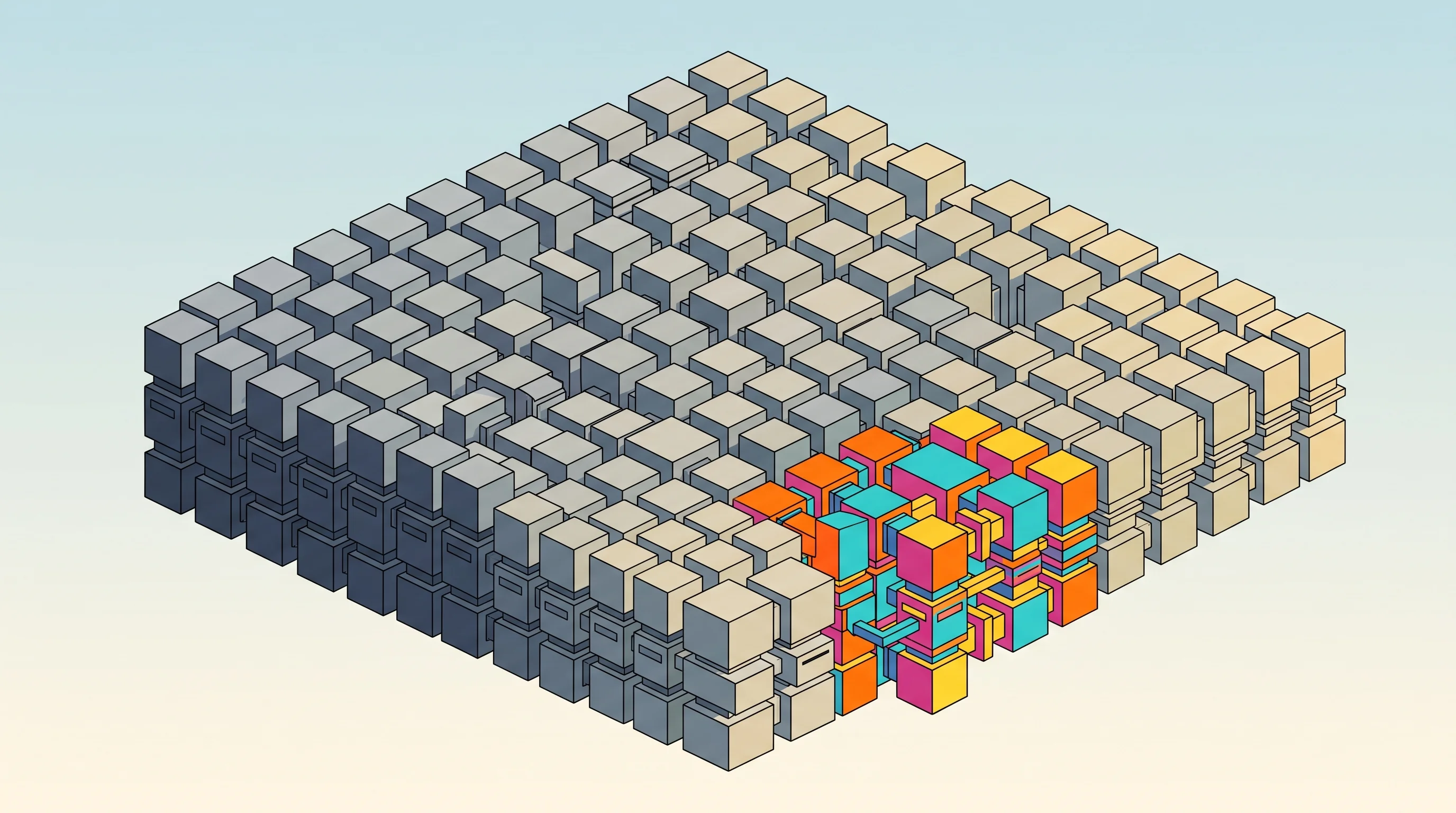
V4 Pro employs a mixture-of-experts design with 1.6 trillion total parameters—but only 49 billion activate per token. V4 Flash scales that down to 284 billion total with 13 billion active. This sparse activation pattern slashes the computational cost of each generated token. You're running a fraction of the full model for any given input, which is the entire point.
Training costs also run far below Western benchmarks, at least according to DeepSeek's own accounting. The company's technical report for its V3 model, released late last year, claimed a training run cost of $5.576 million—calculated from 2.788 million H800 GPU hours at $2 per hour on a 2,048-chip cluster. Independent analysts, including SemiAnalysis and researchers writing in Communications of the ACM, argue the all-in program costs were considerably higher once you factor in hardware capital expenditures, prior experiments, and full R&D cycles. Some estimates suggest total costs including hardware and R&D could be substantially higher than the reported training run figure.
Fair point. But even if the real figure is ten times higher, it's still a fraction of what Western labs are spending on frontier training runs.
Inference is where the cost compression really compounds. Academic papers circulating over the summer detail DeepSeek's Sparse Attention mechanism and token-wise compression techniques that reduce memory bandwidth and key-value cache requirements. One methodology paper proposed low-bandwidth, memory-heavy decode accelerators that could theoretically serve the 671-billion-parameter R1 model for under $30,000 per server, with an estimated $12 per million tokens at production scale.
That's not a shipping product announcement. It's a worked example. But it illustrates the engineering philosophy: relentless focus on reducing the denominator.
Production Deployments and Real-World Switching Costs

Lindy, an AI work assistant startup, went public with a full migration from Anthropic to DeepSeek V4 in early summer. CEO Flo Crivello stated the move would "save millions" annually, with equal or better performance on core use cases. That kind of endorsement from a funded, production-scale company carries weight—particularly when the founder is willing to stake his reputation on it publicly.
Porting isn't frictionless. Migration write-ups note operational complexities around API compatibility, latency tuning, and behavioral differences in edge cases. But the ROI threshold isn't particularly high. For workloads pushing above a few hundred thousand dollars monthly in model spend, the delta justifies the engineering lift.
Self-hosting adds another dimension. DeepSeek releases open weights, enabling companies to run models on-premise or in private cloud environments. That addresses data residency concerns for regulated industries, though it shifts cost from API fees to infrastructure and operational overhead. Not every organization has the technical chops or willingness to manage that complexity.
The real question is whether adoption accelerates beyond early movers and cost-sensitive segments. If enterprises start routing "good enough" tasks to DeepSeek while reserving premium models for the highest-value queries, the revenue mix shifts fast for incumbent providers. And once that routing logic gets baked into orchestration layers, reversing it becomes harder.
Regulatory Headwinds and Compliance Friction

DeepSeek's momentum comes with regulatory baggage that could reshape adoption curves in Western markets—or limit them entirely.
In spring, the White House Office of Science and Technology Policy issued a memo alleging "industrial-scale" adversarial distillation by China-based actors against U.S. frontier models. The House Homeland Security Committee and the Select Committee on China launched a joint investigation into risks posed by PRC-linked AI models. Proposed legislation making the rounds could restrict use of Chinese models by government agencies and critical infrastructure vendors.
The EU AI Act brings its own compliance burden. General-purpose AI provider obligations began phasing in over the summer, with requirements around transparency, copyright, and safety documentation. Open-source exemptions exist for some provisions, but deploying DeepSeek in European production environments still requires legal review and careful interpretation.
Content and alignment concerns layer on top. Studies by Enkrypt AI and other research groups claim PRC models exhibit political bias in China-related queries and refuse certain topics altogether. One study earlier this year by Enkrypt AI reported a 91% pro-China lean in geopolitical responses from the R1 model, though methodology and independence of such assessments vary widely. For companies where neutrality is mission-critical—news organizations, research institutions, certain consulting firms—that's a blocker.
Data residency gets murkier still. Direct API usage routes through Chinese infrastructure. Some U.S.-facing resellers add markups ranging from 1.8× to 3.5× to cover hosting in domestic data centers, which narrows the cost advantage considerably. Buyers need to verify end-to-end "effective cost per million tokens" using their own logs, factoring in caching behavior and actual traffic patterns. The sticker price is seductive, but real-world TCO requires homework.
The Repricing of Intelligence
Gartner predicted earlier this year that inference costs for trillion-parameter language models would drop over 90% by decade's end, driven by quantization, pruning, and architectural optimizations. McKinsey noted that hyperscalers are pouring more than $700 billion into AI infrastructure, with software-layer efficiencies already cutting per-token costs by 85-95% on some workloads.
DeepSeek just compressed that timeline.
An academic paper framed the phenomenon as "Tiered Super-Moore's Law," estimating a 600-fold decline in token prices from 2020 to the mid-2020s—driven far more by software and architecture than hardware advances. If DeepSeek's reported chip development initiative bears fruit, as Reuters reported over the summer, the cost floor drops further. Vertical integration from silicon to model training to inference could eliminate supplier markups and supply constraints that currently limit scale.
The incumbents aren't standing still, obviously. OpenAI's Luna price cut signals willingness to defend market share aggressively. Anthropic is betting that enterprises will pay for guaranteed performance on the hardest tasks—coding agents, complex multi-step reasoning, mission-critical automation. Both strategies assume a capability gap that justifies premium pricing.
But the gap is closing. Benchmark aggregators show Claude variants typically leading on SWE-bench and agentic coding leaderboards, though margins vary by task. DeepSeek performs close enough on many workloads that cost becomes the deciding factor, particularly for companies building multi-model routing architectures that balance capability, speed, and price dynamically.
The industry is moving toward intelligent model selection. Route simple queries to flash models. Send complex tasks to reasoning models. Send everything in between to the cheapest option that clears a quality bar. As one trade publication summarized it in late summer: "Tokens flow to cheap models, dollars to the best ones."
Which means the race isn't to zero—it's to the lowest price that still funds the next generation of frontier research. DeepSeek proved that floor is far lower than Western labs assumed.
And the market is repricing accordingly.


