

Subvocal, a startup fresh from Y Combinator's latest cohort, has begun inviting developers to test Murmur, an under-chin patch that reads muscle signals from speech motions to control Mac computers without making a sound. The three-person San Francisco team is entering a crowded field of companies and research labs trying to crack what may be the next computing interface problem: how to give commands when your hands are full, your screen is elsewhere, and speaking aloud would invite eavesdroppers or dirty looks on the train.
The timing reflects a broader shift. Smart glasses shipments jumped 167% year-over-year in the first quarter of 2025, reaching 2.25 million units, according to IDC data. Meta officially announced it would bundle its Ray-Ban Display glasses with an EMG wristband on September 30, 2025. As more people walk around wearing always-on cameras and microphones, the old input methods feel inadequate. Voice dictation announces your grocery list to the coffee shop; touch means looking down at a phone or watch. Silent speech interfaces decode nerve and muscle signals before sound leaves the body, promising privacy and speed without the awkwardness of talking to invisible assistants in public.
Subvocal's system uses a disposable adhesive patch placed under the chin, paired with a reusable sensor puck that captures electromyography signals from the muscles you'd normally use to speak. The company's macOS desktop app integrates with Slack, Gmail, Calendar, and Notes, according to its website, with Windows and web versions in the works. Subvocal describes the experience as "audio-first," using open-ear feedback plus hold-to-speak, confirmation prompts, and undo controls. The startup declined to disclose pricing, ship dates, or how many users are testing the device.
Hardware Meets Regulatory Pressure
Wearable device shipments hit 145.7 million units in the first quarter of 2025, up 4.3% from a year earlier, and IDC expects smart glasses alone to reach 27.3 million units by 2030. That's a compound annual growth rate of 18.9%, assuming the category doesn't stumble along the way. Meanwhile, privacy laws have started treating neural data as sensitive. California's Consumer Privacy Act, which took effect at the start of this year, now classifies information "generated by measuring the activity of a consumer's central or peripheral nervous system" as requiring heightened consent and minimization obligations.
Academic labs have made uneven progress. A May 2026 review published in ScienceDirect surveyed surface EMG silent speech research and found advances in sentence-level decoding and fewer-channel sensors, but noted that cross-day accuracy drift and per-user calibration remain unsolved. A March paper on arXiv introduced SilentWear, a neck textile EMG neckband with a 15,000-parameter convolutional neural network achieving 77.5% average accuracy on silent human-machine-interface commands. Another team presented PPGSpeech, a neck-worn photoplethysmography device, in the IEEE Internet of Things Journal in February. A January review in Nature Sensors cataloged the trade-offs inherent to different sensing modalities: EMG, lip-reading cameras, ultrasound, radar, EEG. Each approach sacrifices something, whether privacy, comfort, or robustness.
Startups and Silicon Valley Pitches
Subvocal was founded by CEO Aarush Yadav and CTO Arnav Kumar. The company is backed by Y Combinator and Afore Capital, which included it in the FIR U Summer cohort. Afore wrote on LinkedIn that the founders "hit 45% accuracy on any word in the English language, trained on less than two hours of data." That claim is an investor marketing statement posted on LinkedIn and hasn't been peer-reviewed. Subvocal's own job postings describe "prototypes that decode continuous subvocal speech at 200+ words per minute with high accuracy," though the company has not published independent benchmarks or named customers. The website emphasizes that signal data is "treated as sensitive" and highlights "intentional activation" with preview and undo features, but doesn't detail whether processing happens on-device or in the cloud, or how long data is retained.
Meta ships its Neural Band bundled with the Ray-Ban Display glasses. The EMG wristband decodes finger gestures. A Reddit post from September showed an independent developer repurposing the band to work on Linux and Android without the glasses, suggesting early hacker interest. Meta's December 2024 whitepaper positioned wrist surface EMG as peripheral and less invasive than brain-sensing for human-computer interaction.
Augmental launched its MouthPad^, a custom dental tongue-operated trackpad, in the United States on July 22, priced at $1,400, according to a PR Newswire release. The company said it had more than 100 users in early access, some wearing the device 16 hours a day. Augmental also announced Vox, a whisper-microphone pendant for low-audibility speech, in beta with shipments estimated for the fourth quarter. MouthPad targets both assistive users (people with mobility or voice impairments) and knowledge workers seeking hands-free cursoring, though the $1,400 price point may limit adoption outside the former group.
Fragmentation and Forecasts
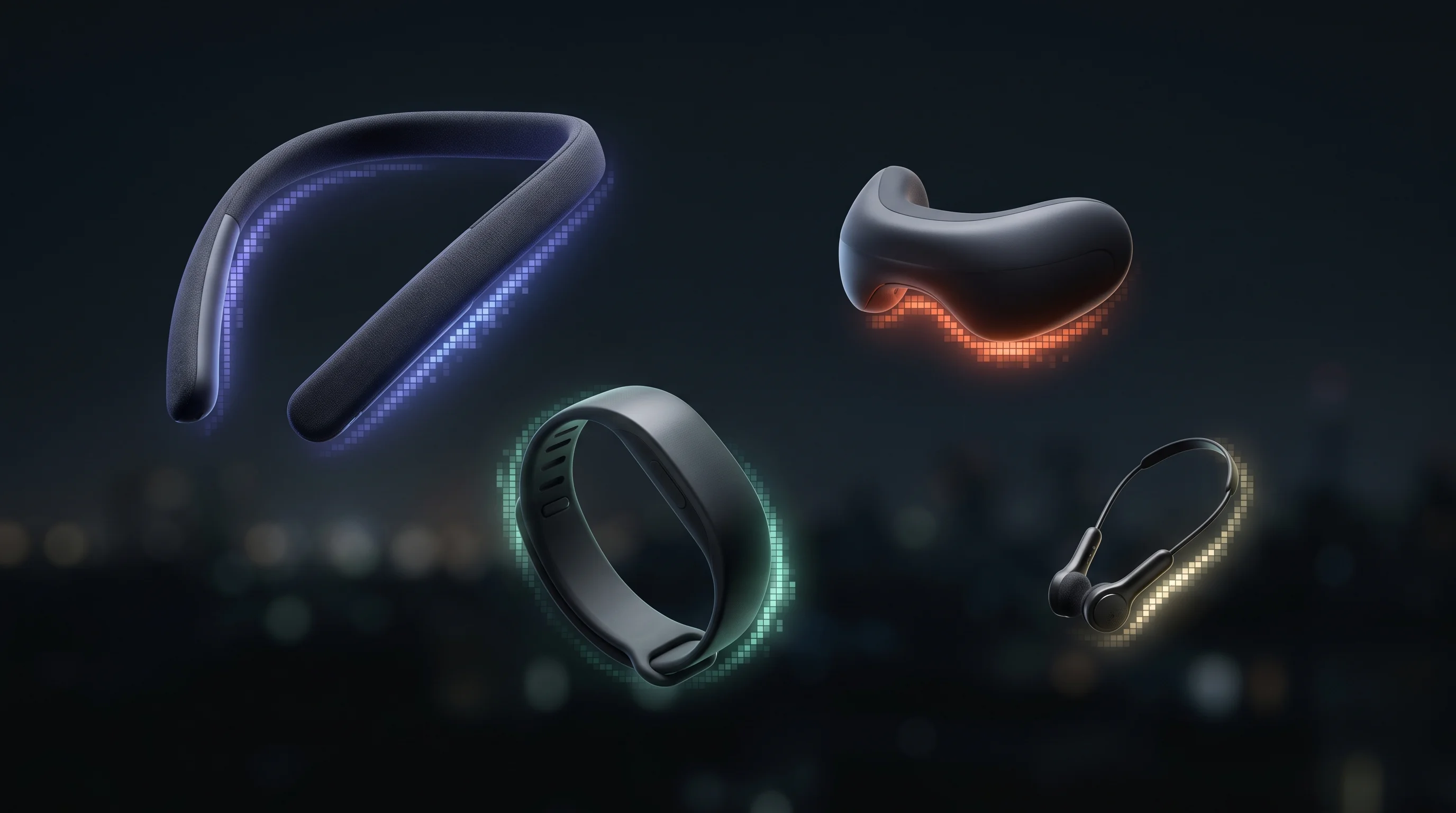
The field is splintering by form factor. Under-chin and neck patches belong to Subvocal and academic textile neckbands. Wrist EMG appears in Meta's Neural Band and the Mudra Band. In-mouth devices include Augmental's MouthPad. A March arXiv preprint introduced NasoVoce, a nose-mounted microphone. Some researchers are embedding electrodes in headphones. A March survey titled "Silent Speech Interfaces in the Era of LLMs" argued that coupling silent speech with large language models helps compensate for noisy, low-channel signals by applying linguistic priors and decoding context. Software, in other words, may close accuracy gaps faster than hardware alone.
Regulatory timelines are tightening, though perhaps not as quickly as some founders fear. The European Union's AI Act took effect in August 2024, with general obligations applying from August 2 this year and high-risk system duties delayed until December 2027 and 2028. Silent speech systems not used for remote biometric identification may avoid the high-risk classification but must still meet transparency and safety provisions. Illinois' Biometric Information Privacy Act treats voiceprints as regulated biometric identifiers; EMG signals aren't enumerated but could fall under "biometric information" if used for identification. Colorado added "neural data" protections to its Privacy Act in April 2024.
The near-term opportunity centers on workflows where voice fails: open offices, commutes, accessibility needs. IDC's smart-glasses forecast suggests a rising total addressable market for input methods that don't rely on touch or audio. Investors should watch for external accuracy benchmarks, disclosed pricing, and regulatory compliance details. Developers joining early-access programs can expect per-user calibration, placement repeatability challenges, and active research on cross-session stability, based on the academic literature from the past two years.
The earliest consumer devices are shipping now. Whether silent speech scales beyond early adopters depends on bridging the gap between controlled lab demos and all-day, any-vocabulary use. Open-plan workplaces remain acoustically hostile (field studies published last year identified speech leakage and noise as top complaints), and privacy-conscious professionals may pay a premium to avoid broadcasting every message to nearby strangers. But the technology still feels provisional. Accuracy numbers remain scattered and unverified, form factors range from awkward to invasive, and no one has demonstrated a device that works reliably across users, environments, and sessions without constant recalibration. The race is on, but the finish line keeps moving.


