

Nicholas Donahue's first swing at transforming how Americans build homes raised $20 million and shut down in early 2025. His second attempt just pulled in $16 million and churned out over 325,000 floor plans in a single month.
The whiplash says something about where opportunity actually lives in residential construction—and where it doesn't.
Donahue's earlier venture, Atmos, emerged from Y Combinator promising something audacious: one-click custom home builds, end to end. The pitch was vertical integration on steroids—design, permitting, construction, the works. It shut down in early 2025 after affordability pressures and the grinding realities of managing physical construction made the economics untenable. Rather than disappear, Donahue spent months combing through what had worked. Turned out the answer wasn't building houses at all. It was helping people design them before anyone orders lumber.
Drafted, Donahue's new company out of Y Combinator's Spring 2026 cohort, announced a $16 million seed round on May 29. Buckley Ventures led. The investor roster tilts heavily toward founders who understand design-driven products: Pinterest's Ben Silbermann, musician and producer Ryan Tedder, Samsung NEXT, and YC itself. Combined with earlier capital, the company has raised roughly $17.5 million since launching ten months ago, according to its Y Combinator profile.
But the funding matters less than what's happening underneath. Drafted says it attracted 120,000 users last month—people uploading sketches, drawing footprints on a canvas, describing spatial relationships in plain language, and watching AI assemble coherent residential floor plans and exterior elevations in minutes. Users describe the workflow as conversational, almost improvisational, more like bouncing ideas with a designer than wrestling with CAD software. The platform exports DXF and IFC files that plug directly into Revit, AutoCAD, or Chief Architect, where actual construction documentation happens.
Narrowing the Bet
Atmos tried to compress the entire home-building supply chain into a single platform. Ambitious, certainly. Also capital-intensive and, ultimately, vulnerable when housing markets turned brittle. Drafted strips away everything downstream of early-stage design. No construction crews. No lumber procurement. No exposure to field conditions. Just AI-assisted spatial planning, positioned explicitly as what happens before real modeling begins.
Users can combine hand-drawn footprints with structured inputs—room lists, square footage targets, lot boundaries, preferences about which spaces should be adjacent—and the software generates layouts that look architecturally plausible. It's not producing permit-ready construction documents. No one's pretending it is. The output is the thing architects and builders iterate on before committing to expensive drafting hours. Drafted's tutorial library walks users through exporting plans to Chief Architect, converting images to Revit, bridging the gap between conceptual chaos and something buildable.
This positioning matters in an industry still deeply skeptical of AI's ability to handle the nuance embedded in building codes, structural realities, and the astonishing variation in local regulatory requirements. A study published by the American Institute of Architects in March 2025 found formal AI implementation rates remain low across the profession—61% of large firms reported experimenting with the technology versus just 27% of small practices. Most use cases clustered around concept imagery, visualization, and early adjacency studies. Precisely where Drafted is planting its flag. No one's trusting AI to stamp permit sets yet. But roughing out a dozen layout options in an afternoon instead of a week? That has buyers.
A Suddenly Crowded Field
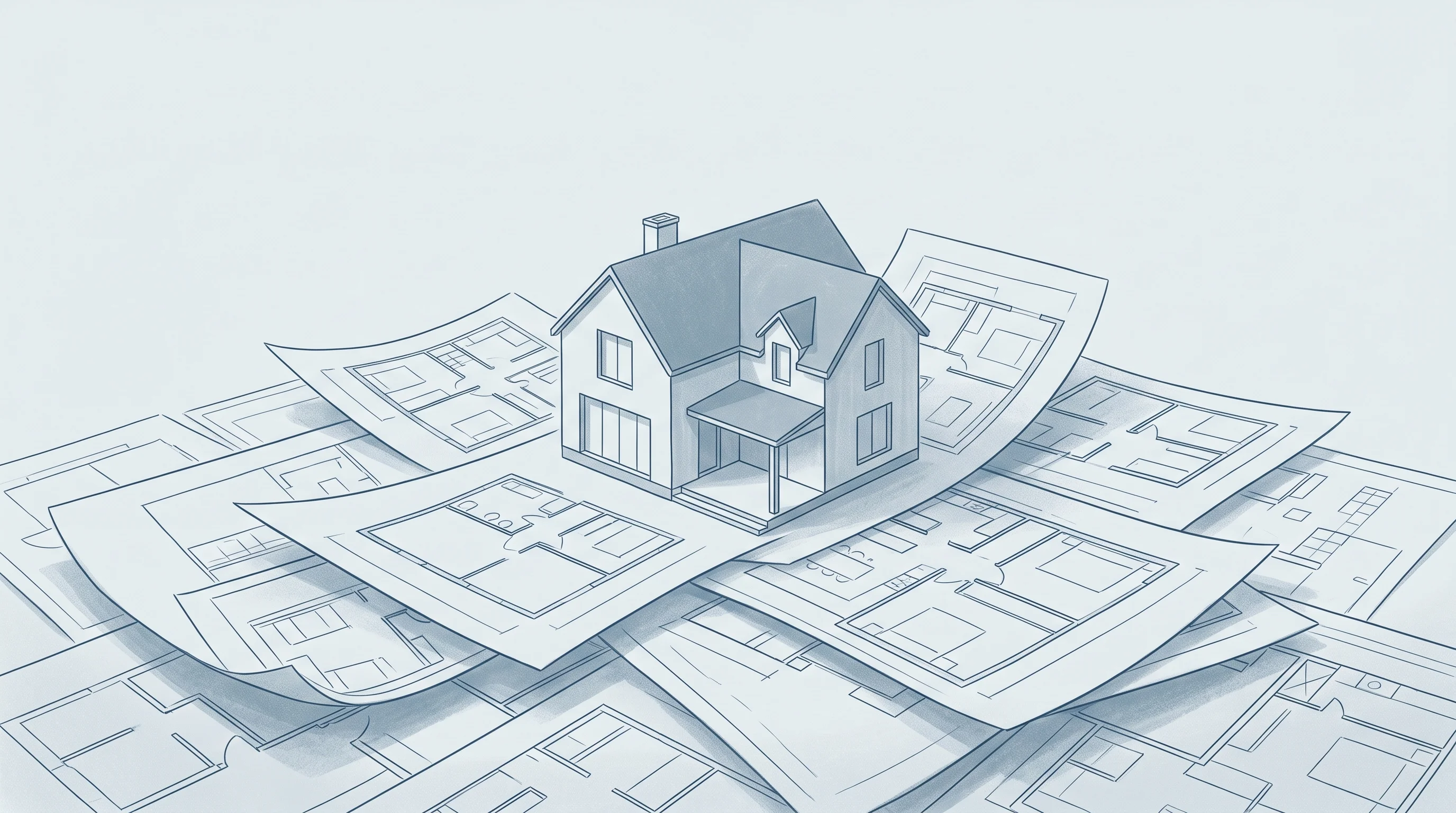
Drafted isn't alone in chasing this slice of the market. The residential AI-for-design category has exploded over the past year and a half, with entrants ranging from consumer-facing plan generators to enterprise platforms woven into production builder workflows.
Autodesk unveiled Building Layout Explorer in June 2026, a generative tool inside its Forma platform that creates floor plan options from building massing. Cloud-native, analysis-heavy, tightly coupled to Revit downstream—classic Autodesk leveraging distribution muscle. Higharc, which raised a $53 million Series B in February 2024 with backing from Home Depot Ventures and Ferguson, targets production homebuilders with a full "Homebuilding Cloud" spanning design, options configuration, estimation, and buyer portals. Customer case studies cite measurable ROI—Signature Homes reported $30 million in savings since summer 2025; Legacy Design Homes claimed 60% less pre-sale prep time—though these remain vendor-supplied testimonials, not third-party audits.
Maket.ai has pulled in multiple seed rounds (most recently $1.43 million in October 2025) and offers conversational refinement of residential layouts aimed at architects, builders, and homeowners. RoomSketcher launched AI Render for photorealistic visualization on June 15, 2026. Homestyler shipped version 6.0 in April with AI threaded through concept-to-interior-to-visualization workflows. Planner 5D, Finch3D, TestFit, Snaptrude—the list sprawls, each carving slightly different customer wedges and workflow entry points.
What separates Drafted, according to its own positioning at least, is the emphasis on multimodal inputs and explicit handoff into professional CAD and BIM environments. It's not trying to be the final drafting tool. It's trying to be what happens before drafting—when a builder or designer is still figuring out whether the program even fits the lot, or whether shifting the kitchen buys enough space for a fourth bedroom. The workflow guides walk users through exporting DXF files, importing into Revit, and continuing work in tools architects already trust. That "before modeling" framing sidesteps some of the accuracy and liability concerns that plague fully autonomous plan generation.
Perhaps more than Drafted would prefer to admit.
The Economics Remain Speculative

The traction is real, even if the business model is still taking shape. Drafted hasn't started charging yet—monetization is slated to begin "in three to six months" from late May, according to coverage in Business Insider around the funding announcement. The company floated an exploratory price point of "around $1,000" for basic plan sets, though no pricing page exists and no conversion metrics have been disclosed.
Still, 325,000 floor plans generated in a month suggests strong top-of-funnel appetite. Whether that translates into paying customers depends on how well Drafted threads the needle between "fast enough to be useful" and "accurate enough to be professional." The challenge facing all AI layout tools is the gap between visually plausible and technically correct.
Academic research published through 2026—papers on controllable vector floor plan generation, LLM fine-tuning for layout optimization, multimodal floor plan understanding—consistently highlights that models can produce outputs that resemble architecture without satisfying structural logic, egress requirements, daylighting performance, or dimensional coordination. Industry surveys echo this. Architects express excitement about AI for iteration speed and client communication, but wariness about relying on it for anything touching life safety or regulatory compliance.
Drafted's bet seems to be that the market doesn't need AI to nail the permit set. It needs AI to compress the messy early phase—the phase where a custom home buyer sketches on a napkin, or a small builder tries to figure out if a tight infill lot can support their standard floor plan. If the output is "good enough to start a real conversation in Revit," that might be sufficient. And if pricing lands in four figures rather than five (typical architect fees for schematic design on a custom single-family home can run $5,000 to $15,000 depending on scope and geography), it could carve out a distinct wedge.
The addressable market is hard to pin cleanly. U.S. single-family housing starts ran at 882,000 on a seasonally adjusted annual basis in May 2026, according to the National Association of Home Builders—down 6.7% year-over-year but hovering in a range that Fannie Mae's June forecast expects to hold near 900,000 through late 2026 as mortgage rates moderate. Home remodeling and improvement spending exceeds $600 billion annually in the U.S., according to Harvard's Joint Center for Housing Studies. The global architecture, engineering, and construction software market was valued at roughly $12 billion in 2025 and is projected to hit $39 billion by 2033, per estimates from Grand View Research published in 2026. Interior design software specifically is growing from $5.37 billion in 2024 to a projected $9.66 billion by 2030.
Drafted sits somewhere in the overlap: not quite full AEC software, not quite consumer interior design, but aimed squarely at the residential layout question that precedes both. With a nine-person team based in San Francisco as of late May, the company is still figuring out whether its go-to-market motion tilts toward individual professionals, small design-build firms, production builders, or homeowners willing to pay for faster design iteration.
Maturing Fast, Carefully
The broader AI-in-architecture conversation is evolving quickly. Autodesk's "State of Design & Make: 2026 AI Pulse" report—surveying 2,500 leaders across architecture, engineering, construction, and manufacturing—signals a shift from "access to AI" as the competitive edge to "ability to apply it effectively." The Chaos/Architizer 2026 report, based on a November 2025 survey of roughly 800 design professionals, found rising usage in visualization workflows but persistent concerns around ethics, output quality, and professional liability.
Adoption is happening, but it's uneven and cautious. Large firms are formalizing AI pilots. Small firms are experimenting informally. Formal implementation rates remain stubbornly low—in the single digits across some survey slices.
Meanwhile, regulatory complexity isn't slowing down to accommodate new technology. California's 2025 energy code went into effect January 1, 2026, with new heat pump requirements, electric-readiness mandates, and stricter ventilation standards. The International Code Council's 2024 I-Codes are rolling through state adoption cycles—Georgia adopted the 2024 IRC and IBC effective January 1, 2026; combined Public Comment Hearings for the next code cycle started in Hartford in April. Compliance documentation, energy modeling, field verification—none of that vanishes because AI can sketch a floor plan faster.
Electronic permitting is spreading (Oregon mandated e-submission access by January 2025; Los Angeles runs ePlanLA), but the submittal medium doesn't change the substantive requirements. Many states exempt one- and two-family residences from mandatory architect stamps under certain conditions, but structural, mechanical, and life-safety considerations often pull licensed professionals back into the loop.
Drafted's strategy appears to embrace this reality rather than fight it. The company frames its output as a starting point—a way to get spatial ideas into a format that professionals can refine, check, and stamp. It's not trying to eliminate architects. It's trying to give them (and builders, and ambitious homeowners) a faster way to explore options before the meter starts running on full design fees.
Whether that positioning captures enough value to justify a venture-scale outcome remains an open question. Donahue has been here before—raising capital, building traction, watching market conditions shift. The difference this time is scope. Atmos tried to own the whole stack and got crushed when housing affordability cratered. Drafted is betting that owning one narrow, high-frequency workflow—the chaotic early design phase—might be defensible if the product is good enough and the handoff is seamless enough.
The 120,000 users generating hundreds of thousands of plans suggest people want the tool. The next twelve months will reveal whether they'll pay for it—and whether the output quality holds up when real money and real permits are on the line.


