

The soldier in the grainy video footage straps on what looks like a scaled-down motorcycle frame around his waist, clips two battery packs to his belt, and hoists a 122mm artillery shell that would normally require a two-person carry. He walks it fifty meters across muddy ground near Pokrovsk without visible strain. The timestamp reads May 2026.
This wasn't a Pentagon demo or a Silicon Valley pitch deck. Ukraine's 7th Rapid Response Corps had begun testing powered exoskeletons in logistics operations near the front lines, and the device came from a Palo Alto startup that had recently emerged from the defense tech ecosystem.
Edgerun Industries, a Palo Alto outfit that participated in Y Combinator's 2025 batch, has reported more than $100 million in letters of intent from Ukrainian military units after running over 100 field tests near the front lines, according to a Dealroom note tracking the company's Ukraine engagement. The company's hip exoskeleton weighs under 10 pounds with batteries included and runs for twelve-plus hours on power packs compatible with those Ukrainian forces use for their FPV drones. If the specifications hold, it represents a significant advance in lightweight powered systems.
Whether those letters of intent translate to actual purchase orders remains an open question. A search of Prozorro, Ukraine's public procurement database, turned up no corresponding contracts as of September last year. Letters of intent are exactly what they sound like: expressions of interest, not binding commitments. Ukrainian units typically spend months validating performance before funding materializes through channels like the Brave1 innovation program, which processes orders through a combat-points system that has handled over half a million drone purchases since launching in mid-2026.
Still, the fact that frontline commanders are testing exoskeletons at all marks a shift. For years, military robotics stayed confined to labs and controlled trials, with soldiers rejecting systems too heavy, rigid, or power-hungry to integrate with existing gear. Lockheed Martin's ONYX program faced significant challenges by 2024, as documented in a November 2024 Wired investigation. The Army documented the pattern in a 2023 study: systems that interfere with mobility or require constant recharging don't survive contact with real missions.
Edgerun took a different tack. The company focused solely on the hip joint rather than attempting full-body assistance, a design choice grounded in recent biomechanics research. Studies published in Nature between 2025 and 2026 showed hip exoskeletons reducing walking metabolic cost by 10 to 18 percent, with multi-joint systems achieving further gains in laboratory settings. Army-funded research dating back to 2018 confirmed that optimized assistance across joints cuts energy expenditure during load carriage, though real-world terrain introduces complications that treadmill tests don't capture.
"Every system on the modern battlefield has been upgraded," wrote David Venegas, Edgerun's founder and CEO, in an August 2026 mission statement. "The human carrying it has not." The company operates a Kyiv field office alongside its Palo Alto headquarters, with manufacturing based in Taiwan and a government affairs operation in Washington.
The hip-only approach comes with tradeoffs. Edgerun claims its device reduces effort per step by 30 to 45 percent under load in internal testing, but third-party metabolic validation using indirect calorimetry hasn't been published. The company website features a testimonial from Ihor Bohdan, head of the 7th Corps Innovation Centre, praising the "product built not for the training ground, but for the soldier." That's marketing copy, not peer-reviewed data.
What the Ukrainian trials do demonstrate is something lab tests can't replicate: survivability under artillery strikes, dust ingestion, temperature swings, and the kind of continuous multi-day operations that break conventional military equipment. The 7th Corps videos from March 2026 showed soldiers using the systems for logistics tasks, particularly artillery shell handling, where repetitive lifting generates the musculoskeletal injuries that represent the single largest medical cost to the Department of Defense. Exact figures remain classified, but Defense Centers for Public Health data updated through last year quantifies the burden in billions of dollars annually when accounting for lost duty days and long-term care.

The U.S. military has pursued its own exoskeleton programs, though progress has been slower. The Army announced its Intrepid Battlefield Exoskeleton in May 2026, a seven-pound collapsible device designed for casualty self-evacuation that reportedly survived a 400-foot drone drop test. The unpowered SABER back-assist exosuit, developed by Vanderbilt University and the Army's DEVCOM command, remains in field evaluations with the 101st Airborne. The Royal Australian Air Force ordered SABER's successor system, Apex 2, in 2025.
Near-term military adoption concentrates in logistics and casualty evacuation rather than direct combat, where actuator failure under fire could immobilize a soldier. "The IBEX enables more walking wounded, which means more warfighters putting bullets downrange while providing a smaller target for enemy drones to attack," Dr. Lee Childers, a senior scientist at the Army's Extremity Trauma and Amputation Center of Excellence, told military media in May 2026.
The hardware trend favors targeted, lightweight systems over the "powered armor" concepts that dominated earlier thinking. Soldiers want exoskeletons that integrate with existing kit, fail gracefully when unpowered, and survive austere conditions. A November 2024 analysis noted that systems meeting those criteria remain the exception, not the rule.
Battery standardization represents an overlooked factor in adoption. Edgerun's use of commercial drone batteries mirrors how Ukrainian forces scaled FPV drone operations by building supply chains around off-the-shelf components rather than waiting for purpose-built military power systems. That modularity could allow exoskeleton units to share battery packs with other electric systems as battlefield electrification spreads, or cannibalize power from downed drones when resupply breaks down.
China's People's Liberation Army has fielded passive and assistance-frame exoskeletons to high-altitude logistics units in Tibet since 2020, when NORINCO delivered initial systems to border troops, Defense One reported in August 2025. The PLA's approach favors logistics and transport over direct combat applications, the same use cases proving viable in Ukraine.
Several other companies are pursuing military contracts. Dephy's ankle-focused ExoBoot underwent Army biomechanics testing in 2025, according to a Frontiers in Bioengineering pilot study. Roam Robotics received Air Force and Special Operations Command small business innovation research contracts modified as recently as April last year for pneumatic knee and hip systems. Mawashi's UPRISE passive load-bearing frame won an Air Force purchase order for its Gen 5 system in September 2025, per Federal Compass contract records.
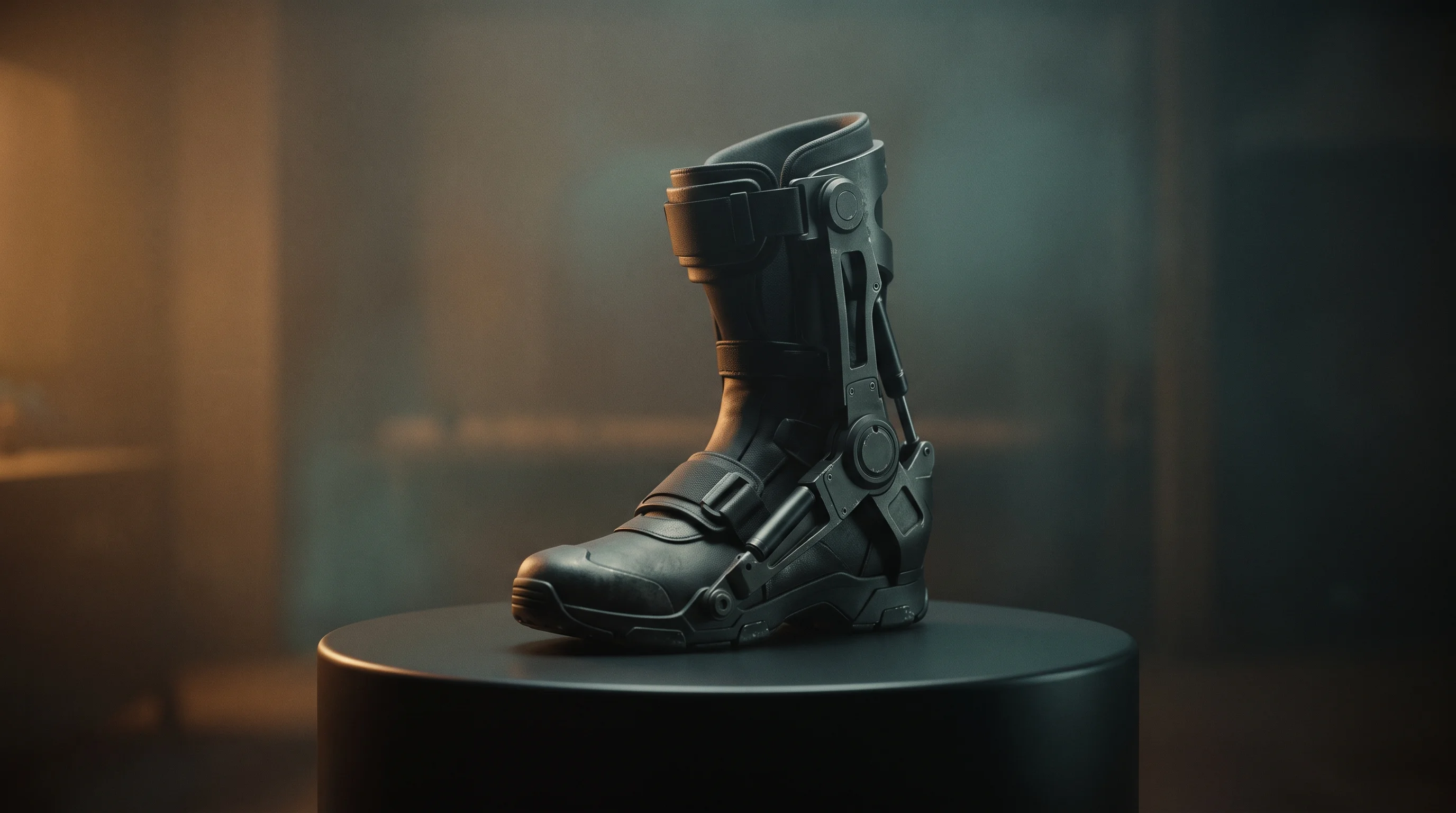
The regulatory landscape complicates foreign sales. In January 2025, the State Department added developmental exoskeletons funded by the DoD to the U.S. Munitions List Category X(b), requiring International Traffic in Arms Regulations authorization for exports. The classification shift reflects Pentagon interest in keeping battlefield robotics technology domestic. Startups manufacturing overseas must also navigate the Berry Amendment, which requires textile components in military exoskeletons to be made from U.S. materials when purchased with DoD funds. That adds compliance costs for companies like Edgerun that manufacture in Taiwan.
Market projections vary widely depending on how analysts segment the sector. Coherent Market Insights estimated the military exoskeleton market at $201.2 million in 2026, projecting growth to $525.5 million by 2033 at a 14.7 percent compound annual rate. A separate April projection from The Insight Partners estimated the broader sector expanding from $1.43 billion in 2025 to $3.94 billion by 2034. The divergence reflects how analysts categorize powered versus passive systems and whether they include industrial applications.
Controller technology has advanced rapidly. Reinforcement learning and simulation-trained algorithms validated on hardware last year enable user-dependent, multi-terrain assistance that adapts to individual gait patterns, according to arXiv preprints published in 2026. Compact "limb-encircling" actuators explored in recent papers promise higher torque-to-weight ratios than previous motor designs, though durability under ballistic impacts and dust ingress remains unproven outside controlled settings.
European defense funding mechanisms are accelerating cross-border procurement. The European Defence Fund announced 2025 call results in April last year with rising collaborative R&D budgets. NATO's Communication and Information Agency launched the UNITE–Brave innovation program on April 2, 2026 with €10 million to speed evaluation of Ukraine-tested technologies. Ukraine's July 2026 controlled-export mechanism aims to formalize pathways for domestic defense companies to sell internationally, potentially creating NATO-interoperable supply chains faster than traditional procurement cycles allow.
Parallel developments in medical and industrial sectors signal the technology maturing. Wandercraft's FDA clearance for its Eve personal exoskeleton in August 2026 and German Bionic's acquisition by Archimedes Partners in March 2026 suggest controller algorithms and actuator designs may cross-pollinate between sectors, though ballistic survivability and electromagnetic compatibility requirements remain uniquely military problems.
The battlefield data emerging from Ukraine represents something unprecedented: large-scale combat validation of powered exoskeletons under conditions that lab testing cannot replicate. Whether the 7th Corps' logistics trials scale to broader Ukrainian adoption and eventually NATO procurement will depend on demonstrated injury reduction and endurance gains that justify the per-unit cost. Edgerun and competitors have not publicly disclosed pricing.
Letters of intent measure interest. Procurement records measure conviction. For now, the soldier near Pokrovsk carrying that artillery shell alone offers the most concrete evidence available, one grainy video frame at a time.


