

ElevenLabs just raised $500 million. The valuation: $11 billion. That's triple what the London-based voice AI company was worth twelve months ago, and roughly the GDP of Monaco. It's also Europe's largest AI funding round this year, which says something about where investor conviction has landed in 2025—not on chatbots or image generators, but on technology that speaks.
The round, led by Sequoia Capital with Andrew Reed taking a board seat, reflects a simple thesis: voice agents have escaped the lab. They're answering customer service calls, taking restaurant orders, and handling government inquiries across seventy languages. What was experimental eighteen months ago is now, apparently, enterprise infrastructure.
The revenue figures support that read. ElevenLabs disclosed annual recurring revenue north of $330 million, up from roughly $200 million in September. Do the math: that's $100 million in new ARR in less than half a year. For context, most SaaS companies would consider that a good year.
The Money and What It Means
Sequoia didn't just show up for this round. The firm participated in ElevenLabs' November employee tender offer at a $6.6 billion valuation, suggesting conviction built over successive quarters rather than a single pitch deck. Andreessen Horowitz quadrupled its stake. ICONIQ tripled down. Those aren't typical moves for firms already holding significant positions—usually you see incremental increases, not multiples.
New investors include Lightspeed Venture Partners, Evantic Capital, and BOND. Returning backers BroadLight, NFDG, Valor Capital, AMP Coalition, and Smash Capital all stayed in. The company says it will announce additional investors later this month, some likely strategic. Given the client roster—Deutsche Telekom, Square, MasterClass, the Ukrainian government—corporate money from telecom, fintech, or media wouldn't be surprising. Perhaps expected.
At 33x revenue, the valuation sits at the high end even by AI standards. But the funding velocity mirrors the revenue velocity, which suggests either exceptional capital efficiency or an acute awareness that the voice AI window won't stay propped open forever. Maybe both.
From Dubbing to Deployment
ElevenLabs began with a specific frustration. Founders Mati Staniszewski, who spent time at Palantir, and Piotr Dąbkowski, formerly of Google, launched the company in January 2023 after noticing how terrible dubbed foreign films sounded. The initial product: text-to-speech. Clean, natural-sounding, good enough for audiobooks and voiceovers.
That was the wedge. The company's trajectory shifted when it released its Agents platform, enabling businesses to deploy conversational AI for customer service, phone systems, and voice interfaces. Suddenly the pitch extended well beyond narration.
Deutsche Telekom now uses ElevenLabs for AI-powered customer service agents. Square integrates the tech for voice ordering at its merchants. MasterClass built "On Call," voice-cloned coaching sessions with its celebrity instructors—Gordon Ramsay critiquing your risotto technique, presumably without the profanity. Ukraine's Ministry of Digital Transformation deployed a digital twin of its minister and plans voice interfaces across Diia, its public services app.
February brought the general availability of Eleven v3, the company's latest text-to-speech model. It supports audio tags for emotional delivery—[whispers], [laughs], [angry]—and handles multi-speaker dialogue across seventy languages. The improvements target real-time, expressive use cases. The kind you'd need if your voice agent is fielding live customer calls at 2 a.m. on a Saturday.
Celebrity Voices and the Consent Question

ElevenLabs also launched its Iconic Voice Marketplace, licensing celebrity and historical voices for commercial use. Michael Caine. Maya Angelou. Liza Minnelli. Art Garfunkel. Alan Turing. Mark Twain. Caine's among the few living celebrities granting rights directly; estates handle the rest via CMG Worldwide.
Matthew McConaughey, a long-time investor and customer, uses the platform to create Spanish versions of his newsletter in his own voice. Whether the translations capture his trademark drawl is unclear.
In August 2025, the company released Eleven Music, an AI music generator it claims is cleared for commercial use. The positioning matters, given the company's history. A 2024 Biden deepfake robocall was traced back to ElevenLabs technology by researchers at Pindrop and UC Berkeley, prompting swift account bans and policy updates. The FCC later banned AI-generated voices in robocalls entirely. A lawsuit from voice actors was settled; details remain undisclosed.
Since then, the company has leaned hard into consent-based licensing. The Iconic Marketplace and music generator represent a broader bet: that generative audio will follow generative imagery's path, with rights management and licensing determining commercial viability. Or put differently, that the future of AI audio won't be piracy at scale.
What Half a Billion Buys
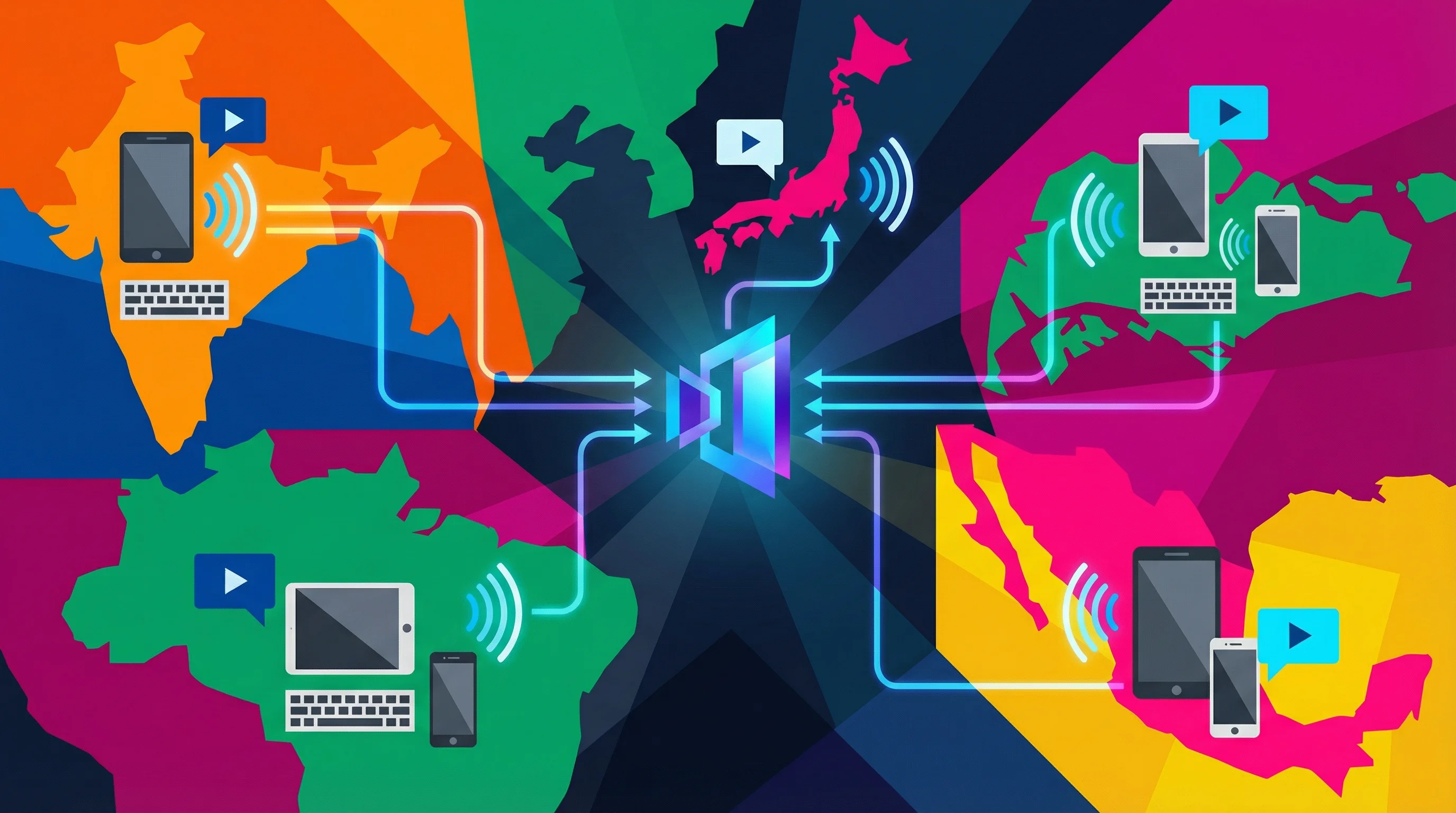
ElevenLabs says it will use the capital to expand go-to-market teams in India, Japan, Singapore, Brazil, and Mexico. These aren't random choices. Voice interfaces in local languages could unlock enterprise adoption in regions where typing remains cumbersome and where mobile-first infrastructure already dominates. The company already operates offices in London, New York, Warsaw, San Francisco, Dublin, and Tokyo. LinkedIn shows a headcount of 693, which feels lean for a company at this scale. Then again, voice AI is software. You don't need assembly lines.
The broader text-to-speech market is forecast to reach $11 billion by 2034, though market research methodologies vary wildly. AI voice generator projections run higher—up to $40 billion by 2032 in some estimates—suggesting the category's boundaries remain undefined.
ElevenLabs competes with Big Tech: Google's WaveNet, Amazon Polly, Microsoft Azure Speech. It also faces a cohort of startups—PlayHT, Resemble AI, Murf, WellSaid Labs—though none have matched its enterprise agent platform or celebrity licensing. Whether that represents defensible differentiation or temporary lead depends largely on how fast foundational model companies decide to enter the space.
The Platform Question
What comes next likely hinges on whether enterprises view voice agents as a feature or a platform. If it's a feature, OpenAI or Google will eventually bundle voice capabilities into existing products and compress margins. If it's a platform, ElevenLabs has a shot at building something with real moats: enterprise integrations, licensing relationships, multi-language localization at scale.
The company raised $180 million at a $3.3 billion valuation just over a year ago. Before that, an $80 million Series B at a $1 billion valuation in January 2024. Three funding rounds in under eighteen months. That's aggressive even by Silicon Valley standards, where companies now raise preemptively to ward off competition and extend runways in case the market turns.
For now, the $500 million round and tripled valuation suggest investors believe voice AI is platform territory. Whether they're right—and whether ElevenLabs can hold its lead as competitors inevitably build similar tools—remains the open question.
But at $330 million in ARR and accelerating, the company has at least bought itself time to find out.


