

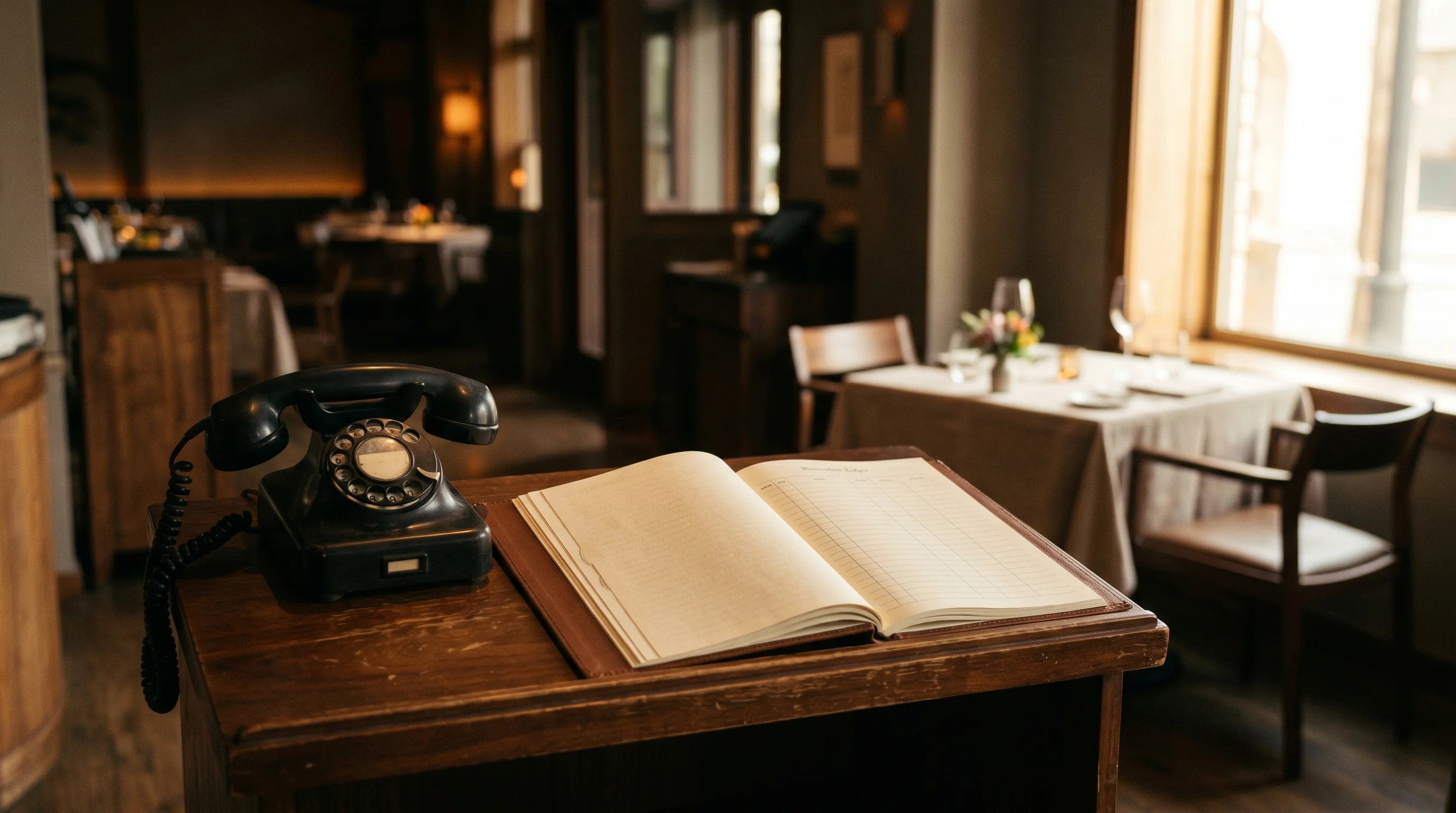
The phone rings. Again. And again. The host stand is slammed—there's a walk-in party of six, two servers calling out sick, and someone asking about gluten-free options while waving a credit card. That incoming call? It goes to voicemail. So does the next one.
This is the problem Felix Odeberg Glasenapp and Alan Mando kept watching unfold during their early research phase. Childhood friends from Stockholm, they didn't start by coding—they started by working restaurant host stands, fielding calls and juggling floor plans. What they saw convinced them that the issue wasn't just operational friction. It was hemorrhaging money.
Their pitch, delivered through Elyra, a Y Combinator P26 startup they co-founded, puts a precise number on the damage: more than $100,000 annually for a mid-sized restaurant—a figure based on their internal modeling rather than independent verification. Not from no-shows. Not from last-minute cancellations. From calls that simply never get answered.
Whether that figure holds up under scrutiny is one question. Whether restaurants will trust an AI to answer their phones is another.
The Unanswered Call Economy
Forty percent of restaurant calls go unanswered, Elyra claims in its launch materials—a statistic that tracks closely with third-party vendor research, though these figures originate from companies with products to sell. A 2025 report from Slang AI, itself a voice automation company, pegged the miss rate at 43%, with 71% of those calls tied to revenue according to their findings. Elyra's own modeling, published in a March blog post, estimates a 100-seat restaurant loses roughly $1,825 per week from booking requests that fall through the cracks.
These are, of course, figures generated by companies with products to sell. But the underlying logic is hard to dismiss. Restaurants operate on thin margins. Peak service windows are chaotic. A missed call during Saturday dinner rush often means an empty four-top that could have turned twice.
Elyra's answer is a bundled platform that handles three functions at once: a voice agent for phone reservations, an email concierge that responds instantly to booking inquiries, and a table allocation system that optimizes seating in real time. The voice agent fields questions about menus, dietary needs, and house policies. The email module mirrors the restaurant's tone (or tries to). The table module adjusts floor plans dynamically based on party size and availability.
In April, the company rolled out a website builder that syncs directly with the booking engine—hours, menus, special events all feeding into both the AI agents and the public site. Setup is guided by an in-product AI that walks operators through booking rules, voice persona configuration, and floor plan mapping. Under the hood, Elyra runs on models from Anthropic and OpenAI, hosted on AWS infrastructure. The company's trust center, last updated in April, notes GDPR compliance and SOC 2 certification in progress.
Stockholm First, Then the World

As of April 2026, Nordic media outlets reported that Elyra had roughly a dozen Stockholm restaurants as customers and was processing more than 1,000 bookings monthly. The company's website showcases logos from restaurant groups like ESS Group, Melanders Group, Kasai Gruppen, and The Kitchin—though no third-party case studies with hard metrics have surfaced publicly.
Customer testimonials on Elyra's site make bold claims: "We made back a year's cost in two weeks"—a company-provided quote that remains unverified externally. Another: "Record occupancy within weeks" for new venues. These are the kind of marketing copy that sounds impressive until you start asking how exactly "record occupancy" was measured.
Elyra secured $500,000 in funding connected to its Y Combinator acceptance, per reports from Breakit and listings in Nordic startup databases. The company maintains dual entities—Elyra AB in Sweden and Elyra, Inc. in Delaware—and is now pushing into the U.S. market. Glasenapp, who studied engineering physics at KTH Royal Institute of Technology, told Nordic outlets that American demand feels more urgent than what they encountered at home. That could be optimism. It could also be accurate—U.S. restaurant operators, after all, have been burned by labor shortages and rising costs in ways that make automation look less like a luxury and more like survival.
A Very Crowded Kitchen

Elyra is hardly alone in chasing this opportunity. The restaurant voice automation space has gotten noisy fast.
SevenRooms, the DoorDash-owned reservation platform, launched its own Voice AI module. OpenTable now has multiple third-party voice agents plugging into its APIs—Loman AI announced an integration in December 2025, and competitors like Tablevoice and VOICEplug have followed. Slang AI, a venture-backed player, focuses on voice answering with hooks into OpenTable, SevenRooms, and Yelp. Then there's Certus AI, out of Y Combinator's Summer 2025 batch, positioning itself as a full phone line replacement.
Where Elyra claims to stand apart is in the bundling. Instead of layering voice onto an existing reservation system—the approach most competitors take—Elyra offers an integrated stack: voice, email, table management, guest intelligence, campaign tools, website builder. All in one.
Whether that resonates with operators already locked into OpenTable or SevenRooms ecosystems remains an open question. Independent restaurants, exhausted by per-cover fees and fragmented toolsets, might find the pitch more compelling. Elyra's pricing, notably, isn't public. Prospects are directed to book a demo, which is either strategic positioning or a sign the company is still figuring out what the market will bear.
Trust, But Verify
The skepticism here isn't about the math—missed calls do cost money, and automation can help. The skepticism is about execution. Can an AI agent handle the kind of edge cases that trip up even experienced hosts? The caller who wants a table "near the window but not too near," or the one asking if the chef can accommodate a shellfish allergy while also avoiding nightshades?
Elyra's co-founders spent time in the trenches, which counts for something. They've seen the chaos firsthand. But witnessing a problem and solving it at scale are different challenges entirely. Right now, Elyra is a two-person team managing four-figure monthly booking volumes across a cluster of Nordic venues. They have a Y Combinator credential and a pitch that restaurant operators will either find urgent or overfamiliar, depending on how many automation demos they've already sat through.
The real test isn't whether the technology works in Stockholm. It's whether it scales beyond it—into markets where operators are more skeptical, margins thinner, and the tolerance for AI mistakes lower. A reservation system that fumbles a booking during Friday night service doesn't just cost revenue. It costs reputation.
For now, Elyra is placing a bet: that restaurants are ready to hand over the phone, the inbox, and the floor plan to software that promises never to miss a call. Whether operators trust that promise—or whether they'll keep one hand on the host stand, just in case—is a question the next twelve months will answer.


