

On November 3, 2025, EO Charging announced a £25 million recapitalization that tells two stories at once. One is about confidence: existing investors Zouk Capital and Vortex Energy doubling down with fresh equity, HSBC expanding its debt facility. The other is about retreat.
To understand where the UK fleet charging company is headed, look at what it's leaving behind. EO is pulling out of the United States entirely. It has sold its domestic EV charger hardware manufacturing business to Cogent Technologies, part of the Heathpatch Group. What remains is a more modest ambition: software-led infrastructure services, concentrated in Britain and mainland Europe, aimed squarely at commercial fleets and logistics operators.
For a company that once pursued a $675 million SPAC merger and planted flags across three continents, this represents something closer to strategic consolidation than expansion. Whether that gamble pays off may depend less on what EO is building than on what it's willing to abandon.
The Turn Inward
CEO Richard Staveley describes this as an "evolved strategy." The language is careful, as it should be. Evolution implies progress, not contraction—though in EO's case, the distinction feels semantic.
The company is pivoting hard toward what Staveley frames as "reliable infrastructure and intelligent software." That means its Charge Assurance managed service, which promises uptime above 99.5%, and the EO Cloud platform that manages charging operations. Gone is the ambition to control the full stack, from manufacturing hardware to deploying software. EO will now focus on truck hubs, logistics depots, and the kind of high-utilization charging sites where software optimization matters more than the price of the box on the wall.
"This recapitalization represents our shareholders' confidence in our evolved strategy," Staveley said in the announcement. Perhaps. It also represents their willingness to fund a narrower vision than the one EO originally sold them.
An American Dream, Deferred

The US withdrawal is more than a footnote. As recently as February 2025, EO announced a depot electrification deal with Bollinger Motors. Three months earlier, in May 2024, it signed on to electrify rental car locations for Aero Corporation. Both partnerships now sit in an uncertain state as the company exits the market altogether.
It's unclear what becomes of those commitments, or whether EO will hand off existing US contracts to partners. The company declined to provide specifics. What's certain is that the American expansion that once seemed central to its growth story—ambitious enough that founder Charlie Jardine planned to relocate there—has been shelved, probably for good.
The timing is awkward. The US market for commercial EV charging remains one of the most capital-hungry but potentially lucrative in the world, particularly as federal incentives push fleet electrification. EO's departure suggests either that it couldn't secure the funding required to compete there, or that it decided the opportunity wasn't worth the cost. Likely both.
A Decade of Ambition, Compressed
EO's story began in 2014 on a farm in Suffolk, where Jardine launched what would become a significant player in depot charging. The company built credibility deploying infrastructure for marquee clients: Amazon, DHL, UPS, Tesco. It claims more than 100,000 chargers installed across 1,700-plus sites in over 30 countries, processing north of 50 million charging sessions through its software platform.
But the growth trajectory has been anything but smooth.
In February 2023, EO raised approximately $80 million from Vortex and Zouk to fuel expansion into North America and Europe—an infusion that now looks more like a lifeline than a launchpad. Before that, in 2021, the company tried to go public via a SPAC merger with First Reserve Sustainable Growth Corp. The deal valued EO at $675 million. It collapsed in March 2022 as investor appetite for EV infrastructure evaporated and market conditions soured.
Staveley replaced Jardine as CEO in May 2024. Jardine moved into a President role, part of a broader leadership reshuffling that, in hindsight, foreshadowed the strategic reset now underway.
What's Left to Build
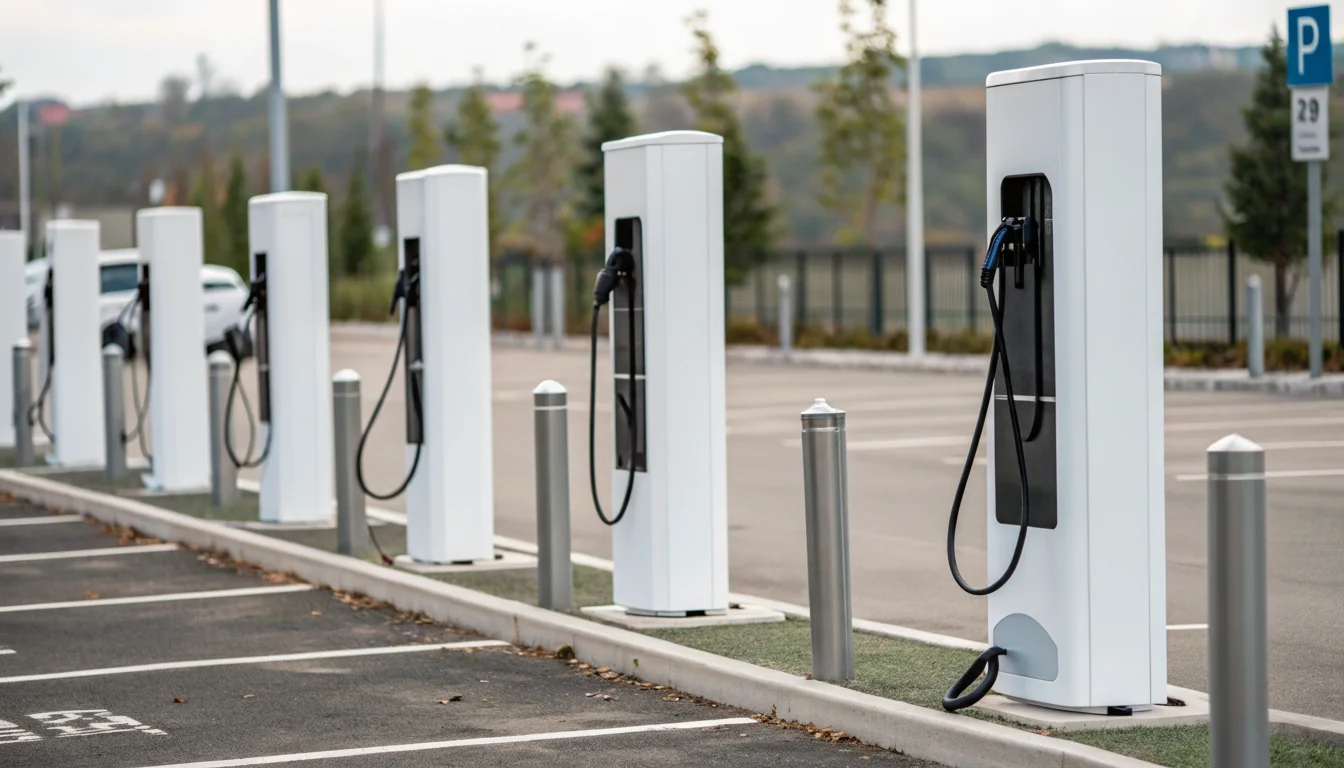
The £25 million will fund what EO describes as "commercial-grade charging infrastructure," paired tightly with its Charge Assurance service model. The company has shown real traction in UK bus electrification: working with Finnish manufacturer Kempower, it installed 342 bus chargers across 11 depots for operators including Metroline, Go-Ahead, and Stagecoach. Another 150 are under construction.
In July 2025, EO announced a partnership with Horizon Energy Ventures that points toward a Charging-as-a-Service model—infrastructure funded through joint investment rather than capital-intensive hardware sales. That approach aligns with the company's stated focus: high-utilization depot charging where reliability and software optimization carry more weight than unit economics on charger sales.
It's a defensible strategy. Fleet operators care deeply about uptime. A single charger failure can strand a delivery truck or idle a bus, cascading into operational headaches. If EO can prove that its software and service guarantees are worth the premium, it may carve out a sustainable niche—even a narrow one.
But sustainability is not the same as scale. The UK and European markets, while substantial, are a far cry from the global ambitions EO once harbored. And in a sector where first-mover advantage and network effects matter, retreating from the US and exiting hardware production means ceding ground to competitors willing to bet bigger.
The Question That Remains

For investors who backed EO through multiple funding rounds and a failed SPAC attempt, this recapitalization represents something more complicated than renewed confidence. It's a wager that a smaller, more focused EO can succeed where a sprawling, hardware-and-software, multi-continent version could not.
Whether that bet is wise depends on factors still playing out. Will fleet operators pay a premium for software-driven services over cheaper hardware alternatives? Can EO's 99.5% uptime guarantee hold at scale? And perhaps most critically: is the UK and European market large enough to justify the ambitions—and valuations—that once stretched across the Atlantic?
The company that started on a Suffolk farm has traveled a long way. Whether this latest turn represents strategic clarity or necessary compromise may not be clear for years. What's certain is that EO is now playing a different game than the one it set out to win.


