

The pitch sounds almost too simple: clean a ship's hull more often, burn less fuel. But for Sydney-based Hullbot, that straightforward value proposition has translated into 1,000 cleanings, 82 customers across five countries, and now a fresh $10.6 million war chest.
The Series A round, announced November 4 and led by California's Regeneration.VC, arrives as the maritime industry confronts an uncomfortable arithmetic. Ships account for roughly 3% of global carbon emissions—north of a billion tonnes annually as of 2018—and even a barely visible film of algae and microorganisms clinging to a hull can spike fuel consumption by a quarter. That's not a rounding error. That's real money, and real carbon, disappearing into the ocean.
Hullbot's solution is deceptively low-tech in concept, if high-tech in execution: autonomous underwater robots that gently scrub hulls and propellers on a recurring basis, before the heavy barnacles and slime take hold. The company claims an average 15% fuel saving across its commercial work to date. NRMA's Manly Fast Ferry, operating in Sydney Harbour, logged a 13% drop in diesel use after putting Hullbot's service to the test.
"We're sitting at the intersection of shipping efficiency, decarbonization, and ocean health," CEO Tom Loefler said in a statement accompanying the raise. Loefler, who first sketched the technology as an industrial design student at the University of New South Wales, has built a business model that appears to be sticking—Hullbot reports that every paid trial has converted to a long-term service contract. Whether that's a function of the service working as advertised or savvy customer selection (or both) is harder to parse, but the conversion rate is striking nonetheless.
The Regulatory Tailwind Nobody Saw Coming
Timing helps. The International Maritime Organization's revised Biofouling Guidelines, adopted in 2023, are nudging—some would say shoving—vessel operators toward more proactive hull maintenance. The old playbook of waiting months between dry-dock cleanings no longer pencils out, particularly as fuel prices remain volatile and carbon accounting becomes more than a nice-to-have.
Hullbot's backers see a market measured in billions, not millions. Regeneration.VC, which focuses on climate-tech plays with demonstrated traction, pointed to the company's "commercial proof" in explaining the investment. The round also drew participation from Katapult Ocean, Climate Tech Partners, Folklore Ventures, Australia's Trinity Ventures, and NewSouth Innovations—UNSW's commercialization arm, naturally.
The capital will fund two priorities: scaling up Australian manufacturing capacity and developing larger robotic systems capable of servicing deep-sea vessels, not just ferries and coastal ships. Hullbot is also expanding its network of global service hubs, a logistics challenge that's perhaps more daunting than the engineering.
A Crowded—and Validated—Market
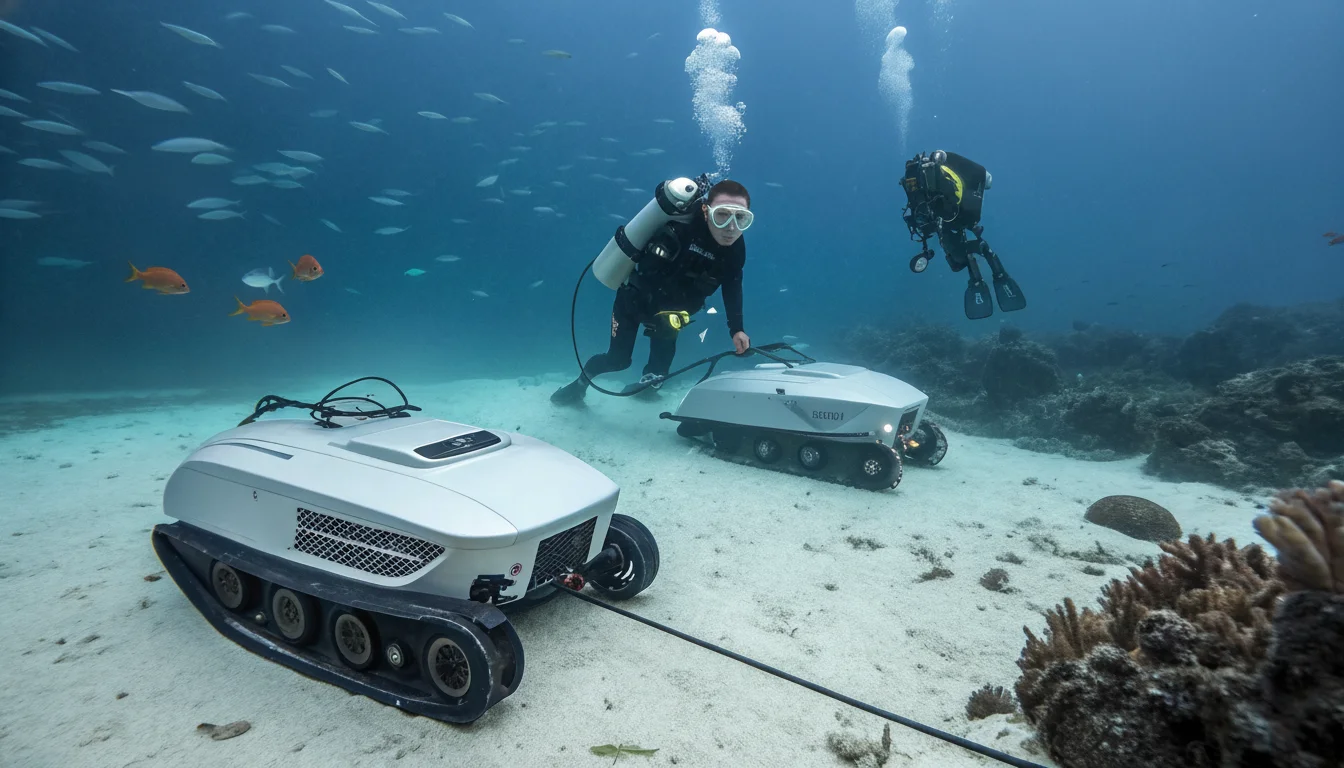
Hullbot isn't alone in spotting the opportunity. Neptune Robotics pulled in a $52 million Series B in September 2025, while established maritime players like Jotun's Hull Skating Solutions and Greensea's Armach Robotics have rolled out competing offerings. GAC HullWiper, Fleet Cleaner, and Australia's CleanSubSea are all jockeying for market share. The competition is a form of validation, even if it complicates the path forward.
Weeks before closing the Series A, Hullbot collected the 2025 Australian Good Design Award of the Year, along with gold and best-in-class honors in commercial and industrial product design. It also took home hardware from Robotics Australia and the Australian Marine Industry. Awards don't always correlate with commercial success—plenty of well-decorated startups have flamed out—but they signal credibility in a sector that values proven reliability over flashy promises.
There's an environmental subplot here, too. Hullbot touts compatibility with non-toxic hull coatings, reducing the industry's dependence on copper-based biocides that leach into seawater. The company reports its robots have prevented more than 250,000 kilograms of CO₂ emissions to date, with each unit potentially abating up to 150 tonnes per year. Loefler has set an audacious target: half a gigatonne of annual CO₂ reduction by 2035. Hitting that mark will require not just technical execution but a level of fleet adoption that has eluded many sustainability-focused maritime ventures.
For now, though, the company seems to have cracked something fundamental—a service that saves operators money in the short term while addressing a long-term regulatory and environmental problem. In climate tech, that's the rare double win that actually scales. Whether Hullbot can maintain its 100% trial conversion rate as it moves beyond early adopters and into the broader shipping market remains the open question. But with $10.6 million in new capital and a proven service model, they've at least bought themselves the runway to find out.


