

The vats are the same. Steel tanks, some tall enough to require ladders, humming away in converted warehouses and purpose-built facilities from California to Copenhagen. Inside: engineered microbes churning out dairy proteins, fats, even collagen—the building blocks of what optimists call the future of food.
The problem has always been getting those microbes to perform on cue. For decades, that's meant dumping in chemical inducers—IPTG, methanol, compounds with regulatory paperwork and sometimes flammability ratings—to flip the genetic switches and start production. It works. It's also expensive, occasionally hazardous, and inelegant in the way that most industrial biology tends to be.
What if you could replace all that with light?
Not metaphorical light. Actual photons, delivered in pulses through external modules that retrofit onto existing fermentation infrastructure. Turn the lights on, protein production ramps up. Adjust the wavelength, change what gets expressed. No chemicals required.
That's the pitch from Fermeate, a San Francisco-based startup that, according to the company, closed a $2 million seed round in late April 2026. Leading the round: Newfund Capital, with participation from SOSV, Ajinomoto Group Ventures, Ki Tua Fund, Heuristic Capital Partners, Momentum Capital, Plug and Play, Tesserakt Ventures, and Ag Startup Engine. The investor list reads like a who's-who of agtech and industrial biotech—perhaps a signal that optogenetic control, long confined to academic labs, is finally approaching commercial credibility.
The Retrofit Bet
Fermeate's founders, Kevin Xu and Saurabh Malani, aren't asking precision fermentation companies to rip out their tanks and start over. Both came out of Princeton's Avalos Lab, which has published foundational work on light-switchable gene expression in yeast. Their hardware module plumbs into existing fermenters—scaled, they say, up to 100,000 liters—drawing a small volume of broth, exposing it to carefully timed light pulses, then returning it to the tank.
Inside those microbes, engineered light-sensitive proteins respond to specific wavelengths the way a thermostat responds to temperature. Blue light, red light, green—each triggers different genetic pathways, controlling which enzymes get produced and when.
The company claims early collaborations have shown output increases between 60% and 300%, with some edge cases hitting a 20-fold lift in product output and 30% reductions in biomass. One case study highlights methanol-free protein production in yeast—eliminating both the cost and the safety headaches of handling methanol at industrial scale. Fermeate suggests payback periods under a year.
Worth noting: these are company-reported performance metrics, not peer-reviewed data. And specifics about which partners ran which trials, at what scale, remain sparse. That's typical for early-stage industrial biotech, where collaboration agreements come with NDAs and competitive sensitivities. Still, it leaves room for healthy skepticism until more data becomes public.
As Malani explained to AgFunderNews in April 2026, the approach requires engineering a light-sensitive protein into the production strain, then coupling it with a promoter that controls the specific enzyme or protein you want to regulate. Straightforward in principle. Devilishly complex in execution, particularly at the cell densities and volumes that matter for commercial production.
From Academic Curiosity to Industrial Tool
The science underpinning optogenetic control in microbes is substantial, if relatively young at industrial scale. Researchers have demonstrated light-switchable transcription using blue, red, and green photoreceptors—systems with names like EL222, CRY2/CIB1, and various phytochromes that respond to specific wavelengths with precision that chemical inducers can't match.
Published work from the Avalos and Toettcher labs at Princeton in 2021 showed OptoAMP circuits in Saccharomyces cerevisiae achieving up to 41-fold induction under light versus dark conditions. Critically, they demonstrated activation at roughly 1% duty cycle and homogeneous induction in 5-liter bioreactors at cell densities above OD600 of 40—densities that actually matter for industrial production, not just proof-of-concept demos. Those same circuits improved production of lactic acid, isobutanol, and naringenin when operated with three-phase light schedules.
The advantage over chemical inducers extends beyond economics. Light offers reversibility, low toxicity, and the ability to dial expression up or down dynamically as fermentation conditions shift. Recent work has extended these systems to Yarrowia lipolytica, developed OptoLacI circuits to replace IPTG induction in E. coli, and even demonstrated optogenetic control of cellular energy budgets by modulating ATPase expression—all published between 2022 and 2025.
But bench-scale demonstrations are one thing. Industrial fermentation is another entirely.
The Scale-Up Gauntlet
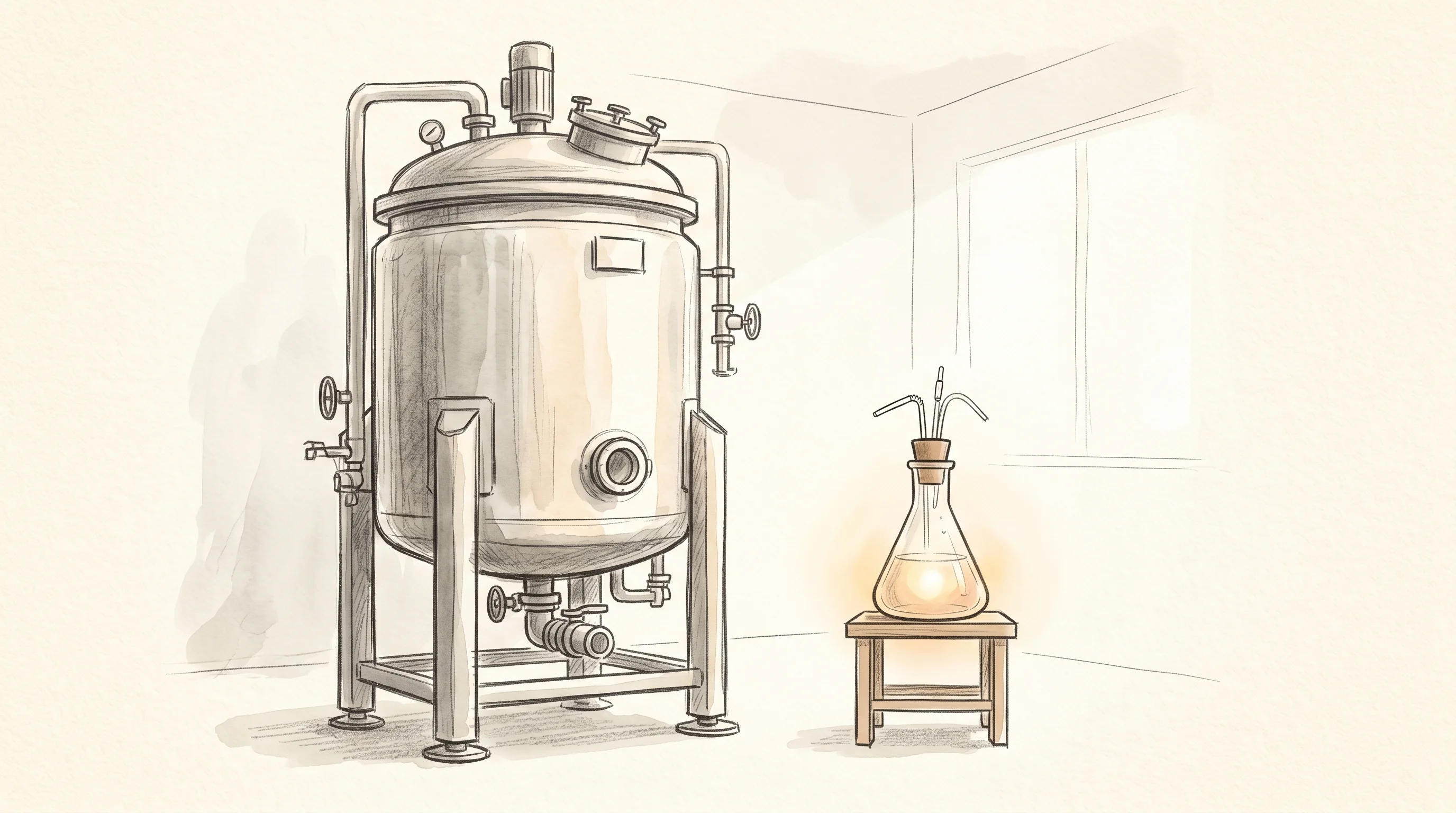
The gap between 5-liter academic demos and commercial production has narrowed faster than many industry watchers expected. Prolific Machines, focused primarily on biotherapeutics and cell culture systems, completed optogenetic bioproduction at 200 liters in stainless-steel bioreactors in April 2025—at the time, the largest demonstration of optogenetics to date. By May 2026, the company reported achieving a 21 g/L antibody titer in a 15-day intensified fed-batch CHO run using light-controlled gene expression. CEO Deniz Kent called it "the highest reported" for mAb fed-batch production, though that claim, like many in the competitive biomanufacturing space, is difficult to verify independently.
Fermeate's retrofit architecture represents a different approach to the same scaling challenge. Rather than purpose-built illumination systems integrated into reactor design from the ground up, the external loop concept aims to work with the installed base of fermentation capacity—thousands of tanks already humming away in facilities around the world. It's a practical response to a practical problem: precision fermentation companies need to prove economics now, not after a multiyear tank requalification process and capital expenditure cycle.
Whether that pragmatism translates to market traction depends partly on factors Fermeate can't control. The broader precision fermentation industry raised $651 million in 2024 across privately held companies, according to the Good Food Institute's April 2025 report. That's down from earlier peaks but reflects resilience compared to the broader alternative protein landscape, which has faced a brutal reckoning over the past two years. Major 2024 deals included Meati's $100 million Series C, Perfect Day's $90 million Series E, and Formo's $61 million Series B. Since 2013, privately held fermentation companies have raised $4.8 billion.
But money for startups doesn't automatically translate to production infrastructure.
The Pilot Problem
Industry observers have been flagging a pilot and demonstration capacity gap for years—companies stuck between lab-scale proof-of-concept and commercial production, unable to generate the data they need to attract manufacturing partners or CPG buyers. BioMADE finalized plans for a $132 million demonstration-scale facility in Maple Grove, Minnesota in April 2025, including two 25,000-liter fermenters with mechanical completion expected by mid-2027. GEA opened a New Food Application & Technology Center in Janesville, Wisconsin in July 2025 with pilot-scale systems for precision fermentation and downstream processing.
Still not enough, according to those in the trenches. As Roebling's Joshua Lachter told FoodNavigator-USA in April 2026, commercialization requires alignment among incumbents, startups, and capital—both public and private—to build out the biotech scale-up ecosystem. CPG engagement earlier in the development cycle matters, particularly when pilot bottlenecks slow the path to market and the financial runway starts running out.
Optogenetic control won't solve every cost challenge. GFI's techno-economic analyses identify feedstock costs, feedstock conversion efficiency, and capital utilization as the dominant levers for reducing cost of production. Light-based induction primarily addresses the yield and capital efficiency sides of that equation—boosting titers per batch and potentially enabling more continuous operation without the operating expense drag of chemical inducers.
Which matters, perhaps more than Fermeate's founders initially expected. In an industry where the difference between commercial viability and expensive curiosity can hinge on a few percentage points of conversion efficiency, incremental improvements compound quickly.
Open Questions
The technology still faces questions, some technical, some commercial. Light penetration at high cell density remains a consideration, though recent work demonstrates strategies for homogeneous illumination even in dense cultures. Phototoxicity and photobleaching need active management. And the field lacks peer-reviewed industrial case studies quantifying OPEX and cost of goods sold reductions from light induction at 1,000-liter scale and above in food-grade fermentation. Most public data sits at lab scale or comes from adjacent mammalian cell bioproduction, where tolerances and regulatory frameworks differ substantially.
There's also the adoption curve to consider. Precision fermentation companies are already managing strain development, bioprocess optimization, downstream purification, and regulatory pathways. Adding light-controlled gene expression—even via retrofit—means another variable in an already complex system. Another thing that can go wrong. Another supplier relationship to manage.
Then again, if the yield improvements hold at scale, those concerns become manageable trade-offs rather than dealbreakers.
The trajectory, at least, seems clear. More color-orthogonal circuits enabling multiplexed control—like the "optovolution" work published in Cell in March 2026—will expand what's possible with multi-wavelength systems. More pilots integrating illumination hardware with standard stainless steel will generate the data the industry desperately needs. And more companies like Fermeate, building tools that work with existing infrastructure rather than requiring wholesale replacement, will accelerate adoption.
The precision fermentation industry spent years perfecting the biology. Now it's learning to control it with light.
Whether that light leads to profitability remains the open question. But after a decade of expensive chemistry and incremental progress, trying something different doesn't seem particularly radical anymore. It seems necessary.


