An open-source project called Fugleramme is turning backyard birdsong into a rotating gallery of 19th-century natural history illustrations, sidestepping both cloud computing and the AI-generated art that has become ubiquitous in similar consumer devices. Arne Giacomo Munthe-Kaas, a fullstack developer in Bergen, Norway, published documentation for the project in mid-September, and it quickly attracted attention from makers and bird enthusiasts who prefer their tech to run entirely offline.
The setup is deceptively simple. A USB microphone picks up garden sounds and feeds them to BirdNET-Go, a local audio classifier that identifies species by their calls. When the software detects a new visitor, Fuglerampe pulls a corresponding illustration from a hand-curated library of more than 800 cutouts spanning over 400 species and refreshes an E-Ink display mounted in a picture frame. The illustrations are genuine scans from period plates by naturalists such as John Gould, Magnus von Wright, Henry Dresser, and John Gerrard Keulemans.
"Every bird is a cutout from a real scanned 1800s plate," Munthe-Kaas wrote in a Hacker News comment shortly after the launch. "No bird has been prompt/diffusion generated, although I did use diffusion-based tools to remove birds from the perches."
That choice matters. The market for consumer bird-identification devices has grown crowded in recent years, with turnkey products like Haikubox, BirdWeather PUC, and the camera-equipped Bird Buddy all relying on cloud connectivity and, in some cases, subscription models. Most use contemporary photography or AI-generated imagery. Fugleramme takes a different path, requiring assembly and emphasizing privacy alongside a certain aesthetic nostalgia.
The technical pipeline runs on a Raspberry Pi, which connects to the BirdNET-Go detector and matches each species to a public-domain illustration. The software then assembles a collage on a textured digital "paper" background and pushes the composition to a Pimoroni Inky Impression display. Larger birds gravitate toward the center of the frame and scale according to real body mass data pulled from AVONET datasets, according to the project's GitHub repository. The same image is served as a web interface on port 8080, and an admin panel lets users adjust detection windows, cap species counts, toggle labels, and switch display languages.
Four physical buttons mounted on the panel allow manual control. Users can cycle through display modes—collage view, latest bird, newest arrival—or toggle species labels, rotate the image, and switch between artwork styles.
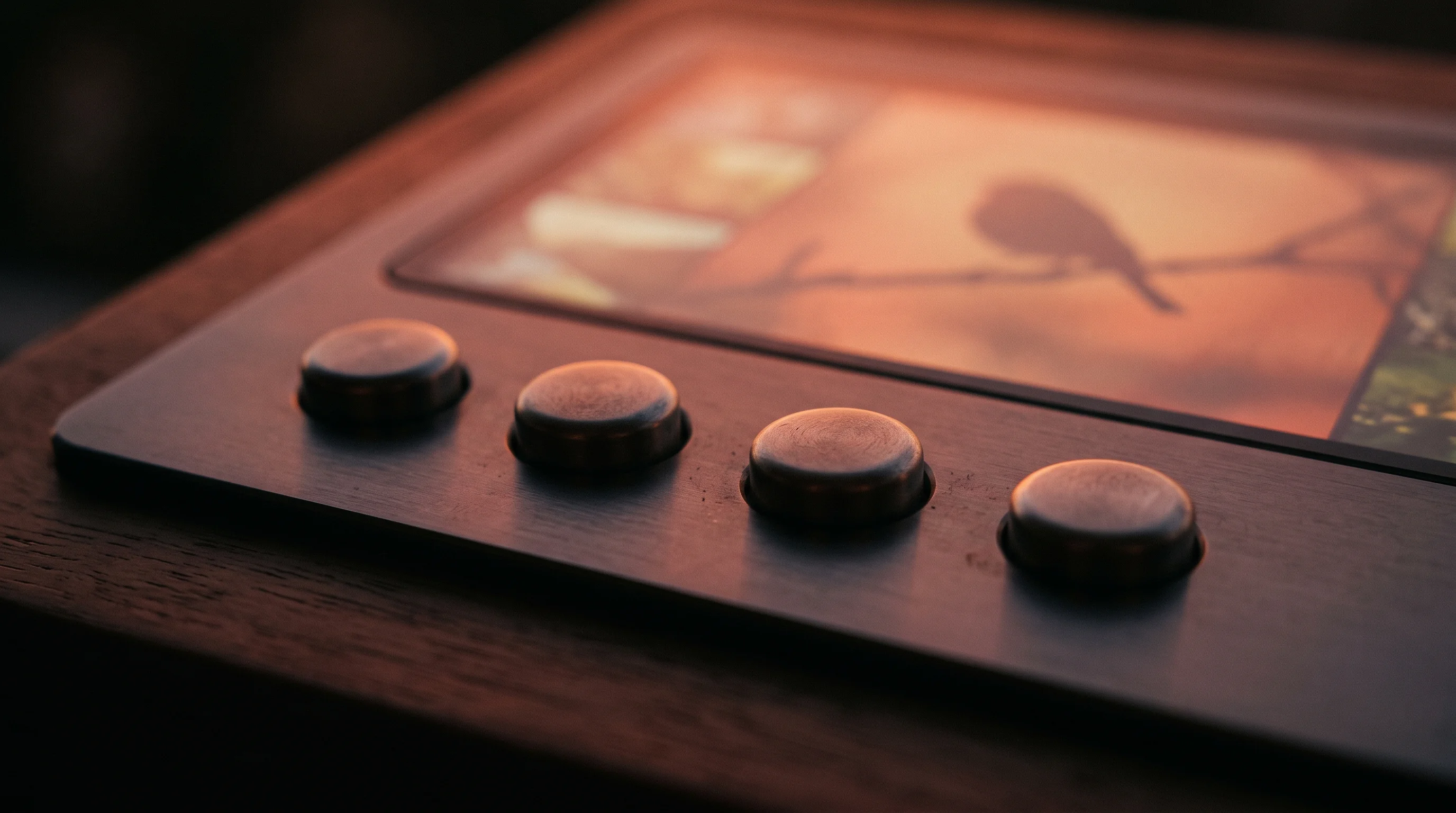
The recommended build pairs a Raspberry Pi 5 with Pimoroni's 13.3-inch Inky Impression Spectra 6 panel, a UGREEN USB audio adapter, and an IKEA RÖDALM A4 frame. Pimoroni published a bill of materials in early September pricing the full kit around £340 in the UK. The project FAQ lists rough cost estimates of €380–450 or $420–500 for the large version, with a smaller 7.3-inch variant running between €170–220 or $190–240. A "frame-only" configuration can run on any 40-pin Raspberry Pi, including the budget Pi Zero 2 W, and can point to an existing BirdNET-Go station elsewhere on a local network. Docker images also support headless kiosk deployments for those who want to skip the E-Ink hardware entirely.
Munthe-Kaas told Reddit's r/eink community in early September that he doesn't plan to commercialize the project. "I don't think I could practically sell these, but the code is open-source and all build instructions can be found online," he wrote. One-line installers and Docker images are available now.
The artwork ships under a Creative Commons BY-SA 4.0 license, while the code carries an MIT license. BirdNET-Go's detection model uses CC BY-NC-SA 4.0, which restricts commercial use. Artwork coverage is best for the Nordic countries, British Isles, and Germany, with North America expansion in planning, according to the README.
Within 24 hours of a Show HN post in mid-September, the project had drawn approximately 1,400 points and 185 comments on Hacker News. The GitHub repository accumulated about 1,800 stars in the days following launch. Munthe-Kaas, who works at Stacc in Bergen, runs a live demo from his kitchen window at arnegiacomo.dev.
Similar open-source efforts exist. The README cites AvianVisitors, another framed E-Ink collage, as inspiration, and lists veteranbv's inky-bird-frame under "Similar projects," though Fugleramme does not share code with either.
The latest tagged release, version 0.21.3, shipped in mid-September with artwork additions and testing changes. For now, the project remains a DIY affair—part maker kit, part meditation on what it means to observe birds in an age when most devices want to upload your data and most images start life in a diffusion model rather than in the field notebooks of Victorian ornithologists.